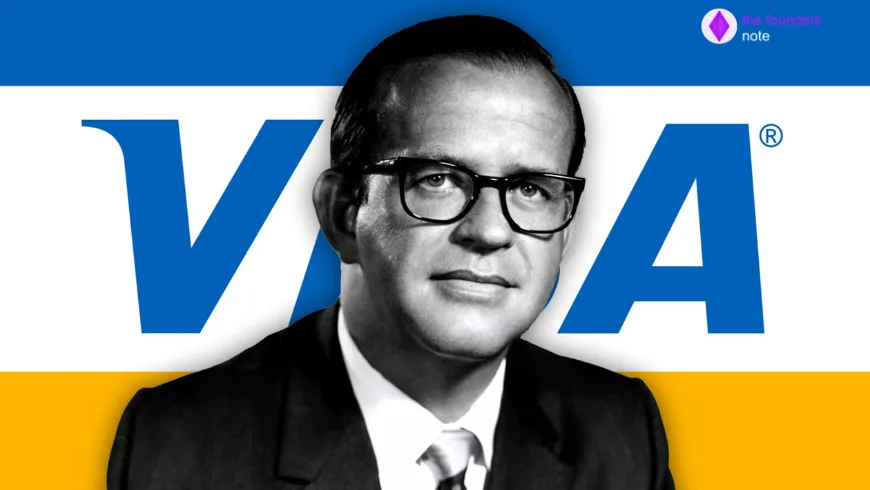
Dee Hock: The Father of Fintech Who Founded Visa
From a rural Mormon upbringing in Depression-era Utah to building the decentralized network behind trillions of dollars in payments — this is the full story of the man who coined the word “chaordic.”

Visa
Early Life & Family Origins
Dee Ward Hock was born on March 21, 1929, in North Ogden, Utah, to Alma Hock, a utility lineman, and Cecil (Dawson) Hock, a homemaker. The youngest child in a devout Mormon family, Hock grew up in a rural mountain town where close-knit family bonds and spiritual devotion shaped daily life.
His upbringing unfolded amid the hardships of the Great Depression, in a modest household defined by economic scarcity and self-sufficiency. The family’s Mormon faith instilled principles of self-reliance, communal support, and ethical integrity, fostering a worldview centered on cooperation and enduring, principled choices over short-term gain — themes that would resurface decades later in his ideas about organizational design.
Education Foundations
Hock attended Weber College (now Weber State University) in Ogden, Utah, from September 1947 to June 1949, earning a two-year associate degree in business. Unlike many future finance leaders, he never pursued formal education beyond that associate degree, instead relying on self-directed reading and hands-on experience to build his understanding of business and organizational dynamics — an approach that emphasized practical insight over academic credentials.
His rural upbringing also instilled a deep fascination with biology and ecology, an early interest in interconnected natural systems that foreshadowed his later explorations into balancing order and chaos in human organizations.
Early Roles in Finance 1949–1966
Hock’s career in finance began in 1949 at Pacific Finance Corporation, where he served as branch manager in Ogden, Utah (1949–1952), then Klamath Falls, Oregon (1952–1953), before moving into public relations and advertising at the company’s Los Angeles headquarters (1953–1955), developing early expertise in risk management and customer relations. In 1955, he became general manager of Columbia Investment Company in Los Angeles, overseeing loan operations in a competitive postwar lending market until 1962 — a role that, by one account, ended on a sour note: promised a profit share for helping build up the firm, Hock felt conned by his employer and moved on to Seattle.
From 1962 to 1966, Hock served as Northwest Regional Supervisor for CIT Financial in Seattle, coordinating operations across multiple branches and sharpening his salesmanship, risk-assessment, and team-leadership skills. By 1966, by his own wry description, he was “retired on the job” — his term for working at National Bank of Commerce with no real sense of commitment. Around the same time, he also faced a period of unemployment in Seattle while supporting three young children and a wife pursuing her teaching degree — a difficult stretch that, by his own account, fueled the resilience he would later need at Visa.
Joining the BankAmericard Crisis 1966
In 1966, Hock joined the National Bank of Commerce in Seattle as Vice President and General Manager of its BankAmericard department, taking on Bank of America’s newly licensed credit card program at a moment of near-collapse. The system was plagued by fraud, bad debts, manual processing delays of up to eight days, duplicate merchant charges, and unresolved disputes over authorizations and reimbursements — losses that licensee banks described as “horrendous.”
By the mid-1960s, Bank of America had begun licensing its card to banks in other regions — it had no centralized way to gauge the creditworthiness of cardholders outside its own footprint, and it was awkward for out-of-state merchants to open accounts at a California branch. So it franchised the technology: for $25,000 plus a royalty tied to transaction revenue, other banks could operate the card under license. That is how Hock was drawn in, despite feeling no personal enthusiasm for the product at all.
I have absolutely no use for credit cards. All I had were destroyed… I’ve not had one since and want none in the future.
Still, when his boss asked him to help launch National Bank of Commerce’s card program within ninety days, he took the job — and delivered. Through that process, he identified the structural flaw at the heart of the crisis: Bank of America provided accounting software and marketing support as licensor, but no centralized clearing system, forcing each merchant’s bank to seek payment directly from the cardholder’s bank. As volumes grew, “back rooms filled with unprocessed transactions, customers went unbilled, and suspense ledgers swelled like a hammered thumb.” Hock chaired a national executive committee in 1968 to tackle these issues, proposing a collaborative overhaul of the entire system — reportedly drawing on debating skills honed back in school to navigate the competing interests involved.
Founding NBI & the Rise of Visa 1970–1976
By 1970, Hock had founded National BankAmericard Inc. (NBI) as its president and CEO, transforming the faltering licensing program into a decentralized, member-owned association that relinquished Bank of America’s central control and gave more than 20,000 banks irrevocable participation rights and local autonomy. The new model established global interoperability through standardized rules, including fixed interchange fees of 1.95%, uniform card designs, and penalties for non-compliance — directly resolving the duplicate-charge and dispute problems that had nearly sunk the system.
In 1976, NBI and its international arm, IBANCO, were unified globally under a single new name: Visa — chosen for being short, evocative, and pronounceable in essentially every language and currency, supporting the network’s ambitions for worldwide expansion.
Key Innovations: BASE I & II 1973–1974
Under Hock’s leadership, Visa introduced VisaNet in 1973 — the world’s first electronic authorization network. Its core system, BASE I, provided real-time electronic authorization, cutting approval delays from days down to seconds, while BASE II, launched in 1974, enabled overnight electronic settlement between banks, eliminating much of the paper-based inefficiency and fraud vulnerability that had plagued the old system. These innovations helped fuel 50% annual growth within two years.
The network’s structure expanded in the early 1980s to include semi-autonomous regional operations — Asia Pacific, Europe, Latin America and the Caribbean, Central Europe, the Middle East and Africa, and North America — allowing local adaptation while preserving global standards such as standardized magnetic-stripe encoding (by 1979) and multi-currency settlement across 16 currencies. By 1980, the network spanned 150 countries with 3 million merchant locations and processed $45.7 billion in worldwide sales volume, 40% of it from outside the United States; by 1984, it covered 170 countries. By fiscal year 2023, Visa was processing a total volume of $14.8 trillion, including $12.3 trillion in payments volume, across 212.6 billion transactions — a staggering evolution from a system that nearly collapsed in the late 1960s.
“We Were in the Business of Value Exchange” Big Idea
Hock’s second major insight, alongside his organizational redesign, concerned the true nature of the credit card itself. He came to see the card’s function in three parts: identifying buyer to seller and seller to buyer; guaranteeing the value data behind a transaction; and originating and transferring that value data electronically.
The card was no more than a device bearing symbols for the exchange of monetary value. That it took the form of a piece of plastic was nothing but an accident of time and circumstance. We were really in the business of the exchange of monetary value.
Hock used this framing to build consumer trust, marketing Visa not as a “credit card” but as a medium of exchange — borrowing conceptually from the earliest trust-scaling technology in history, the stamped coin, which shifted buyer trust onto a recognized issuing authority. Visa’s consistent branding and stamp gave it an edge over rival network Interbank (later Mastercard), whose early cards carried a barely visible lowercase “i” in one corner. Visa’s tagline became “think of it as money,” and the company came to spend roughly $1 billion a year reinforcing that message of legitimacy.
The JC Penney Fight 1979
Hock’s “value exchange” framing eventually put him at odds with Visa’s own member banks, since taken to its logical conclusion, it made the banks’ gatekeeping role less essential. In 1979, Hock struck a deal allowing JC Penney — then one of the three largest U.S. retailers — to participate directly in the Visa system, bypassing the usual bank intermediary relationship. The backlash from banks, who saw it as a threat to their role as merchant acquirers, was fierce enough that they resolved not to allow further direct merchant participation.
Many bankers refuse to realize that many large retailers can do everything a bank can do, and often better. Penney is more sophisticated in data capture and data communications than any bank I know of.
Leadership Challenges & Resignation 1984
Throughout his tenure as CEO of Visa USA and Visa International, Hock navigated persistent rivalries among member banks. Early licensee meetings — such as a contentious 1968 gathering in Columbus, Ohio — often devolved into mutual blame over operational failures, worsened by fragmentation between the BankAmericard and rival Interbank systems. U.S. Department of Justice antitrust scrutiny in the 1970s added further pressure, prompting Bank of America to relinquish centralized control and allow the formation of the independent, bank-owned NBI in 1970 to head off potential litigation.
Interpersonal conflict could be sharp: one senior Bank of America vice president reportedly objected, “We invented the [darn] system! We own it! We produce 40 percent of the system volume! [Darned] if we will be pushed around!” Hock ultimately convinced Bank of America that it stood to gain more from a share of a larger, more efficient market than from clinging to direct control. He also had to persuade roughly three thousand individual licensee banks to surrender their licenses and become NBI members within ninety days — something a Bank of America vice chairman told him flatly “can’t be done.” Hock did it anyway.
To hold the coalition together, Hock built in a profit-sharing model that distributed revenue from transaction fees among member banks based on their volume contributions, removing the incentive for any single dominant owner to control the system. He paired this with a non-hierarchical governance structure — Visa was organized as a for-profit, non-stock membership corporation in which every member bank held equal voting rights, reinforcing the decentralized decision-making that let the network keep expanding globally.
Hock resigned as CEO of Visa USA and International in May 1984, at age 55, saying he had “proved everything I had set out to prove about the effectiveness of these concepts of organization.” He stepped away after a brief advisory transition, severing most business ties to retreat into a period of reflection. Visa’s valuation and transaction volume only accelerated in the years that followed, processing trillions of dollars annually by the 1990s and validating the organizational model he had built. Hock’s own outsider status — a two-year associate degree and a rural, low-income Utah upbringing rather than an Ivy League pedigree — had cut both ways throughout his career: it gave him room to think in genuinely unconventional ways about organizational design, even as it fed skepticism toward his ideas among more traditionally credentialed figures in elite banking circles.
Birth of the Chaordic Philosophy 1984–1996
After leaving Visa in 1984, Hock began formalizing the observations behind the organization he had built. At Visa, thousands of banks had operated as semi-autonomous entities, self-regulating through shared standards without a central authority dictating their behavior — a structure that had prevented the credit card industry’s collapse in the 1960s and 1970s. Around 1993, drawing on explorations of complexity theory at the Santa Fe Institute (and reportedly influenced by reading Mitchell Waldrop’s book Complexity), Hock coined the term “chaordic” — a portmanteau of “chaos” and “order” — to describe organizations that blend self-organizing dynamism with a shared underlying structure.
He framed the idea historically: just as the age of machine-crafting had displaced the dominance of churches, kingdoms, and craft guilds, he argued that an emerging “age of mind-crafting” would give rise to more chaordic organizational forms, displacing the rigid, hierarchical structures still dominant in his own time.
The Seven Chaordic Principles Framework
Hock articulated a set of core principles meant to guide the formation of chaordic organizations — entities that harmonize chaos and order rather than relying on rigid, command-driven hierarchies:
- Equitably owned by all participants
- Power and function must be distributive to the maximum degree possible
- Governance must embrace diversity and change
- Grounded in clarity of shared purpose and principles
- Self-organizing and self-governing, in whole and in part
- Equitably distribute power, rights, responsibility, and rewards
- Harmoniously combine cooperation and competition
Hock pointed to Visa itself as an example in practice: a decentralized network where member banks self-govern transactions, share revenue equitably, and adapt fluidly to global demand while remaining unified by core standards. He contrasted this with what he called “Newtonian” corporate structures — hierarchical, command-driven organizations he believed stifled human potential, enforced top-down control, and struggled to navigate genuine complexity, ultimately fostering alienation and even environmental harm. In their place, he envisioned chaordic organizations as living ecosystems, comparing them to an ant colony, where no central authority dictates individual behavior yet emergent order still arises from countless local interactions — or to a flock of birds or a neural network, where resilience comes from decentralized cooperation rather than a chain of command.
The Chaordic Stepping Stones Practical Tool
To help groups actually build chaordic organizations, Hock developed a design process known as the Chaordic Stepping Stones — a sequence running from articulating the underlying need, to defining a guiding purpose, establishing principles for integrity, selecting collaborators, sketching initial structures, confronting limiting beliefs, outlining practical next steps, and finally committing to ongoing practices that sustain the organization’s relationships and adaptability over time.
Post-Visa Life & Writings 1984–2005
After resigning from Visa, Hock retreated to a 186-acre ranch in Pescadero, California, spending roughly eight years, from 1984 to 1992, in relative isolation — reading, writing, and reflecting on organizational design, with time spent observing animal behavior on the ranch shaping his thinking about self-organizing systems. He later described lessons from this period in talks such as his 1994 piece “The Lesson of the One Horned Cow.”
He eventually relocated to Olympia, Washington, settling into a home overlooking Eld Inlet, where he continued writing and speaking well into his 90s. His two major books distilled these ideas for a broader audience: Birth of the Chaordic Age (1999), which chronicled Visa’s founding through the lens of chaordic organization, and One From Many: VISA and the Rise of the Chaordic Organization (2005), an expanded edition incorporating additional historical detail from Visa’s evolution. A later work, Autobiographies of a Restless Mind (2013), connected his organizational ideas to ecological and environmental themes.
- Birth of the Chaordic Age (1999)
- One From Many: VISA and the Rise of the Chaordic Organization (2005)
- Autobiographies of a Restless Mind (2013)
The Chaordic Commons & Advisory Work 1996–2010s
Hock founded the Chaordic Alliance in 1996 to spread his organizational framework, formally establishing the Chaordic Commons as a nonprofit in 2001, dedicated to developing and disseminating chaordic designs for collaborative enterprises. Through this work, he advised on applying chaordic principles across sectors — from a 1994 engagement with the Joyce Foundation on the Appleseed Foundation’s governance redesign, to a notable 1996 gathering with organizational theorist Peter Senge and the Society for Organizational Learning to prototype chaordic governance models.
His ideas influenced institutions well beyond banking, including the Northwest Atlantic Marine Alliance’s approach to sustainable fisheries governance and applications within knowledge-sharing networks at MIT’s Center for Organizational Learning. In the 1990s, Hock also advised U.S. Vice President Al Gore on the Clinton Administration’s “Reinventing Government” initiative, contributing ideas on performance review and self-managing institutional design intended to streamline federal operations.
Personal Life & Family Family
Dee Hock married Ferol Delores Cragun, his high school sweetheart, on September 22, 1949, in Salt Lake City, Utah. Their marriage lasted 69 years, until Ferol’s death in 2018. The couple had three children — sons David and Steven, both born in 1952 (Steven died in 2012), and daughter Lynette Elze — and by the 2020s the family had grown to include seven grandchildren and seven great-grandchildren.
During his years at the Pescadero ranch, Hock also practiced hands-on environmental stewardship, maintaining the 186-acre property as a bucolic preserve amid rare coastal ecosystems and favoring regenerative land use over the decades he owned it — an extension, in many ways, of the same systems-thinking he applied to organizational design.
The family relocated repeatedly to follow Hock’s career, from Utah to Seattle in the early 1960s and later to California during his years running Visa. After Ferol’s death, Hock remained in Olympia, Washington, where he had settled in 1992, staying close to family until his own death there in 2022.
Honors & Legacy Recognition
1991
1992
Legacy
Nickname
Visa Today
Regulatory Scrutiny
Why He’s Called the “Father of Fintech” Influence
Credit cards first appeared on the streets of Fresno, California, one September day in 1958 — the brainchild of Joseph Williams of Bank of America. Williams’ cards were novel for bundling pre-approved credit with a payment facility; features like the one-month grace period and an interest rate around 18% a year are still standard today. Williams himself didn’t fare so well — card delinquencies spiraled and he was soon pushed out of the bank — but by getting enough merchants to accept the card and enough consumers to carry it, he laid the groundwork for what would become a multi-billion-dollar industry. Hock was the one who got that flywheel truly spinning.
Modern fintech commentators, including the newsletter Net Interest, have credited Hock as the true originator of the payments industry as it exists today. Stripe cofounder and CEO Patrick Collison has publicly cited Hock as an influence, calling him an admirable figure in payments history. Hock’s insight that payments companies are fundamentally in the business of trust and value exchange, rather than simply “credit,” is frequently cited as prefiguring later innovations such as Alipay’s 2004 escrow-based trust model in China — built to overcome weak consumer protection and low buyer confidence in early e-commerce — and even the rise of Bitcoin as, in Hock’s own prescient words, part of “the genesis of a new form of global currency.”
Hock traced the idea of scaling trust in a medium of exchange back to the seventh century BCE, when the Lydians first stamped a seal onto lumps of metal to attest to their authenticity — shifting the burden of trust from the buyer onto a recognized issuing authority. He argued Visa’s own consistent branding and stamp performed the same function electronically, and that if two-hundred-year-old banking oligopolies continued to lose their grip on custody, loans, and the exchange of money, nation-state monopolies on currency itself could eventually erode too. Crypto ventures have tested that vision unevenly: Coinbase, for instance, originally signed up dozens of merchants — including ten with over $1 billion in annual revenue — to accept Bitcoin as payment, according to the book Kings of Crypto, before pivoting toward a brokerage model once consumer demand for Bitcoin-as-payment failed to materialize.
In interviews late in life, Hock offered a framework for thinking through problems that he applied to Visa itself: understanding events and influencing the future, he argued, required mastering four ways of looking at things — “as they were, as they are, as they might become, and as they ought to be.” Judged against that last, aspirational standard, he remained characteristically self-critical about his own creation.
By the standards of what Visa ought to be, it would be a lie to deny a sense of failure. In spite of my pride in all that Visa demonstrated about the power of the chaordic concept of organization and all the things it has accomplished, I do not believe that Visa is a model to emulate. It is no more than an archetype to study, learn from, and improve upon.
He pointed to specific regrets: merchants and cardholders never gained the fuller, direct access to the system he had once envisioned, and Visa ultimately settled into a duopolistic position alongside Mastercard that troubled him. While running Visa, Hock had actually opposed allowing banks to hold membership in both Visa and Mastercard simultaneously, believing dual membership would enhance competition between individual banks but suppress the more important competition between the payment systems themselves — an argument, by his own admission, that he lost. He also expressed lasting regret that so much of the card industry’s economics remained tied to interest income on cardholder debt rather than transaction-based service pricing, a shift he had hoped would more equitably distribute costs between affluent and less affluent customers — a hope that, studies have since shown, largely went unrealized, with lower-income cardholders often effectively subsidizing rewards and benefits enjoyed by wealthier ones.
Death 2022
Dee Hock died on July 16, 2022, at his home in Olympia, Washington, at age 93, from natural causes. Visa Inc. issued a statement honoring him as the architect of a secure digital payments network connecting billions of people worldwide. Obituaries in outlets including The New York Times and The Wall Street Journal credited his unconventional, decentralized approach to leadership with transforming a fledgling, failing card network into a global financial powerhouse. No public funeral details were announced, with his family maintaining privacy.
Quick Facts At a Glance
Full Name
Born
Died
Education
Known For
Visa Roles
Spouse
Children
Key Books
Legacy Org
Milestone Timeline Journey
Born in North Ogden, Utah.
Attends Weber College, earning an associate degree in business.
Marries Ferol Cragun; begins career at Pacific Finance Corporation.
Serves as general manager of Columbia Investment Company.
Northwest Regional Supervisor for CIT Financial in Seattle.
Joins National Bank of Commerce to run its BankAmericard program amid crisis.
Chairs a national committee to redesign the licensing system.
Founds National BankAmericard Inc. (NBI) as President & CEO.
Launches BASE I and BASE II, the first electronic authorization and settlement systems.
NBI and IBANCO unify globally under the new Visa brand.
Strikes the controversial direct-participation deal with JC Penney.
Resigns as CEO of Visa USA and International; retreats to a California ranch.
Coins the term “chaordic.”
Founds the Chaordic Alliance, later the Chaordic Commons.
Publishes Birth of the Chaordic Age.
Publishes One From Many: VISA and the Rise of the Chaordic Organization.
Wife Ferol Hock dies after 69 years of marriage.
Dies in Olympia, Washington, at age 93.
Frequently Asked Questions FAQ
Who is Dee Hock?
Dee Hock was an American businessman and organizational theorist who founded and led Visa International, transforming a chaotic, failing credit-card licensing system into the world’s dominant global payments network.
What does “chaordic” mean?
A term Hock coined by combining “chaos” and “order,” describing organizations that are self-organizing and adaptive, yet held together by shared purpose and principles rather than rigid hierarchy.
Why is Dee Hock called the “Father of Fintech”?
He’s credited with recognizing early on that payment cards were fundamentally about trust and electronic value exchange rather than simple consumer credit — an insight many see reflected in later fintech and even cryptocurrency innovations.
When did Dee Hock lead Visa?
He founded its forerunner, National BankAmericard Inc., in 1970, oversaw its rebranding to Visa in 1976, and served as CEO until his resignation in May 1984.
What books did Dee Hock write?
His major works include Birth of the Chaordic Age (1999), One From Many: VISA and the Rise of the Chaordic Organization (2005), and Autobiographies of a Restless Mind (2013).
When did Dee Hock die?
He died on July 16, 2022, at his home in Olympia, Washington, at the age of 93.
An Organization Built Like Nature
Dee Hock’s greatest invention wasn’t a piece of plastic or a network of computers — it was a way of organizing people that let thousands of competing banks cooperate without anyone being fully in charge, a lesson the digital economy is still learning from today.