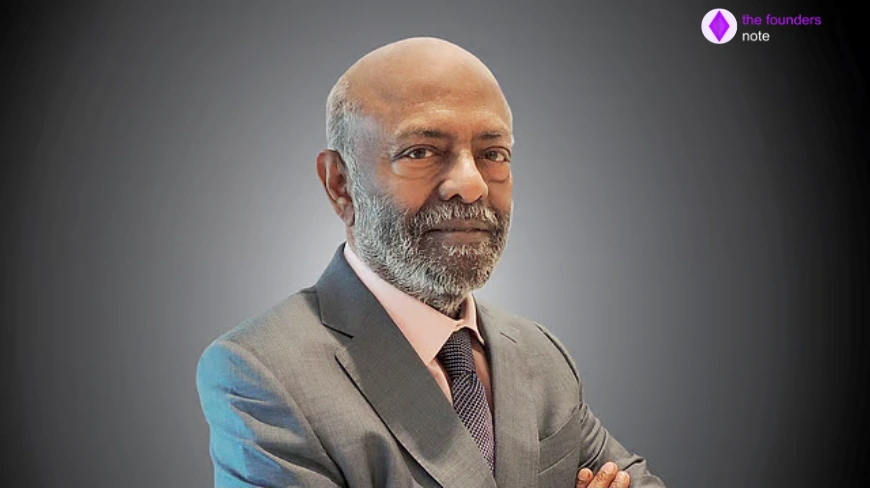
Shiv Nadar: From a Delhi Garage to India’s HCLTech Empire
From selling teledigital calculators out of a modest garage on Delhi’s outskirts, to building one of India’s largest global IT companies and handing it to his daughter — this is the complete story of HCLTech’s founder.

HCLTech
Early Life & Family Origins
Shiv Nadar was born on July 14, 1945, in Moolaipozhi village, about 10 kilometers from Tiruchendur, in what is now the Thoothukudi district of Tamil Nadu — then part of Madras Presidency in British India. He was born into a middle-class Tamil Hindu family belonging to the Nadar community, historically associated with trade and entrepreneurship in southern Tamil Nadu. His father was Sivasubramaniya Nadar, and his mother, Vamasundari Devi, was related to S.P. Adithanar, founder of the popular Tamil-language newspaper Dina Thanthi — a family connection to publishing that sits alongside Nadar’s own eventual career in technology. He has a brother, S.N. Balakrishnan, among several siblings.
Education Foundations
Nadar’s early schooling took him through several institutions in Tamil Nadu, beginning at Town Higher Secondary School before continuing at Elango Corporation Higher Secondary School; in 1955 he was admitted to Town High School, where he studied until 1957, before completing his secondary education at St. Joseph Boys’ Higher Secondary School. His schooling was conducted primarily in Tamil, and he did not begin speaking English regularly until around age 22. After his high school diploma, Nadar pursued pre-university studies at American College in Madurai, before earning a degree in Electrical and Electronics Engineering from PSG College of Technology in Coimbatore.
Early Career: Cooper Engineering & DCM 1967–1975
After graduating, Nadar began his career in 1967 at Cooper Engineering Company in Pune, part of the Walchand Group. He soon moved north to Delhi, joining Delhi Cloth Mills (DCM) as an engineer in its calculator division. Over the following years there, he built relationships with a number of colleagues who would go on to become his business partners, including Arjun Malhotra, Ajai Chowdhry, Subhash Arora, D.S. Puri, and Yogesh Vaidya (some accounts also credit S. Raman and Mahendra Pratap among the founding group).
Founding Microcomp 1975–1976
Frustrated with corporate life and inspired by Nadar, the group quit their jobs at DCM to start a venture of their own, founding Microcomp Limited in a modest garage on the outskirts of Delhi. The company sold teledigital calculators under the brand name Televista, giving the founders their first taste of running an independent technology business.
Founding Hindustan Computers Limited 1976
In August 1976, Microcomp was renamed Hindustan Computers Limited (HCL), officially launched on a plot of land donated by the Uttar Pradesh state government, with the founding group pooling together a starting capital of roughly ₹187,000.
A Policy Shift Opens the Door 1977
In 1977, changes to Indian industrial policy under new Industries Minister George Fernandes prompted large multinational companies, including IBM and Coca-Cola, to exit the country. The departure of established foreign players gave HCL crucial breathing room to expand its own market share by selling microcomputers developed and manufactured entirely within India.
International Expansion: Singapore & NIIT 1980–1981
In 1980, Nadar founded Far East Computers in Singapore to sell computer hardware regionally; the venture proved successful, generating roughly ₹1 million in revenue in its first year alone. Nadar remained the company’s largest shareholder without taking on any direct management role. The following year, in 1981, the National Institute of Information Technology (NIIT) was founded to meet India’s rapidly growing demand for computer education; Nadar invested heavily in the institution and eventually became its principal shareholder by 2003.
Building Proprietary Technology 1983–1984
Around 1983, HCL began producing its own 16-bit processors alongside a proprietary database management system, and by the following year the company had unveiled a full client-server system of its own design — technical milestones that positioned HCL as a genuine engineering-driven competitor rather than simply an assembler of imported components.
HCL America & the U.S. Market 1989–1991
As Indian import laws eased further, Nadar traveled extensively to source components and gain firsthand knowledge of global markets, ultimately launching HCL America to compete in the U.S. computer-hardware market beginning around 1989. The venture initially struggled, running into difficulty obtaining an environmental permit for its operations, but by 1991 the business had turned a corner through a partnership with Hewlett-Packard.
Partnerships, the 1998 Exit & Going Public 1994–1998
In 1994, HCL partnered with Nokia and Ericsson to sell mobile phones and mobile switching equipment in the Indian market. In 1998, co-founder Arjun Malhotra departed to start his own company, taking one of HCL’s largest shareholders with him. In response, Nadar listed HCL on the Indian stock exchange, restoring the capital base the company needed to keep growing. Between then and 2006, HCL struck a series of further strategic partnerships aimed at establishing the company as a genuinely global player, culminating in HCL Technologies being spun out as a distinct software-services business in 1991 and growing into the group’s flagship enterprise in the years that followed.
Founding the Shiv Nadar Foundation 1994–Present
Well before stepping back from day-to-day management of HCL, Nadar established the Shiv Nadar Foundation in 1994, driven by a vision of ensuring that future generations of Indians could access quality education regardless of economic background. The foundation went on to found and operate the VidyaGyan schools — leadership academies that select academically gifted students from hundreds of villages across Uttar Pradesh and provide them a free, residential education — alongside the SHIKSHA adult-education initiative and the Kiran Nadar Museum of Art. In 2010, HCL Corp sold a 2.5 percent stake in HCL Technologies, raising roughly $125 million, which Nadar donated in full to the foundation.
SSN College of Engineering 1996
In 1996, Nadar founded SSN College of Engineering in Chennai, Tamil Nadu, named in honor of his father, Sivasubramaniya Nadar. He took an active, hands-on role in the college’s affairs, including gifting roughly ₹1 million worth of HCL shares to the institution, and in 2006 announced plans for the college to expand into research and pursue tie-ups with foreign universities. He joined the executive board of the Indian School of Business in 2005.
Stepping Back as CEO & Chairman 2007–2021
Nadar stepped down as CEO of HCL Technologies in 2007, handing the role to Vineet Nayar while remaining the company’s largest shareholder and chairman; in his newly freed time he devoted increasing attention to his philanthropic ambitions. In August 2020, he stepped down as chairman of HCL Technologies as well, passing the position to his daughter, Roshni Nadar Malhotra, who became the first woman to chair a listed Indian IT company. In July 2021, Nadar also stepped down as the company’s managing director, a role that passed to HCL Technologies CEO C Vijayakumar for a five-year term; Nadar has since served as chairman emeritus and strategic advisor.
Succession: Roshni Nadar Malhotra The Next Generation
Roshni Nadar Malhotra, born in New Delhi in 1982, is the only child of Shiv and Kiran Nadar. She attended Vasant Valley School in Delhi before pursuing higher education abroad, and joined HCL in 2009, working her way into senior roles across the group’s holding companies before her father formally handed her the chairmanship of HCL Technologies in 2020. As she has put it about the transition: “I haven’t stepped into his shoes. I think I stand on his shoulders. There isn’t another tech company in India that has a woman chair.” Beyond her corporate role, she is a trustee of the Shiv Nadar Foundation and has been the driving force behind VidyaGyan, founded The Habitats Trust in 2018 to protect India’s natural habitats and indigenous species, serves on the global board of The Nature Conservancy, and is a member of the US-India Strategic Partnership Forum.
The March 2025 Stake Transfer 2025
In March 2025, Shiv Nadar formalized his succession plan by executing a private family arrangement that transferred a 47 percent stake in HCL Corporation and Vama Sundari Investments (Delhi) — the two holding entities that together control HCLTech and its group companies — to Roshni Nadar Malhotra, making her the majority shareholder of both. An exchange filing described the move as designed to “streamline succession, ensuring continued ownership and control by Mr. Shiv Nadar’s family while providing the company with the desired stability.” The transfer also gave Roshni voting rights over HCL Corp’s roughly 49.94 percent stake in HCL Infosystems and Vama Delhi’s roughly 12.94 percent stake in the same company, consolidating family control across the group’s structure and making her India’s third-richest person in her own right.
HCLTech Today 2026
HCL Technologies Limited — now branded HCLTech — is headquartered in Noida, Uttar Pradesh, and operates in 60 countries with more than 227,000 employees as of March 2026, a footprint that has expanded considerably from the roughly 42 countries the company operated in during the earlier part of its global build-out. For fiscal year 2026, the company reported revenue of ₹131,674 crore (about $14 billion), operating income of ₹23,058 crore (about $2.4 billion), and net income of ₹16,652 crore (about $1.8 billion), with total assets of roughly ₹116,258 crore and total equity of about ₹75,197 crore. In 2026, HCLTech won two Google Cloud Partner Awards — for Global Infrastructure Modernization and for Industry Solutions in Energy and Manufacturing — reflecting the company’s ongoing push into cloud and AI-era services under Roshni Nadar Malhotra’s leadership.
Flagship Companies & Philanthropic Institutions The Group
| Entity | Focus |
|---|---|
| HCLTech (HCL Technologies) | Global software services and IT digital solutions |
| HCL Infosystems | Hardware, distribution, and ICT systems integration |
| Universal Office Automation Ltd. | Office equipment and communication solutions |
| International Data Management Ltd. (IDM) | Early data-processing and technology joint venture |
| HCL Corporation & Vama Sundari Investments | Primary holding and promoter investment companies |
| Foundation / Institution | Focus |
|---|---|
| Shiv Nadar Foundation | Philanthropic umbrella funding education-focused non-profits |
| Shiv Nadar University | Multi-disciplinary research university (Greater Noida and Chennai) |
| Shiv Nadar School | K–12 school network across multiple Indian cities |
| VidyaGyan | Free residential leadership academy for rural Uttar Pradesh students |
| SSN College of Engineering | Engineering college in Chennai, named for Nadar’s father |
| Kiran Nadar Museum of Art (KNMA) | Contemporary and modern art museum in New Delhi |
Awards & Recognition Honors
Nadar received an honorary doctorate from the University of Madras in 2007, on the occasion of the university’s 150th convocation, and was named Ernst & Young Entrepreneur of the Year (Services) that same year. In 2008, the Government of India awarded him the Padma Bhushan, the country’s third-highest civilian honor, for his contributions to trade, industry, and education. He was named to Forbes’ list of 48 Heroes of Philanthropy for the Asia-Pacific region in 2011, received the BNP Paribas Grand Prize for Individual Philanthropy in 2013 for the work of the Shiv Nadar Foundation, and was named Forbes International’s Outstanding Philanthropist of the Year in 2015. He topped the EdelGive Hurun India Philanthropy List in both 2016 and 2019, and again in 2024, when he was reported to have donated an average of nearly ₹6 crore a day over the course of the year. In 2023, he received the Lifetime Achievement Award for Corporate Excellence at The Economic Times Awards.
Personal Life & Family Tree Family
Shiv Nadar is married to Kiran Nadar, whom he met while she was working at an advertising agency; she later helped shape HCL’s brand while working at NIIT in its early years, before establishing herself as one of India’s most prominent art collectors. Kiran Nadar founded the Kiran Nadar Museum of Art (KNMA) in New Delhi, is a leading contract bridge player and, together with her husband, sponsors the HCL Bridge Tournament in India; she was awarded the Padma Shri in 2024. Shiv Nadar himself is a passionate amateur painter who has exhibited his own artwork. The couple have one child, Roshni Nadar Malhotra, who is married to Shikhar Malhotra and today serves as chairperson of HCLTech.
In His Own Words Quotes
“If you have excellent people, then you have to give them the power.”
“If you go to Wall Street, there is someone from Harvard, Stanford, etc, who relate to each other by the batch they studied in, the dorm they lived in, and so on.”
“A founder can carry an institution only so far, and then others have to step in, even the alumni. That’s how an institution becomes one.”
“Like education, healthcare also needs to be given importance.”
“Any institutions’ alumni are key to its growth. We are focused on giving a global experience to our students.”
“It is good to start as young as you can. What is more important is to carve out your vision and assess your readiness to start giving. Commitment and purpose are core to giving.”
“Education is and will be the most powerful tool for individual and social change, and we must do all that it takes to facilitate it.”
“If you are calm about your ambitions, you become confident of achieving what you set out to do.”
“We need a world class institution which will create leaders out of the children who have not had a good start in life.”
“When you live away from your family, your friends and faculty become your family.”
“Adaptability and constant innovation is key to the survival of any company operating in a competitive market.”
“We need schools like Doon and Mayo for the poor.”
“In the future, there are going to be various components of doing business that have to be looked at.”
“When you are running a business, there is a constant need to reinvent oneself. One should have the foresight to stay ahead in times of rapid change and rid ourselves of stickiness in any form in the business.”
Net Worth Wealth
Shiv Nadar’s fortune is drawn almost entirely from his family’s controlling stake in HCLTech, held through the holding entities HCL Corporation and Vama Sundari Investments. His net worth climbed to roughly $36.7 billion by March 2024, and peaked around $44.4 billion at the end of 2024 after HCLTech’s stock surged approximately 33 percent that year. Following the March 2025 transfer of a 47 percent stake in his holding companies to daughter Roshni Nadar Malhotra, his personal net worth declined accordingly, settling at roughly $34.4 billion by July 2025 and around $32.1 billion in 2026, when Forbes ranked him 71st on its Billionaires list. Roshni Nadar Malhotra’s own net worth, boosted by the stake transfer, stood at approximately $45 billion (₹3,76,221 crore) by April 2026, making her India’s richest woman and the country’s third-wealthiest person overall — meaning the combined Nadar family fortune across father and daughter comfortably exceeds $75 billion.
Net Worth & HCLTech Growth Interactive Chart
The chart below tracks Shiv Nadar’s estimated net worth alongside HCLTech’s annual revenue, year by year. Use the toggle buttons to isolate either series, and hover or tap any point for the exact figure.
Net worth figures are drawn from Forbes’ historical rankings for Shiv Nadar individually. The visible decline from 2024 to 2025–2026 reflects both market movement and the March 2025 transfer of a 47% holding-company stake to his daughter, Roshni Nadar Malhotra — not a decline in the family’s total wealth. HCLTech revenue figures are drawn from the company’s own published annual results.
Significance & Legacy Impact
Shiv Nadar's career traces one of the more complete arcs in Indian business history: from a garage startup selling calculators in 1976, through the era of India's economic liberalization, to a global IT services company employing more than 227,000 people across 60 countries. His willingness to hand over both the CEO role in 2007 and, more strikingly, the chairmanship itself in 2020 to his daughter — making her the first woman to chair a listed Indian IT company — set a template for orderly, transparent succession that stands in contrast to the more contentious transitions seen at several other large Indian business houses. Through the Shiv Nadar Foundation, he has directed well over a billion dollars toward education for underprivileged children, and his and his wife's parallel commitment to the arts, through the Kiran Nadar Museum of Art, has made the family a significant force in Indian cultural life as well as technology and philanthropy.
Quick Facts At a Glance
Full Name
Born
Education
Current Roles
Company Founded
Ownership
Spouse
Child
Est. Net Worth
Honors
Milestone Timeline Journey
Born in Moolaipozhi, Tamil Nadu.
Begins his career at Cooper Engineering Company, Pune.
Co-founds Microcomp Limited, selling teledigital calculators.
Founds Hindustan Computers Limited (HCL) with roughly ₹187,000 in starting capital.
Founds Far East Computers in Singapore.
Invests in and later chairs the National Institute of Information Technology (NIIT).
Launches HCL America; partners with Hewlett-Packard after early setbacks.
Founds the Shiv Nadar Foundation; HCL partners with Nokia and Ericsson.
Founds SSN College of Engineering in Chennai, named for his father.
Lists HCL Technologies on the Indian stock exchange after co-founder Arjun Malhotra's exit.
Steps down as CEO, handing the role to Vineet Nayar.
Awarded the Padma Bhushan.
Steps down as chairman; daughter Roshni Nadar Malhotra becomes HCLTech's first woman chairperson.
Steps down as managing director; C Vijayakumar takes over for a five-year term.
Receives the Lifetime Achievement Award for Corporate Excellence, The Economic Times Awards.
Net worth peaks near $44.4 billion after a 33% surge in HCLTech's stock.
Formally transfers a 47% stake in HCL Corporation and Vama Sundari Investments to Roshni Nadar Malhotra.
Ranked 71st on Forbes' 2026 Billionaires list, with a net worth of roughly $32.1 billion.
Frequently Asked Questions FAQ
Who is Shiv Nadar?
Shiv Nadar is the Indian billionaire founder of HCL Technologies (now HCLTech), one of India's largest global IT services companies, and the founder of the Shiv Nadar Foundation, a major education-focused philanthropy.
How did Shiv Nadar start his company?
He and a group of colleagues from Delhi Cloth Mills founded Microcomp Limited in a Delhi garage in the mid-1970s, selling teledigital calculators, before renaming the company Hindustan Computers Limited (HCL) in August 1976.
What is Shiv Nadar's net worth?
As of 2026, his personal net worth is estimated at roughly $32–36 billion, down from a peak of about $44.4 billion at the end of 2024, largely reflecting a March 2025 transfer of a 47% holding-company stake to his daughter.
Who runs HCLTech now?
Roshni Nadar Malhotra, Shiv Nadar's only child, has served as chairperson of HCLTech since 2020, becoming the first woman to chair a listed Indian IT company; day-to-day leadership sits with CEO and Managing Director C Vijayakumar.
What is the Shiv Nadar Foundation?
Founded in 1994, it is a philanthropic organization focused on education, funding institutions including the VidyaGyan leadership academies, SSN College of Engineering, and Shiv Nadar University; Nadar has donated more than $1.1 billion to it over his lifetime.
Is Shiv Nadar still involved with HCLTech?
Yes, in an advisory capacity. He stepped down as CEO in 2007, as chairman in 2020, and as managing director in 2021, and now serves as chairman emeritus and strategic advisor to the company he founded.
What awards has Shiv Nadar received?
He was awarded India's Padma Bhushan in 2008, has been named an Outstanding Philanthropist by Forbes International (2015), and has repeatedly topped the Hurun India Philanthropy List, among numerous other business and philanthropy honors.
Building an Institution Beyond a Single Founder
From a garage full of calculator parts to a technology company spanning 60 countries, Shiv Nadar's career stands out not only for what he built, but for how deliberately and smoothly he chose to hand it on — proof that the truest measure of an institution is whether it can outgrow the person who founded it.