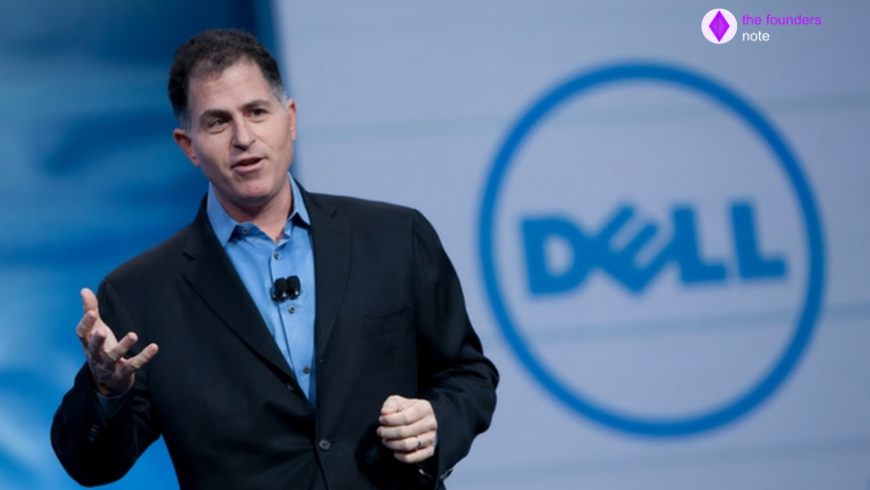
Michael Dell: From a Dorm-Room PC Business to the AI Server Boom
From selling newspaper subscriptions to newlyweds as a teenager, to building computers from a University of Texas dorm room, to riding a historic AI infrastructure boom in 2026 — this is the complete story of Dell Technologies’ founder.

Dell Technologies
Early Life & Family Origins
Michael Saul Dell was born on February 23, 1965, in Houston, Texas, the son of an orthodontist father and a stockbroker mother. He attended Gary L. Herod Elementary School in Houston, where he was a top student who, even as a child, dreamed of becoming an entrepreneur. At the age of eight, Dell attempted to register for the General Educational Development (GED) test — which, if passed, would have conferred the equivalent of a high school diploma — specifically so he could leave school early and start his own business.
A Child Entrepreneur Childhood
Dell held a variety of part-time jobs even as a young child, earning enough to buy his first calculator at age seven. During junior high school, he encountered a teletype machine for the first time and spent countless after-school hours programming it. At fifteen, after seeing computers on display at a local RadioShack store, he became determined to own one himself; he soon purchased his first computer, an Apple II, which he immediately took apart to understand how it worked.
High School & the Houston Post Job Teenage Years
Dell attended Memorial High School in Hedwig Village, Texas, a school that drew students from wealthy Houston-area neighborhoods and offered competitive coursework, including computer science and economics classes. During a summer job selling newspaper subscriptions for the Houston Post by telephone, Dell noticed that newly married couples and people who had recently bought a home were disproportionately likely to subscribe. He obtained lists of names from recently issued marriage licenses and mortgage applications and targeted his sales calls accordingly — a tactic that let him earn more than $18,000 in a single year, more than a beginning teacher’s salary at his own high school.
University of Texas & Founding PCs Limited 1983–1984
After graduating from high school, Dell enrolled at the University of Texas at Austin, initially intending to become a premedical student. While living as a freshman in the university’s private Dobie Center residential complex, he started a side business assembling computers from kits and selling upgrade equipment to existing PC owners. He also secured a vendor license that allowed him to bid directly on contracts with the state of Texas — an advantage over larger rivals who were burdened with far higher overhead costs.
By January 1984, confident that a manufacturer selling PCs directly to consumers could succeed, Dell launched his own computer company, initially called PCs Limited, with just $1,000 in starting capital, operating out of a rented condominium. The business quickly found success selling IBM-compatible PCs built from stock parts. His family subsequently provided him with $300,000 in expansion capital, and Dell dropped out of the University of Texas to devote himself full-time to the company, later renamed Dell Computer Corporation.
Building Dell Computer Corporation 1984–1987
Having outgrown the condominium, Dell relocated operations to a business center in North Austin, joined by a telephone sales staff and a small three-person manufacturing group. In 1985, the company released its first self-designed computer, the Turbo PC, built around an Intel 8088 microprocessor — the same chip used in the original IBM PC — and priced at $795. Consumers learned about the machine through advertisements in national computer magazines, called in to select their preferred configuration, and received their custom-assembled machine shipped directly to their door. The model let Dell undercut retail prices while offering a degree of customization that was rare in the industry at the time; in its first year of operation alone, the company sold more than 60,000 computers and grossed over $70 million in sales.
The Direct Model, IPO & Early Growth 1987–1996
Dell expanded rapidly during the technology boom of the late 1980s, establishing its first overseas presence in Ireland in 1987, a beachhead that was soon followed by eleven more international locations. The company made its initial public offering in June 1988, and its share value doubled within the first month of trading. To ease customer concerns about the lack of physical stores for service and support, Dell established an on-site service program that dispatched technicians directly to a customer’s home or office. In 1990, the company briefly experimented with selling through warehouse clubs and computer superstores alongside its traditional model; the venture attracted attention but ultimately proved unsuccessful, and Dell refocused entirely on direct sales. In 1996, the company extended its direct-ordering system online, allowing customers to purchase machines over the internet for the first time.
Becoming the World’s Largest PC Maker 1997–2004
Michael Dell served as CEO of the company from its founding until 2004, a period that saw tremendous sales growth, particularly from 1997 onward. In 1999, Dell surpassed Compaq Computer Corporation to become the world’s largest PC maker, a position it held for years afterward. National publications such as Consumer Reports and PC Magazine repeatedly rated Dell as having the best customer service, reliability, and technical support of any PC manufacturer, while its inroads into corporate sales gave the company a stable revenue base and quietly influenced the home-computer purchases of employees already familiar with Dell machines from their workplaces. In 2003, the company changed its name from Dell Computer Corporation to Dell Inc. to reflect its expanding product lineup beyond personal computers.
Quality Struggles & Stepping Down as CEO 2002–2006
Dell’s once-sterling reputation for quality began to erode after 2002, when the company started moving its customer-service call centers overseas, a move that frustrated many customers. At the same time, the company’s rapid growth strained its on-site service program past its capacity, and a wave of negative publicity followed well-publicized reports of faulty components causing some Dell laptops to catch fire. These compounding problems slowed Dell’s sales considerably by 2005, when its stock price fell 25 percent, and by 2006 the company’s growth had slipped below that of the broader PC industry for the first time in its history.
Returning as CEO 2007
Michael Dell returned as chief executive in 2007, replacing Kevin Rollins, who had succeeded him three years earlier, and set about overhauling the company he had founded. Under his renewed leadership, Dell acquired storage company EqualLogic in 2008 to gain a foothold in the iSCSI storage-networking market, and purchased Perot Systems in 2009, rebranding it Dell Services as the company built out its information-technology services business. Critics at the time faulted Dell for leaning on outsourcing — cutting domestic staff jobs in the process — and generous government tax incentives to boost the company’s profitability and his own personal wealth, though Dell’s stock price did recover following his return to the CEO role. The broader PC industry, meanwhile, faced a new threat: the 2007 launch of Apple’s iPhone and the 2010 debut of the iPad, along with a wave of competing tablets and e-readers, ate into demand for traditional PCs, while Asian manufacturers Acer and Lenovo steadily gained market share. Dell fell out of the global number-two market-share spot for the first time since 1998 when Acer overtook it in 2009, with Lenovo repeating the feat two years later.
Taking Dell Private 2013
In response to the company’s declining market position, Michael Dell bought out Dell Inc.’s remaining public shares in 2013 for a total of $24.4 billion, financed with the help of loans from Microsoft Corporation and backing from private-equity firm Silver Lake Partners. The transaction, which delisted the company from public markets and left Dell with a roughly 75 percent ownership stake, was designed to free him to overhaul the company’s business model without the short-term pressures of public shareholders and quarterly earnings scrutiny.
The EMC Acquisition & Dell Technologies 2016
In 2016, Dell Inc. acquired computer-storage giant EMC Corporation in what was, at the time, the largest technology acquisition in history. The merger created a new parent company, Dell Technologies, with Michael Dell serving as chairman and chief executive, and the combined entity took on a substantially expanded footprint in enterprise servers, storage, and infrastructure alongside Dell’s traditional PC business.
Returning to Public Markets & the VMware Spin-Off 2018–2021
Dell Technologies returned to public markets in 2018 through an unconventional route: rather than a traditional IPO, the company bought out its DVMT tracking stock — a security tied to Dell’s economic interest in VMware — effectively re-listing on the New York Stock Exchange under the ticker “DELL.” In 2021, VMware, the cloud and virtualization software business that had been part of the Dell/EMC combination, was spun off as a fully independent, separately traded public company.
The Broadcom-VMware Sale 2023
In November 2023, chipmaker Broadcom completed its acquisition of VMware for $69 billion. Michael Dell, who still held a substantial personal stake in VMware from the earlier spin-off, received roughly 39 percent of the deal’s total consideration in the form of Broadcom stock — more than 200 million shares — instantly making Broadcom holdings one of the largest components of his personal fortune alongside his Dell Technologies stake.
The 2026 AI Server Boom 2025–2026
By the mid-2020s, Dell Technologies had repositioned itself as a central supplier of AI-optimized servers, networking equipment, and storage for companies building large-scale data centers and AI systems — no longer priced by investors as a legacy PC company. In fiscal year 2026, the company’s Infrastructure Solutions Group posted revenue of $60.8 billion, up 40 percent year over year, with AI-optimized server revenue reaching $24.7 billion for the year, up 166 percent; fourth-quarter AI server revenue alone hit a record $9 billion, up 342 percent year over year.
The rally accelerated dramatically on May 28, 2026, when Dell reported first-quarter fiscal 2027 results that blew past Wall Street expectations: quarterly revenue of $43.84 billion against estimates of $36.1 billion (an 87.5 percent year-over-year increase and a 21.5 percent beat), with AI server revenue alone hitting $16.1 billion, up 757 percent year over year. Management disclosed $24.4 billion in AI orders for the quarter, and raised its full-year fiscal 2027 AI server revenue forecast to $60 billion, up from a prior guidance of $50 billion. The results were bolstered by a $9.7 billion Pentagon contract securing U.S. military AI-infrastructure business. Dell Technologies shares surged 39–40 percent over the two trading days following the announcement — and the stock more than tripled over the course of 2026 as a whole, driven by the broader AI infrastructure buildout across the technology industry.
Personal Life & Family Family
Michael Dell married Susan Lynn Lieberman on October 28, 1989, in Austin, Texas, after the two met on a blind date the previous year. Susan, who studied fashion merchandising and design at Arizona State University and previously worked in real estate for the Trammell Crow Company, has gone on to found several fashion labels of her own, including one called Phi, alongside her role as co-founder and longtime chair of the Michael & Susan Dell Foundation. The couple live in Austin, Texas, with their four children. Their primary residence, a roughly 33,000-square-foot house, has been reported as the most expensive residential building ever constructed in Texas. The family also owns additional properties, including a home in Hawaii, a vacation home in the Caribbean, and the 6D Ranch outside Austin, where Michael Dell raises Arabian horses.
The Dells have raised their four children — three daughters and a son — largely out of the public eye. Kira Dell, the eldest, graduated from Vassar College and has worked as a teacher and in product management for mission-driven companies before becoming an independent consultant focused on education and social impact. Alexa Dell has been the most publicly visible of the siblings, having worked as an advisor and branding consultant for the dating app Bumble. Juliette Dell, the youngest daughter, has gravitated toward the creative and fashion side of the family’s interests. Zachary Dell, the only son, has pursued his own entrepreneurial ventures. Michael Dell also has a brother, Adam Dell, a businessman and investor in his own right.
The Michael & Susan Dell Foundation 1999–Present
In 1999, Michael and Susan Dell founded the Michael & Susan Dell Foundation, funded primarily through the sale of Dell Inc. shares, to support causes benefiting underprivileged children in urban communities in the United States, India, and South Africa, with a particular focus on education. As of 2025, the foundation managed an estimated $7.5 billion in assets and had distributed roughly $2.9 billion in grants and charitable activities since its founding. In 2004, the foundation donated $25 million toward the capital campaign for a new children’s hospital in Austin, which opened in 2007 as the Dell Children’s Medical Center. Dell has also funded a new computer science building at the University of Texas, along with the Dell Pediatric Research Institute and the Michael and Susan Dell Center for the Advancement of Healthy Living, both located on or near the university’s campus. In recognition of his philanthropy, he received an honorary doctorate from Ireland’s University of Limerick in 2002.
The $6.25 Billion “Trump Accounts” Gift December 2025
On December 2, 2025 — GivingTuesday — Michael and Susan Dell announced at the White House a pledge of $6.25 billion to fund “Trump Accounts,” a new federal children’s investment-account program created under the One Big Beautiful Bill Act. Under the law, the U.S. Treasury deposits $1,000 into an investment account for every American child born between January 1, 2025, and December 31, 2028. The Dells’ gift extends that benefit to roughly 25 million children age ten and under who were born before the cutoff and therefore would not otherwise qualify, seeding each of their accounts with $250. The commitment — more than double the Dells’ entire prior lifetime giving of roughly $2.9 billion — is described by the couple and by advocacy group Invest America as the largest single private commitment ever made to American children. The accounts are scheduled to launch on July 4, 2026, deliberately timed to mark the 250th anniversary of U.S. independence. “If you think about the power of compounding and what these accounts are likely to become over 10, 20, 30 years, that’s super significant,” Dell said at the time of the announcement.
Awards & Recognition Honors
Dell has received an honorary doctorate from the University of Limerick in Ireland (2002) in recognition of his philanthropic contributions, and has been widely recognized in business and technology publications for both his entrepreneurial success and his company’s more recent pivot to AI infrastructure. He has consistently ranked among the world’s wealthiest individuals on the Forbes and Bloomberg billionaire indexes, and by mid-2026 had climbed past figures including Warren Buffett, Jensen Huang, Mark Zuckerberg, and — briefly — Larry Ellison, on the strength of Dell Technologies’ AI-driven stock surge.
Net Worth Wealth
Michael Dell’s fortune is drawn overwhelmingly from three sources: his roughly 40–45.7 percent beneficial stake in Dell Technologies (about 265.7 million shares on an as-converted Class C basis, per a February 2026 SEC filing, giving him sole voting and dispositive control and making Dell Technologies a “controlled company”); more than 200 million shares of Broadcom stock received from the 2023 VMware sale; and a broader portfolio of family-office assets, private investments, and philanthropy-linked holdings. His actual salary is tiny by comparison — Dell Technologies reported his fiscal 2025 total compensation at about $3.1 million, including a $950,000 base salary — meaning a single 1 percent move in Dell’s share price shifts his paper net worth by more than his entire annual pay.
Because almost all of his wealth sits in publicly traded stock, headline net-worth figures for Dell have swung wildly and are only accurate on the day they are published. He was reported to have topped $100 billion for the first time in 2024. He entered 2026 at roughly $120 billion (after making the $6.25 billion Trump Accounts donation, having been valued at about $148 billion at the time of that December 2025 announcement), reached $135 billion in February 2026, $165 billion in April 2026, and then, on May 28, 2026, following Dell Technologies’ blockbuster earnings report, his fortune spiked by an estimated $35.8 billion in a single day to approximately $245.9 billion — briefly making him the world’s sixth-richest person. Subsequent tracker estimates in June 2026 have varied considerably, from around $179 billion to as high as $216 billion, reflecting how sharply his fortune continues to move with Dell’s stock price.
Net Worth & AI Server Revenue Interactive Chart
The chart below tracks Michael Dell’s estimated net worth across the extraordinary swings of late 2025 and 2026, alongside Dell Technologies’ quarterly AI-optimized server revenue for the two quarters in which it was directly reported. Use the toggle buttons to isolate either series, and hover or tap any point for the exact figure.
All net worth figures shown are directly sourced and dated: $148B (Dec. 2025, at the time of the Trump Accounts announcement), $135B (Feb. 2026), $165B (Apr. 2026), $245.9B (May 28, 2026, immediately after Dell’s Q1 FY2027 earnings beat), and approximately $179B (latest tracked estimate, June 2026; other trackers placed the figure as high as $216B the same month). AI server revenue points reflect Dell’s reported Q4 FY2026 ($9.0B, aligned to the Feb. 2026 mark) and Q1 FY2027 ($16.1B, aligned to the May 2026 mark) results specifically.
Significance & Legacy Impact
Michael Dell's career has spanned two transformative technology eras four decades apart: he pioneered the direct-to-consumer, build-to-order model that reshaped how personal computers were sold in the 1980s and 1990s, and decades later engineered one of the more dramatic corporate turnarounds in tech history — taking his own company private, absorbing EMC in the largest tech acquisition ever at the time, and ultimately repositioning Dell Technologies as a critical supplier of the physical infrastructure underpinning the artificial intelligence boom of the mid-2020s. Along the way, he and his wife Susan built one of the largest family philanthropic operations in American business, capped by a $6.25 billion commitment to children's savings accounts that ranks among the largest single private charitable gifts in U.S. history. Few entrepreneurs have remained so continuously central to a single company's fortunes across a 40-plus year span — from a $1,000 dorm-room startup to a fortune that, on its best single day in 2026, grew by more than most companies are worth.
Quick Facts At a Glance
Full Name
Born
Education
Current Roles
Company Founded
Ownership Stake
Spouse
Children
Est. Net Worth
Philanthropy
Milestone Timeline Journey
Born in Houston, Texas.
Buys and disassembles his first computer, an Apple II, at age 15.
Enrolls at the University of Texas at Austin; begins assembling and selling PCs from his dorm room.
Founds PCs Limited with $1,000 in capital; drops out of UT after receiving family investment.
Releases the Turbo PC, the company's first self-designed computer.
Dell holds its initial public offering; shares double within a month.
Marries Susan Lynn Lieberman.
Begins selling computers online.
Dell overtakes Compaq to become the world's largest PC maker.
Founds the Michael & Susan Dell Foundation with his wife.
Steps down as CEO, remaining chairman.
Returns as CEO amid quality and competitive struggles.
Takes Dell private in a $24.4 billion buyout.
Acquires EMC; Dell Technologies is formed with Michael Dell as CEO.
Dell Technologies returns to public markets via the DVMT tracking-stock buyout.
VMware is spun off as an independent public company.
Broadcom completes its $69 billion acquisition of VMware; Michael Dell receives a large Broadcom stake.
Michael Dell's personal net worth tops $100 billion for the first time.
Michael and Susan Dell pledge $6.25 billion to fund "Trump Accounts" for 25 million children.
Dell's blockbuster Q1 FY2027 earnings send shares up ~40% in two days; Michael Dell's net worth jumps to ~$245.9 billion.
"Trump Accounts" formally launch on the 250th anniversary of U.S. independence.
Frequently Asked Questions FAQ
Who is Michael Dell?
Michael Dell is the founder, chairman, and CEO of Dell Technologies, who built the company from a $1,000 dorm-room startup in 1984 into one of the world's largest computer and IT-infrastructure companies.
Did Michael Dell graduate from college?
No. He attended the University of Texas at Austin intending to study pre-med but dropped out in 1984 after his family invested $300,000 to help him grow his PC business full-time.
What is Michael Dell's net worth?
His net worth has been extremely volatile in 2026 due to an AI-server-driven surge in Dell Technologies' stock, ranging from roughly $135 billion in February 2026 to a single-day peak of about $245.9 billion in late May 2026, with mid-2026 tracker estimates generally falling between $179 billion and $216 billion.
Why did Michael Dell take his company private in 2013?
Facing declining PC sales and market share, he bought out Dell's remaining public shares for $24.4 billion, aiming to overhaul the company's business model without the pressure of public shareholders and quarterly earnings scrutiny.
What is Dell Technologies' connection to the AI boom?
Dell now supplies AI-optimized servers, networking, and storage to companies building large-scale data centers; its Infrastructure Solutions Group posted $60.8 billion in fiscal 2026 revenue, and a blockbuster earnings report in May 2026 sent its stock up roughly 40% in two days.
What are "Trump Accounts," and how is Michael Dell involved?
They are federal investment accounts for American children created under the One Big Beautiful Bill Act; in December 2025, Michael and Susan Dell pledged $6.25 billion to seed accounts for 25 million children who wouldn't otherwise qualify for the government's initial deposit.
What philanthropic causes does Michael Dell support?
Through the Michael & Susan Dell Foundation, founded in 1999, he has funded children's education and health initiatives in the U.S., India, and South Africa, including Austin's Dell Children's Medical Center and several University of Texas research institutes.
From a Dorm Room to the Data Center
From assembling upgrade kits in a University of Texas dorm room to supplying the servers powering the world's AI systems, Michael Dell's four-decade career is a study in reinvention — proof that the same company, and the same founder, can define an industry twice.