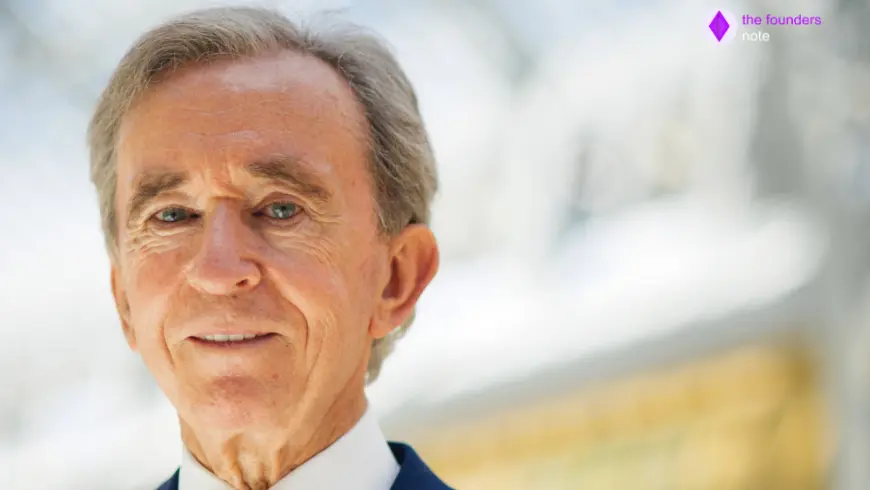
Bernard Arnault: The Engineer Who Built the World’s Largest Luxury Empire
From a Roubaix textile family and a diploma in engineering, to rescuing a bankrupt Christian Dior, to assembling more than 75 of the world’s most desirable brands under one roof — this is the complete story of LVMH’s chairman.

LVMH
Early Life & Family Origins
Bernard Jean Étienne Arnault was born on March 5, 1949, in Roubaix, a textile city in northern France. His father, Jean Léon Arnault, an alumnus of the prestigious École Centrale Paris, ran the civil engineering firm Ferret-Savinel. His mother, Marie-Josèphe Savinel, was a pianist who had a deep admiration for Christian Dior — a detail Arnault himself has cited as a curious foreshadowing of his own career. He was raised in a strict Catholic household, with his grandmother from the Auvergne region instilling much of the family’s discipline, and he took classical piano lessons as a child.
Education Foundations
Arnault studied at the Lycée Maxence Van der Meersch in Roubaix and the Lycée Faidherbe in Lille — a boarding school that prepares students for France’s elite grandes écoles. He went on to the École Polytechnique, France’s foremost engineering school, graduating with an engineering degree in 1971. (Some accounts also credit him with an MBA from HEC Paris, though the École Polytechnique engineering degree is the credential most consistently documented across his official biography and press profiles.)
Joining the Family Business 1971–1979
Arnault joined his father’s construction firm, Ferret-Savinel, as an engineer immediately after graduating in 1971, and was steadily promoted through various executive management positions. He spent several years convincing his father to shift the company’s focus away from industrial construction and toward the more lucrative business of real estate development — eventually selling off the firm’s industrial construction division entirely. He became chairman of the company in 1978, and the following year renamed it Férinel Inc., formally completing its pivot into real estate, including an early, prescient move into building timeshare properties on the French Riviera.
Emigrating to the United States 1981–1984
When France’s Socialist Party, led by François Mitterrand, rose to power in 1981, Arnault emigrated to the United States with his wife and two young children rather than remain under the new government’s economic policies. He prospered there, developing condominiums in Palm Beach, Florida, and running a U.S. branch of his family’s property business. He has said his time in America left a lasting impression on his approach to business and left him more comfortable operating in English-speaking, Anglo-American financial markets — an advantage he would draw on repeatedly in the decades that followed.
Acquiring Boussac & Christian Dior 1984
In 1984, Arnault returned to France and, together with Antoine Bernheim, a senior partner at the French bank Lazard Frères, identified an opportunity in Boussac Saint-Frères, a bankrupt textile conglomerate that also happened to own Christian Dior and the department store Le Bon Marché. Contributing $15 million of his own money and raising the remaining $80 million needed for the deal with Bernheim’s backing, Arnault took control of Boussac via the holding company Financière Agache, becoming its CEO. He then moved aggressively to restructure the business — closing or selling off most of its unprofitable textile operations while retaining and building around Christian Dior — a ruthlessness in cutting jobs that earned him an early reputation in the French press as “the Terminator.”
Investing In & Taking Control of LVMH 1987–1990
LVMH itself had been formed in 1987 through the merger of fashion house Louis Vuitton and the Moët Hennessy drinks group. That same year, Arnault was invited to invest in the newly merged company by its chairman, Henri Racamier, who was then locked in a power struggle with rival executive Alain Chevalier. Investing through a joint venture with the drinks conglomerate Guinness PLC, Arnault steadily built up his position, becoming LVMH’s largest shareholder by 1989. In a swift and decisive boardroom maneuver, he ousted Racamier around 1989–1990 and took control of the company as Chairman and CEO — a role he has held for more than three decades since.
The Acquisition Spree of the 1990s 1988–2001
Once in control, Arnault set about assembling what would become the world’s largest constellation of luxury brands. Fashion houses Christian Lacroix and Givenchy joined the group in the late 1980s, followed in 1993 by Kenzo and the men’s shoemaker Berluti; the perfume house Guerlain followed in 1994, and leather goods company Loewe in 1996. In 1997, Arnault brought the retailer Sephora and fashion label Marc Jacobs into the fold, and in a private capacity — alongside businessman Albert Frère — he purchased the storied Bordeaux vineyard Château Cheval Blanc in 1998. LVMH acquired the shirtmaker Thomas Pink in 1999, the same year the company opened its LVMH Tower headquarters on 57th Street in New York, designed by architect Christian de Portzamparc, and Arnault’s family holding company, Groupe Arnault, made an early investment in the streaming company Netflix. The acquisition spree continued into the new millennium with Emilio Pucci in 2000, and Fendi, DKNY, and the Paris department store La Samaritaine all joining LVMH in 2001. Over these years the group also added leather-goods houses Céline and Fred Joailler, the jeweler, and DFS Group, the world’s largest duty-free retail chain.
The Gucci Battle 1999–2001
In 1999, Arnault set his sights on Gucci, the storied Italian leather-goods house then run by designer Tom Ford and executive Domenico De Sole, quietly building up an LVMH stake in the company in what was widely seen as the opening move of a hostile takeover attempt. Gucci’s management resisted fiercely, engineering a series of defensive maneuvers — including selling a large stake to French rival PPR (led by François Pinault) — that ultimately blocked Arnault’s ambitions. LVMH eventually sold its remaining Gucci stake in 2004 at a substantial profit, closing one of the most closely watched corporate battles in the history of the luxury industry.
Building a Media Empire 1993–Present
Alongside his fashion and drinks acquisitions, Arnault built a significant French media portfolio. In 1993, the same year he bought Berluti and Kenzo, he also acquired the financial newspaper La Tribune; he later sold it and instead acquired the business daily Les Echos and the popular tabloid Le Parisien, both of which he continues to own. In January 2024, Arnault sent a memo to LVMH staff banning them from speaking with reporters at a list of French and English-language outlets — including Glitz Paris, Miss Tweed, Puck, and La Lettre — warning that violations would be treated as serious professional infractions; the move drew a public rebuke in an open letter signed by French journalists, including some from his own Les Echos and Le Parisien, published in the rival paper Le Monde.
The Belgian Citizenship Controversy 2012–2013
In 2012, as France’s newly elected Socialist president, François Hollande, moved to introduce a 75 percent tax on incomes above €1 million, Arnault confirmed reports that he had applied for Belgian citizenship, while insisting he would remain a French tax resident regardless of the outcome and had no intention of becoming a “tax exile.” The move triggered a wave of public criticism in France; the left-wing newspaper Libération ran the front-page headline “Get lost, you rich idiot” in response, prompting Arnault to sue the paper for libel. Facing continued backlash, he withdrew the citizenship application in 2013, describing the move as “a gesture” toward calming the controversy. Records later showed that companies and a private foundation linked to LVMH and based in Brussels held more than €4 billion in assets, which an LVMH spokesman described as ordinary investment vehicles tied to the group’s use of Belgium as an “operational center of finance,” unrelated to Arnault’s personal tax situation.
Fondation Louis Vuitton & Art Collecting 1999–Present
Arnault owned the art auction house Phillips de Pury from 1999 to 2003, and has built a personal art collection that includes works by Pablo Picasso, Andy Warhol, and Damien Hirst, among others. His most significant contribution to the art world has been the Fondation Louis Vuitton, a contemporary art museum in Paris designed by architect Frank Gehry as a striking structure of twelve glass “sails” resembling a transparent cloud, which opened in October 2014. The project’s initial estimated cost of roughly €143 million reportedly grew to more than €700 million by completion, and a €135 million tax break granted to LVMH for the foundation’s construction — approved under President Hollande despite objections from the French Budget Ministry — drew criticism as a sweetheart deal for one of the country’s wealthiest men.
The Tiffany & Co. Acquisition 2019–2021
In November 2019, LVMH agreed to acquire the American jeweler Tiffany & Co. for approximately $16.2 billion — at the time the largest acquisition in LVMH’s history and the largest ever in the global luxury sector. The deal briefly wobbled amid pandemic-era disputes over pricing and completion timing in 2020, before both sides agreed to a slightly reduced price and closed the transaction in January 2021, giving LVMH a flagship entry into high-end jewelry alongside its existing watch and jewelry houses such as Bulgari and TAG Heuer.
LVMH in the 2020s: Olympics, Tariffs & Volatility 2021–2026
LVMH became an official partner of the Paris 2024 Olympic and Paralympic Games, lending its brands’ craftsmanship to elements of the ceremonies and medal presentations — one of two major initiatives Arnault later cited as a particular source of pride for the group. The years that followed brought considerable turbulence for the wider luxury sector: LVMH’s 2024 revenue fell 2% to roughly $88 billion even as fourth-quarter results improved, and the company’s shares fell 17% in the opening months of 2025 amid new U.S. tariff uncertainty under the Trump administration, with LVMH’s first-quarter 2025 revenue of €20.3 billion coming in 3% below the prior year and short of analyst expectations. First-half 2025 revenue fell 4% to €39.8 billion, with net profit at €5.7 billion. The mood shifted in the third quarter of 2025, when LVMH posted its first organic revenue growth of the fiscal year — up 1% to €18.3 billion — sending shares surging 12% in a single session, one of the largest one-day gains in the company’s nearly 40-year history, and adding an estimated $19 billion to Arnault’s personal fortune overnight.
Grooming a Successor Next Generation
All five of Arnault’s children now hold senior executive roles across the LVMH empire and sit on its board, a structure of dynastic involvement often compared in the press to the fictional Roy family of HBO’s Succession. In a September 2023 interview with The New York Times, Arnault said it was “not an obligation, nor inevitable” that a family member would succeed him, adding that “the best person inside the family or outside the family should be one day my successor” — while stressing this wasn’t intended as “a duel for the near future.” In April 2025, LVMH’s board voted by 99.18% to extend Arnault’s mandatory retirement age from 80 to 85, a move widely read as buying additional time to settle the succession question. In January 2025, Arnault attended U.S. President Donald Trump’s inauguration alongside two of his children, Delphine and Alexandre, fueling further speculation about the pecking order among his heirs.
LVMH Financial Performance, 2024–2025 Numbers
LVMH closed out 2025 with consolidated revenue of €80.8 billion, down 5% on a reported basis (and down 1% organically) from €84.68 billion in 2024, as a slowdown in Europe in the second half of the year was partly offset by growth in the United States and a second-half return to growth across Asia. Profit from recurring operations came in at €17.8 billion, a 9% decline that nonetheless preserved a 22% operating margin, while net profit fell 13% to €10.9 billion; operating free cash flow, however, rose 8% to €11.3 billion, underscoring the group’s continued cash-generating strength even in a difficult year. Speaking after the results, Arnault emphasized LVMH’s long-term orientation as a family-controlled group, saying: “We’re a family group. We’re not riveted to quarterly results.”
The 2026 Back-Taxes Ruling July 2026
On July 2, 2026, the Paris Administrative Court of Appeal ruled against Arnault and his wife, Hélène Mercier-Arnault, ordering them to pay nearly €22.5 million in back taxes — reversing two earlier rulings, from 2020, that had gone in the couple’s favor. The dispute centers on the ownership structure through which the Arnault family controls its stake in LVMH: rather than holding shares directly, the family’s stake runs through a chain of holding companies topped by a Belgian entity called Pilinvest, which the court valued at €368.4 million and found to be almost entirely owned by Arnault personally. At issue was a 2010 transaction in which Pilinvest returned roughly €50 million to Arnault and his wife by reducing its share capital; Arnault had treated the payment as a tax-free return of capital, but the court ruled that €32.18 million of it should have been taxed as income. The final assessment splits into €12.96 million in additional income tax, social contributions, surcharges, and late-payment interest for the 2010 tax year, plus €9.5 million in wealth-solidarity tax covering 2012 through 2015; French tax investigators drew on assistance from authorities in both Luxembourg and the Bahamas during the inquiry. Arnault’s representatives have said the ruling will be appealed to France’s highest administrative court, the Conseil d’État, and have noted that LVMH remains France’s single largest corporate taxpayer. Arnault has separately been an outspoken critic of proposed French wealth-tax measures, at one point dismissing economist Gabriel Zucman, an advocate for such a tax, as “a far-left activist.”
Philanthropy Giving Back
Beyond the Fondation Louis Vuitton, Arnault has supported medical research through a 2009 donation to the Institut Curie, a leading French cancer-research center, and has backed the Claude Pompidou Foundation’s work on Alzheimer’s disease research and treatment. He contributed to the restoration of the Palace of Versailles, and following the catastrophic April 2019 fire at Notre-Dame Cathedral in Paris, LVMH pledged funds toward the cathedral’s reconstruction. Arnault has been listed among Forbes’ top 50 philanthropists in the world.
Awards & Recognition Honors
Arnault was made a Grand Officer of France’s Legion of Honor in 2011, and was elevated to Grand Cross of the Legion of Honor — the order’s highest rank — in 2023. He has been repeatedly ranked among the world’s richest people by Forbes and Bloomberg, and LVMH under his leadership became, at various points, the largest company by market capitalization in the eurozone.
Personal Life & Family Tree Family
Arnault has been married twice. He married his first wife, Anne Dewavrin, in 1973; the couple had two children, Delphine and Antoine, before divorcing around 1990. In 1991, Arnault married his second wife, Hélène Mercier, a Canadian-born concert pianist; the couple have three sons together — Alexandre, Frédéric, and Jean.
All five of Arnault’s children hold senior positions within LVMH. Delphine Arnault, a graduate of the London School of Economics who worked at McKinsey & Company before joining the family business in 2001, serves as CEO of Christian Dior Couture after years as executive vice president of Louis Vuitton, and has built a personal fortune estimated at $11–12 billion in her own right. Antoine Arnault is vice-chairman and CEO of Christian Dior SE and also leads LVMH’s communications and image division; he is married to model Natalia Vodianova, with whom he has two children. Alexandre Arnault serves as executive vice president of product, communications, and industrial affairs and deputy CEO of Moët Hennessy, following earlier roles as EVP at Tiffany & Co. and CEO of the luggage brand Rimowa. Frédéric Arnault has served as CEO of LVMH’s watches division since 2024 and additionally took on the CEO role at Loro Piana in 2025, having previously led TAG Heuer. Jean Arnault, the youngest, studied financial mathematics at MIT and mechanical engineering at Imperial College London before joining LVMH in 2021 as director of marketing and development for Louis Vuitton’s watch business. Collectively, the Arnault children and their father control roughly 48.6% of LVMH.
Net Worth Wealth
Bernard Arnault’s fortune is drawn overwhelmingly from his family’s controlling stake in LVMH, held through a chain of holding companies including Christian Dior SE and Groupe Arnault, and it has proven extraordinarily sensitive to swings in LVMH’s share price. In September 2024, Arnault was estimated to be worth $183 billion; by October 14–15, 2025, a single strong earnings report drove LVMH shares up sharply, adding an estimated $19 billion to his fortune in one day and pushing his net worth to roughly $192 billion, moving him to seventh place on the Bloomberg Billionaires Index, ahead of former Microsoft CEO Steve Ballmer. By mid-2026, estimates diverged across trackers, as they often do for fortunes this large and volatile: one June 2026 estimate placed his net worth at approximately $171 billion, while Bloomberg’s index in early July 2026 — around the time of his back-taxes ruling — put the figure at about $165 billion (making him the eighth-richest person in the world at that moment), and a separate estimate cited in French-language coverage of the same tax case placed his fortune at between €123 billion and €141 billion (roughly $133–153 billion). Whichever figure is used, Arnault remains the richest person in France and in Europe, and consistently ranks among the handful of richest individuals on Earth.
Net Worth & LVMH Revenue Growth Interactive Chart
The chart below tracks Bernard Arnault’s estimated net worth alongside LVMH’s total annual revenue, year by year. Use the toggle buttons to isolate either series, and hover or tap any point for the exact figure.
Net worth figures for 2019, 2021, and 2023 are approximate, reconstructed from widely reported year-end rankings during Arnault’s periods atop the global rich list; 2024 ($183B), October 2025 ($192B), and July 2026 ($165B) are drawn directly from Fortune/Bloomberg reporting. LVMH revenue figures (2019–2025) are drawn from the company’s own published annual results; 2026 full-year revenue is not yet available as of this writing and is therefore omitted from the chart.
Significance & Legacy Impact
Bernard Arnault transformed a family construction and real estate business into the world's dominant luxury conglomerate, pioneering a model of brand management — buying storied but often struggling fashion and drinks houses, then investing heavily in marketing, retail experience, and controlled scarcity — that virtually the entire modern luxury industry has since imitated. His decades-long tenure has been marked by an unmatched acquisitive appetite, occasional brutal corporate battles (Boussac, LVMH itself, Gucci), a willingness to court controversy over taxes and media influence, and a deliberate, methodical effort to install his five children across the group's most important divisions ahead of an eventual succession. Whether LVMH's next chapter is written by Arnault himself, deep into his late seventies and given a runway to age 85, or by one of his children, the conglomerate he built remains the definitive benchmark against which the global luxury industry measures itself.
Quick Facts At a Glance
Full Name
Born
Education
Current Roles
LVMH Control Since
Brands Owned
Spouses
Children
Est. Net Worth
Honors
Milestone Timeline Journey
Born in Roubaix, France.
Graduates from the École Polytechnique; joins father's firm, Ferret-Savinel.
Marries Anne Dewavrin.
Becomes chairman of Ferret-Savinel.
Emigrates to the United States amid France's political shift; develops real estate in Palm Beach, Florida.
Returns to France and acquires bankrupt Boussac Saint-Frères, gaining control of Christian Dior.
Invited to invest in the newly formed LVMH by chairman Henri Racamier.
Becomes LVMH's largest shareholder and takes control as Chairman & CEO.
Marries Hélène Mercier.
Leads a sweeping acquisition spree: Kenzo, Berluti, Guerlain, Loewe, Sephora, Marc Jacobs, Fendi, DKNY, and more.
Attempts a hostile takeover of Gucci; ultimately blocked by rival PPR.
Made a Grand Officer of France's Legion of Honor.
Applies for, then withdraws, Belgian citizenship amid France's proposed 75% wealth tax.
Opens the Frank Gehry-designed Fondation Louis Vuitton in Paris.
LVMH agrees to acquire Tiffany & Co. for $16.2 billion.
Tiffany & Co. acquisition closes.
Elevated to Grand Cross of the Legion of Honor; briefly the world's richest person.
LVMH becomes a Paris Olympics partner; sends memo restricting staff contact with certain media outlets.
LVMH board extends Arnault's mandatory retirement age to 85.
LVMH shares surge on first quarterly growth of the year; Arnault's fortune jumps roughly $19 billion in a day.
Ordered to pay €22.5 million in back taxes by a Paris appeals court; says he will appeal to the Conseil d'État.
Frequently Asked Questions FAQ
Who is Bernard Arnault?
Bernard Arnault is a French businessman who is the chairman and CEO of LVMH Moët Hennessy Louis Vuitton, the world's largest luxury goods company, which owns more than 75 brands including Louis Vuitton, Christian Dior, and Tiffany & Co.
How did Bernard Arnault get started in business?
He trained as an engineer at the École Polytechnique, ran his father's construction firm, then in 1984 acquired the bankrupt Boussac Saint-Frères conglomerate — which owned Christian Dior — using it as his entry point into the luxury goods industry.
What is Bernard Arnault's net worth?
Estimates as of mid-2026 range from roughly $165 billion to $171 billion depending on the tracker and date, following a peak of about $192 billion in October 2025; he is consistently ranked as the richest person in France and Europe.
Why did Bernard Arnault apply for Belgian citizenship?
In 2012, amid France's proposed 75% tax on incomes above €1 million, he applied for Belgian citizenship while insisting he would remain a French tax resident; facing heavy public criticism, he withdrew the application in 2013.
Who will succeed Bernard Arnault at LVMH?
No successor has been formally named. All five of his children — Delphine, Antoine, Alexandre, Frédéric, and Jean — hold senior roles across LVMH and sit on its board, and Arnault has said the best candidate, inside or outside the family, should eventually take over.
What happened in Bernard Arnault's 2026 tax case?
In July 2026, a Paris appeals court ordered Arnault and his wife to pay nearly €22.5 million in back taxes related to a 2010 transaction involving a Belgian holding company, reversing two earlier rulings in his favor; he is appealing to France's highest administrative court.
What brands does LVMH own?
LVMH's portfolio spans more than 75 brands across fashion and leather goods, wines and spirits, perfumes and cosmetics, watches and jewelry, and retail, including Louis Vuitton, Christian Dior, Fendi, Givenchy, Bulgari, Tiffany & Co., Moët & Chandon, Hennessy, and Sephora.
The Architect of Modern Luxury
From an engineering degree and a family construction firm to the helm of the world's most valuable luxury empire, Bernard Arnault's career has been a decades-long demonstration that heritage, scarcity, and relentless acquisition can be engineered — brand by brand — into one of the largest fortunes on Earth.