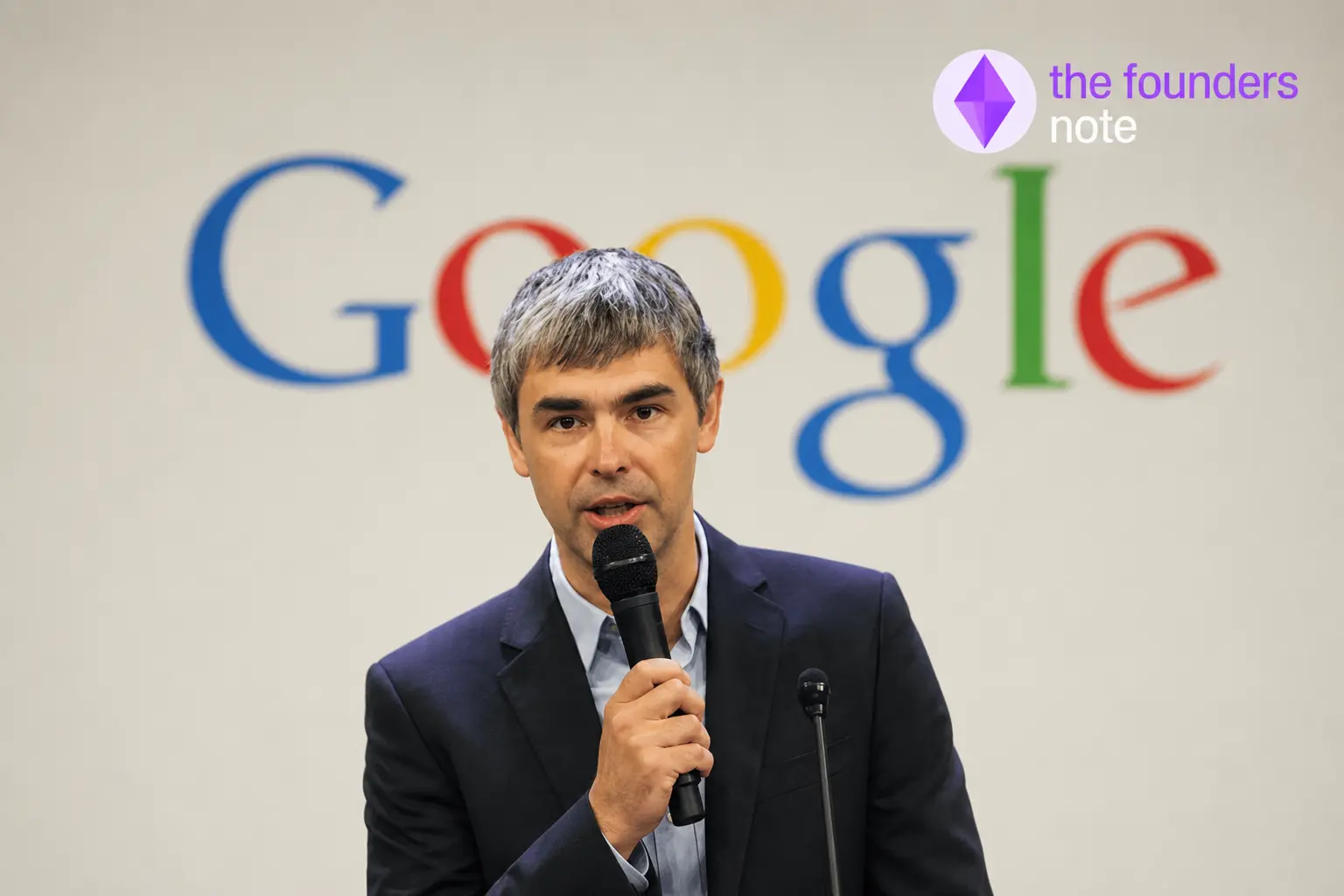
Larry Page: The Quiet Engineer Who Rewired How the World Searches
From a dorm-room experiment at Stanford to a trillion-dollar question of how information should be organized — this is the full story of Google’s co-founder, his family, his fortune, and the ideas that reshaped daily life for billions.

Early Life & Family Origins
Lawrence Edward Page was born on March 26, 1973, in Lansing, Michigan, into a household where computers were not a novelty but a way of life. His father, Carl Victor Page Sr., was a pioneering computer science and artificial intelligence professor at Michigan State University, while his mother, Gloria Page, taught computer programming at the same institution. Page grew up as the middle child, with an older brother, Carl Victor Jr., and a younger sister, Beverly.
His family background was religiously and culturally mixed — his father’s side followed Protestant traditions, while his mother’s side carried Jewish heritage, with his maternal grandfather having emigrated to Israel. This blend of academic rigor and diverse roots gave Page an unusually broad early worldview.
That environment shaped his instincts. Rather than simply consuming technology, Page was drawn to understanding how it worked and how it could be improved — a trait that would define his entire career.
School & Early Inventions Foundations
Page’s early education followed the Montessori method at Okemos Montessori School, an approach built around independent exploration rather than rigid instruction — a style many biographers believe planted the seeds of his self-directed, experiment-first approach to problem solving. He went on to graduate from East Lansing High School in 1991.
Even before college, Page was already building things most adults couldn’t. As an undergraduate at the University of Michigan, he famously constructed a working inkjet printer out of LEGO bricks, and he contributed to the university’s solar car team, working on the signal electronics for a vehicle named Maize & Blue that competed in the 1993 World Solar Challenge. He graduated in 1995 with a Bachelor of Science in computer engineering.
The Stanford Years Education
After Michigan, Page moved west to pursue a master’s and later doctoral studies in computer science at Stanford University. It was there, in the summer of 1995, that he crossed paths with a fellow prospective student named Sergey Brin, who had been assigned to show him around campus. The two argued about nearly everything at first — yet quickly became close collaborators.
The two shared an obsession: the internet was expanding rapidly, but there was no reliable way to sort the genuinely useful pages from the noise. Existing search tools ranked results largely by how often a keyword appeared on a page, a method that was easy to manipulate and often unhelpful.
Inventing PageRank Breakthrough
Working out of Page’s Stanford dormitory room, the pair built a new kind of search algorithm they called PageRank, launching an early prototype in January 1996 under the name BackRub. Instead of just counting keywords, it treated a link from one webpage to another as a vote of confidence — and treated votes from already-important pages as worth more. The more high-quality pages that linked to a site, the more authoritative that site was judged to be.
This idea, an academic adaptation of citation analysis used in scholarly publishing, gave search results a level of relevance nobody had achieved before. Money was tight, though — as graduate students, Page and Brin struggled to afford the servers BackRub needed, so Page became resourceful at squeezing strong results out of cheap, low-capacity hardware scavenged from around campus.
Founding Google 1998
To scale their idea beyond a research project, Page and Brin raised roughly a million dollars from investors, professors, family, and friends. They renamed their engine Google, a playful twist on the word “googol,” representing the number one followed by a hundred zeros — a nod to their ambition of organizing a seemingly infinite amount of information.
Google Inc. was officially incorporated in September 1998, with Page serving as chief executive. A patent for the PageRank system followed soon after, cementing the technology at the heart of the company. Within a year, Google had secured $25 million in venture funding and was already handling roughly half a million searches every day — a number that would soon look tiny compared to what was coming.

Growth & Leadership Scaling Up
As Google’s user base exploded, the company brought in seasoned technology executive Eric Schmidt as CEO in 2001, with Page shifting to president of products. Even without the top title, Page and Brin stayed deeply embedded in day-to-day decisions, particularly on engineering and product direction.
By 2004, Google was fielding around 200 million searches a day. That same year, the company went public, an event that turned Page’s stake into a personal fortune worth billions overnight. Two years later, in 2006, Google made one of its boldest bets by acquiring the video platform YouTube for $1.65 billion in stock — a move that pushed the company well beyond its roots as a search engine.
2001
2004
2006
2011
Building Alphabet Reinvention
In 2011, Page stepped back into the CEO role at Google, with Schmidt moving to executive chairman. Under his renewed leadership, the company pushed hard on a “10x” philosophy — the belief that products should aim to be ten times better than the competition, not just incrementally improved. This mindset fueled ambitious pushes into Android, Chromebooks, and self-driving car research.
To give these ventures room to grow independently, Google restructured in August 2015 into Alphabet Inc., a holding company overseeing Google and its other divisions separately. Page took the helm as Alphabet’s CEO, with Brin as president, marking a new chapter focused on long-term, moonshot thinking rather than quarterly product cycles.
Personal Life & Marriage Family
Larry Page is famously private about his personal life and rarely gives interviews outside of work. In the early 2000s, he was briefly linked to Marissa Mayer, then a Google employee who later became CEO of Yahoo. In 2007, Page married Lucinda Southworth, a research scientist, in a wedding held on Necker Island, the Caribbean island owned by Richard Branson. The couple has two children, born in 2009 and 2011, whose identities they have kept almost entirely out of the public eye.
Page holds a pilot’s license and has a well-known passion for kiteboarding and windsurfing. He also owns several private islands across the Caribbean and South Pacific — including Hans Lollik Island, Eustatia Island, Cayo Norte, and Tavarua — reflecting his preference for secluded, low-profile living away from media attention. During the COVID-19 pandemic, reports indicated his family relocated to Fiji and later New Zealand, where Page holds a resident’s visa.
Wealth & Investments Fortune
Most of Larry Page’s fortune comes from his significant shareholding in Alphabet Inc. His net worth has climbed steadily alongside the company’s growth, regularly placing him among the handful of wealthiest people on the planet and ranking him, at various points, in the top ten of global rich lists. Beyond Alphabet, Page has invested heavily in futuristic transportation, backing flying-car startups such as Kitty Hawk and Opener, as well as sustainable technology ventures including stakes in electric vehicles.
He is considered one of a small group of entrepreneurs — alongside Sergey Brin, Bill Gates, and Mark Zuckerberg — who built enormous personal fortunes primarily through their own company rather than inheritance.
Philanthropy Giving Back
Together with his wife Lucinda, Page established the Carl Victor Page Memorial Foundation, named after his father, which funds causes spanning medicine, education, and poverty relief. Between 2013 and 2016, the couple donated roughly $15 million toward relief efforts during the West African Ebola epidemic.
Page has spoken candidly about preferring to fund ambitious, high-risk ventures — including space exploration and other “moonshot” ideas — over traditional charitable giving, arguing that solving hard technical problems can do as much long-term good as direct donations.
Honors & Awards Recognition
2004
2005
2009
2014
2015
2017
Later Years, Legacy & Recent Moves Impact
Page stepped down as Alphabet’s CEO in December 2019, handing the role to Sundar Pichai, though he remained on the company’s board of directors, staying connected to the organization he helped build from a research paper into a global institution.
Larry Page has kept a famously low public profile in the years since, rarely appearing at industry events. Reports from 2025 point to him quietly launching a new AI-and-manufacturing venture, sometimes referred to as Dynatomics, aimed at combining artificial intelligence with physical product design — and to a rare public appearance at a Y Combinator event, where he mentored early-stage founders, surprising much of the tech world given his usual privacy.
His legacy is inseparable from the modern internet itself. The ranking principles born in that Stanford dorm room reshaped not just how people search, but how entire industries think about relevance, authority, and information design. Few inventions have altered daily human behavior as thoroughly as the one he and Brin sketched out together.
Quick Facts At a Glance
Full Name
Born
Parents
Siblings
Education
Spouse
Children
Known For
Key Roles
Hobbies
Milestone Timeline Journey
Born in Lansing, Michigan, to two computer science educators.
Graduates from East Lansing High School.
Graduates from the University of Michigan with a degree in computer engineering; meets Sergey Brin at Stanford.
Launches the BackRub prototype, applying the early PageRank algorithm.
Google Inc. is founded, with Page serving as its first CEO.
Steps aside as CEO for Eric Schmidt, remaining president of products.
Google goes public in a landmark IPO.
Google acquires YouTube for $1.65 billion.
Marries Lucinda Southworth on Necker Island.
Returns as Google’s CEO.
Becomes CEO of the newly formed Alphabet Inc.
Steps down as CEO, remaining on Alphabet’s board.
Reemerges with a new AI-driven venture and a rare public mentoring appearance.
Frequently Asked Questions FAQ
Who is Larry Page?
Larry Page is an American computer scientist and entrepreneur who co-founded Google with Sergey Brin and later served as CEO of both Google and its parent company, Alphabet.
What is PageRank?
PageRank is the algorithm Page and Brin developed to rank web pages based on the quantity and quality of links pointing to them, forming the foundation of Google’s search engine.
Why is it called “Google”?
The name comes from “googol,” a mathematical term for the number one followed by one hundred zeros, reflecting the founders’ goal of organizing a vast amount of information.
Is Larry Page married?
Yes. He married research scientist Lucinda Southworth in 2007, and the couple has two children.
Is Larry Page still involved with Google?
He stepped down as Alphabet’s CEO in December 2019 but continues to serve on the company’s board of directors, and has reportedly returned to active work through a new AI venture.
The Search Continues
From a dorm-room prototype to a company that redefined how billions of people access information, Larry Page’s story is a reminder that the biggest ideas often start as a simple question — asked persistently, and answered with patience.