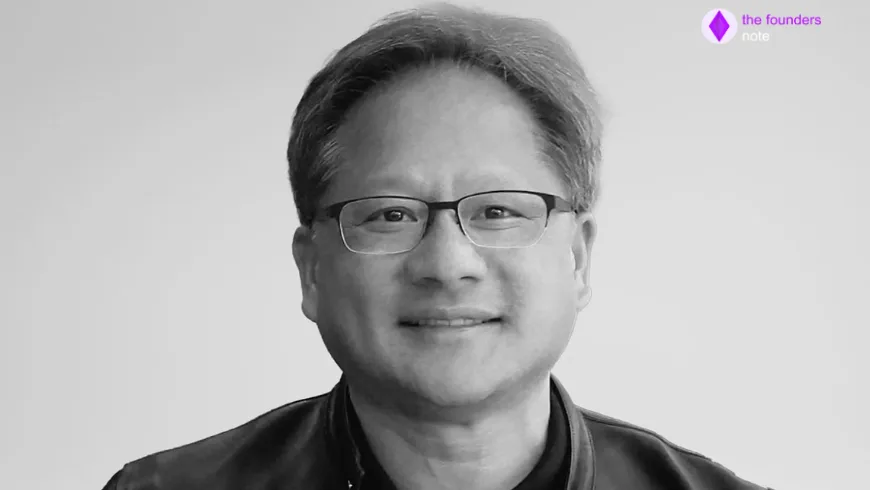
Jensen Huang: The Leather-Jacket Engineer Powering the AI Era
From cleaning toilets at a Kentucky reform school to leading the most valuable company on Earth — this is the full story of NVIDIA’s cofounder, from a Denny’s booth to a $5 trillion market cap.

NVIDIA
Early Life in Taiwan & Thailand Origins
Jensen Huang — whose given name is actually Jen-Hsun — was born on February 17, 1963, in Tainan, Taiwan, the second son of Huang Hsing-tai, a chemical engineer, and Lo Tsai-hsiu, a grade-school teacher. When Jensen was five, the family relocated to Thailand, though the stay would not last long. Huang’s father had earlier taken part in a worker-training program at the American air-conditioner manufacturer Carrier and had come away with a strongly positive impression of the United States, planting the idea of eventually sending his sons there for a better education.
The escalating Vietnam War made that decision more urgent. As U.S. bombing campaigns crept closer to the Thai border through 1969 and 1970, Jensen’s parents grew increasingly convinced the region was too unstable for their children’s future. To prepare her sons for America despite speaking no English herself, Huang’s mother picked ten words from the dictionary every day and drilled them with Jensen and his brother until the family’s eventual move.
The Kentucky Ordeal Adversity
In 1972, nine-year-old Jensen and his older brother were sent ahead to live with an uncle in Tacoma, Washington, while their parents remained in Thailand to save money and arrange the paperwork to join them. Shortly after the boys arrived, their uncle sent them to the Oneida Baptist Institute, an all-boys school in rural Oneida, Kentucky — mistakenly believing it to be a prestigious boarding school.
It was, in fact, a religious reform school for troubled children. Huang was assigned to clean toilets daily while his brother worked a tobacco farm, and both boys faced relentless bullying, ethnic slurs, and even knife threats from other students. About two years later, Huang’s parents finally arrived in the U.S., discovered the situation, and immediately pulled their sons out of the school.
Reunion & Life in Oregon Coming of Age
Once reunited, the Huang family settled in the suburbs of Portland, Oregon, where Jensen attended Aloha High School. There, he found an unlikely competitive outlet: table tennis, in which he earned a national ranking as a teenager. He graduated in 1981 and enrolled at Oregon State University, where he studied electrical engineering and met a fellow engineering student, Lori Mills, whom he later married.
Education Foundations
Huang earned his Bachelor of Science in electrical engineering from Oregon State University in 1984. While working in Silicon Valley, he returned to school part-time and earned a Master of Science in electrical engineering from Stanford University.
Early Career: AMD & LSI Logic 1984–1993
After graduating from Oregon State, Huang moved to Silicon Valley and took a job at Advanced Micro Devices, staying roughly a year before moving to LSI Logic Corporation. At LSI Logic, he rose through the ranks and eventually became director of a company division — practical, hands-on experience in chip design and business management that directly informed the company he would soon start.
Founding NVIDIA at a Denny’s April 1993
In April 1993, Huang founded NVIDIA together with fellow microchip designers Chris Malachowsky and Curtis Priem — the trio famously hashed out much of the founding vision over meals at a Denny’s diner in East San Jose. Malachowsky and Priem chose Huang, then 30, to serve as president and CEO, and he has also served on NVIDIA’s board of directors since its inception. Their aim was ambitious but narrow at the time: build graphics processing units for the video game industry.
The trio started with just $40,000 in personal capital, soon supplemented by an initial venture investment of $20 million. That backing helped NVIDIA survive several precarious early years before the company found solid footing in the emerging PC graphics market. Notably, Taiwan — the country of Huang’s birth — is today the world’s leading nation in advanced semiconductor manufacturing, and Taiwanese chipmaker TSMC has fabricated NVIDIA’s most cutting-edge chips for years, bringing Huang’s story full circle in an industry sense.
Going Public & the Tattoo 1999
NVIDIA went public in 1999, the same year it is credited with inventing the modern GPU — an innovation that sparked the growth of the PC gaming market and redefined computer graphics. When NVIDIA’s stock price first hit $100 per share, Huang celebrated by getting the company’s logo tattooed on his left shoulder, a story that has since become part of NVIDIA company lore.
Beyond Gaming: Powering the AI Boom Turning Point
Under Huang’s leadership, NVIDIA grew well beyond its original gaming focus, expanding into artificial intelligence, mobile computing, autonomous-vehicle technology, and even social networking platforms during the 2010s. Of all these directions, AI proved by far the most transformative: NVIDIA’s GPUs, originally engineered purely for rendering video-game graphics, turned out to be extraordinarily well-suited to another workload entirely — the parallel matrix computations at the heart of machine learning. That discovery, made largely by outside researchers rather than NVIDIA itself, repositioned the company at the center of the generative AI boom of the 2020s, as its chips became the primary hardware powering large language models and other AI systems worldwide.
Huang has described this shift as an example of NVIDIA’s chips being “computationally challenging” enough for gaming that they happened to translate into extraordinary generality — a bit of foresight-meets-luck he has referenced in interviews going back to 2017.
“Huang’s Law” 2018
At NVIDIA’s 2018 GPU Technology Conference in San Jose, Huang observed that the company’s GPUs had become 25 times faster than they had been five years earlier — a pace of improvement significantly outstripping the historical doubling-every-two-years rhythm described by Moore’s Law for general semiconductor performance. The press quickly dubbed this observation “Huang’s Law,” and it has since become a widely cited shorthand for the unusually rapid performance gains in accelerated computing.
Leadership Style & the Leather Jacket Public Persona
Huang has cultivated one of the most recognizable public personas among major tech CEOs, forgoing traditional business attire in favor of black leather jackets — often custom or near-custom pieces reported to cost around $9,000 — and casual polo shirts, worn to keynotes, earnings calls, and even meetings with heads of state. He is also known for an ability to explain extraordinarily complex hardware concepts in plain, accessible language during his keynote presentations, a skill that has made NVIDIA’s product launches into closely watched media events in their own right.
Despite the casual image, NVIDIA’s success has not come from infinitely scalable software alone — the company has grown by designing and manufacturing some of the most advanced computer hardware ever produced, historically fabricated in partnership with Taiwan’s TSMC.
Wealth & Net Worth Fortune
Huang’s fortune is built almost entirely on his roughly 3% ownership stake in NVIDIA, held personally and through family trusts. As NVIDIA’s valuation has swung dramatically through 2026 — touching a record market capitalization above $5.7 trillion in May before pulling back toward $4.6 trillion by late June — Huang’s personal net worth has moved just as sharply, briefly crossing $200 billion in May 2026 before settling to an estimated $160 billion by late June, according to Forbes and Bloomberg tracking. At his peak, that made him the seventh-richest person alive; by mid-2026 he ranked around ninth, behind Elon Musk, Larry Page, Sergey Brin, Jeff Bezos, Michael Dell, Larry Ellison, and Bernard Arnault.
His NVIDIA salary is comparatively modest — about $36.3 million in total compensation for fiscal 2026 — a figure dwarfed many times over by the value of his stock holdings. Roughly 97% of his total wealth remains concentrated in NVIDIA shares, giving him one of the most concentrated single-stock fortunes among the world’s wealthiest people.
Personal Life Family
Huang has been married to Lori Mills Huang, whom he met as a fellow engineering student at Oregon State University, for decades; the couple has two adult children. Despite his immense wealth, Huang’s real estate footprint is comparatively modest for someone of his net worth — his primary residence is a roughly $38 million home in San Francisco’s Pacific Heights neighborhood, alongside a family estate in Los Altos Hills near NVIDIA’s Santa Clara headquarters and a vacation property in Wailea, Maui.
Philanthropy Giving Back
In 2007, Huang and his wife established the Jen-Hsun and Lori Huang Foundation, which has funded gifts to both of their alma maters and supported public health and Bay Area community organizations. Huang personally donated $30 million to Stanford for an engineering center and $50 million to Oregon State University in 2022 to establish a namesake research center, reflecting the two schools most central to his own education.
NVIDIA in 2026 Recent
2026 has been a whirlwind year for both Huang and NVIDIA. At CES 2026, the company unveiled its Rubin architecture — named after astronomer Vera Rubin — as the successor to its Blackwell platform, pushing NVIDIA’s market capitalization past $5 trillion for the first time. At GTC 2026, Huang unveiled a five-layer AI platform spanning chips, agent runtimes, open models, and “AI factory” blueprints, and separately named 103 companies as NVIDIA’s “AI natives,” underscoring how central the company has become to the broader AI ecosystem.
Huang has also become a visible figure in U.S.–China trade diplomacy, joining President Donald Trump’s delegation to China in mid-2026 alongside other tech CEOs following the U.S. government’s approval of H200 chip sales to Chinese firms — a reversal after Huang had reportedly been excluded from an earlier version of the trip amid tighter export restrictions. He has also sparred publicly with Anthropic CEO Dario Amodei over AI chip export-control policy, reflecting a broader industry divide over how tightly advanced AI hardware should be restricted from sale to China. In a separate widely discussed remark, Huang said in 2026 that he believed the industry had “achieved AGI,” a claim that drew both attention and skepticism given the term’s contested definition. He was also appointed in 2026 to the President’s Council of Advisors on Science and Technology.
Awards & Honors Recognition
| Year | Honor |
|---|---|
| 2017 | Fortune’s Businessperson of the Year |
| 2019 | Ranked world’s best-performing CEO by Harvard Business Review |
| 2021 | Named to TIME’s 100 Most Influential People |
| Ongoing | National Academy of Engineering, elected member |
| 2026 | Appointed to the President’s Council of Advisors on Science and Technology |
| — | Robert N. Noyce Award, Semiconductor Industry Association’s highest honor |
| — | IEEE Founder’s Medal |
| — | Dr. Morris Chang Exemplary Leadership Award |
| — | Named World’s Best CEO by Fortune, The Economist, and Brand Finance |
| — | Honorary doctorates: National Chiao Tung University, National Taiwan University, Oregon State University, Huazhong University of Science and Technology, Linköping University |
Quick Facts At a Glance
Full Name
Born
Nationality
Education
Current Role
Company Founded
Spouse
NVIDIA Stake
Est. Net Worth
Known For
Milestone Timeline Journey
Born in Tainan, Taiwan.
Family relocates to Thailand.
Sent with his brother to live with an uncle in Tacoma, Washington; sent to Oneida Baptist Institute in Kentucky.
Parents arrive in the U.S. and pull the boys out of Oneida; family settles near Portland, Oregon.
Graduates from Aloha High School; enrolls at Oregon State University.
Graduates from OSU with a BSEE; moves to Silicon Valley to join AMD.
Cofounds NVIDIA with Chris Malachowsky and Curtis Priem.
NVIDIA goes public and is credited with inventing the modern GPU.
Establishes the Jen-Hsun and Lori Huang Foundation.
Named Fortune’s Businessperson of the Year.
“Huang’s Law” is coined at NVIDIA’s GPU Technology Conference.
Named to TIME’s 100 Most Influential People.
Unveils the Rubin architecture at CES; NVIDIA’s market cap passes $5 trillion.
Huang’s personal net worth briefly tops $200 billion as NVIDIA hits a record $5.7 trillion valuation.
Appointed to the President’s Council of Advisors on Science and Technology; joins a U.S. delegation to China.
Frequently Asked Questions FAQ
Who is Jensen Huang?
Jensen Huang is a Taiwanese-born American entrepreneur who cofounded NVIDIA in 1993 and has served as its president and CEO ever since.
What is Jensen Huang known for?
He is best known for building NVIDIA into the leading maker of GPUs, chips that first transformed PC gaming and later became the primary hardware powering the global AI boom.
What is “Huang’s Law”?
A term coined by the press after Huang observed in 2018 that NVIDIA’s GPU performance was improving faster than traditional Moore’s Law predictions — more than doubling every two years.
How did NVIDIA get started?
Huang cofounded the company in April 1993 with fellow engineers Chris Malachowsky and Curtis Priem, reportedly planning much of the initial vision over meals at a Denny’s diner in San Jose.
What is Jensen Huang’s net worth?
Estimates fluctuate closely with NVIDIA’s stock price; as of late June 2026, Forbes and Bloomberg placed it at roughly $160 billion, down from a brief peak above $200 billion in May 2026.
Why does Jensen Huang always wear a leather jacket?
It has become his signature public look, worn at nearly every keynote and appearance, and has grown into an iconic part of his brand as NVIDIA’s CEO.
From a Denny’s Booth to the Center of the AI Era
Jensen Huang’s story — from a Kentucky reform school to leading the most valuable company in history — is a reminder that the hardware behind the AI revolution was built by people who understood both silicon and struggle.