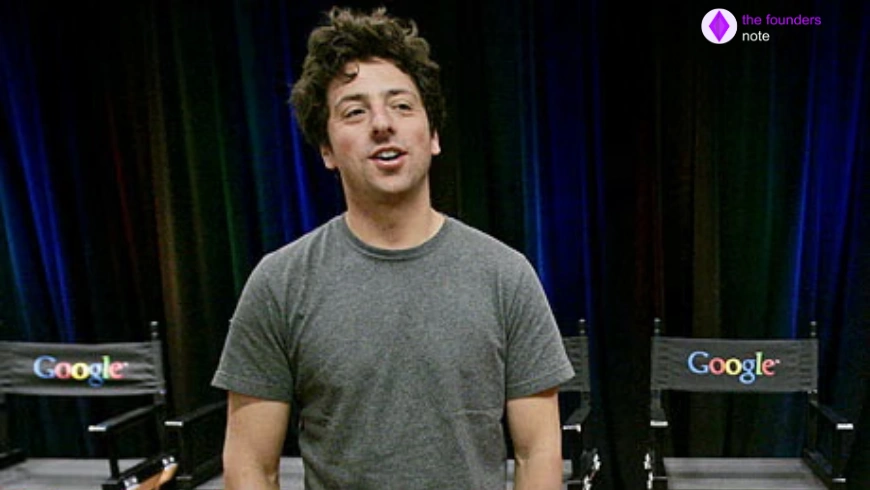
Sergey Brin: From Moscow Refugee to Co-Founder of Google
From a Commodore 64 in a Maryland bedroom, to a Stanford dorm-room search engine, to Alphabet’s boardroom and a fleet of experimental airships — this is the complete story of Google’s co-founder.

Early Life & Family Origins
Sergey Brin was born on August 21, 1973, in Moscow, in what was then the Soviet Union, to a Jewish family. His father, Michael Brin, was a mathematician who went on to become a professor of mathematics at the University of Maryland, and his mother, Eugenia Brin, later worked as a researcher at NASA’s Goddard Space Flight Center. In 1979, facing anti-Semitism in the Soviet Union, the family fled the country and immigrated to the United States when Sergey was six years old, eventually settling in Adelphi, Maryland.
Like Google co-founder Larry Page, Brin attended a Montessori school as a young child — the Paint Branch Montessori School — and also attended the Mishkan Torah Hebrew School. He began programming at age nine on a Commodore 64 computer his father had given him. He proved so precocious in mathematics that he began studying the subject at the University of Maryland at just fifteen years old, and he ultimately dropped out of high school after his junior year to enroll at the university full-time, having already graduated from Eleanor Roosevelt High School in Greenbelt, Maryland, in 1990.
Education Foundations
Brin earned his Bachelor of Science degree in mathematics and computer science from the University of Maryland, College Park, in 1993, graduating with highest honors (summa cum laude) in just three years. He was awarded a graduate fellowship from the National Science Foundation and entered the PhD program in computer science at Stanford University later that year.
Meeting Larry Page & BackRub 1995–1996
At Stanford, Brin met fellow computer science graduate student Larry Page in 1995, who recruited him to join his research project. The internet and World Wide Web were just taking shape as major forces in telecommunication at the time. Page wanted to devise a method for determining how many other web pages linked to any given page, since existing search facilities could only rank results by how often a word appeared on a page — often producing long lists of results with little relevance to the user’s query. Page found that ranking sites by the number of links leading to them from other sites was a far more useful measure of relevance, and he called on Brin’s data-mining expertise to explore the idea more fully.
Together, Page and Brin developed a project called BackRub, initially built as a class assignment, which analyzed backlinks connecting one web page to another on the logic that pages with more incoming links were probably more useful. They wrote the papers “Dynamic Data Mining: A New Architecture for Data with High Dimensionality” and “The Anatomy of a Large-Scale Hypertextual Web Search Engine,” the latter of which became one of the most downloaded scientific documents in the history of the internet. For a time, they ran the BackRub prototype on an assortment of inexpensive personal computers in Larry Page’s Stanford dorm room, before running into trouble with the university over the amount of bandwidth the project required. Word nonetheless spread beyond Stanford that the two graduate students had built something far more useful than existing search technology.
The timing mattered: the rapid growth of the internet, including an estimated 25 million web pages by the late 1990s, meant users badly needed a way to locate the best and most relevant information without wading through minimally helpful or irrelevant results — exactly the gap BackRub’s link-analysis approach was designed to close.
Founding Google 1997–1998
Page and Brin tried to sell their search technology to existing companies such as Excite and Infoseek, but found no takers, so they decided to build the business themselves. They registered the domain name google.com in 1997 — a play on “googol,” the number represented by a one followed by 100 zeros, chosen because the site googol.com had already been taken and because it evoked the vast scale of data the engine was designed to explore. Both left Stanford in 1998, taking a leave of absence from their PhD studies, and moved their servers from Page’s dorm room to a friend’s garage in Menlo Park, California, while living in rented rooms nearby.
Google, Inc. was incorporated as a privately held company on September 7, 1998, attracting $25 million in venture capital by June 1999. Page initially served as CEO and Brin as president; the pair’s stated mission was “to organize the world’s information and make it universally accessible and useful.” The Google.com homepage’s famous simplicity was originally due to the founders’ limited web-design expertise, but it was kept as a deliberate feature for its speed and efficiency — even as the underlying PageRank algorithm, which indexed billions of pages using automated “web crawlers,” grew increasingly sophisticated.
Google’s Early Growth & IPO 1999–2004
After outgrowing a series of office locations, Google leased a complex of buildings in Mountain View, California, in 1999 — later purchasing the entire property outright and turning it into the “Googleplex.” Google became the default search provider for Yahoo! in 2000, the same year it began selling text-based ads tied to search keywords through its AdWords program, which generated more than $600 million in annual revenue by 2003. Google was receiving more than 18 million queries a day in 2000, was released in ten foreign languages that May, fifteen by September, and seventy-two — including the fictional Klingon language — by 2002. The Google Toolbar plug-in launched in December 2000, letting users search without visiting the homepage directly.
That same year, Brin and Page, still enrolled as Stanford PhD candidates, attended the Academy of Achievement’s International Achievement Summit in London as graduate student delegates, returning in 2004 to the Summit in Chicago as recipients of the Academy’s Golden Plate Award. In 2001, as countless internet startups were folding, Google was growing explosively and turning a profit; the pair recruited Novell executive Eric Schmidt as CEO, with Brin becoming president of technology and Page president of products — a triumvirate that ran the company for years afterward. That year Google also launched Google Groups (via its acquisition of the Deja News Research Service) and tested early versions of Froogle and Google News, followed by Google Print in December 2003 and Gmail, Google SMS, and Google Desktop Search in 2004.
By 2001, Google’s underlying index — built by automated “web crawlers” that followed links across the web to catalog pages — had grown to include more than 3 billion web pages, with PageRank treating each link between pages like a vote in a popularity contest, so that links from already-popular pages counted for more. Because being ranked highly on Google became so commercially valuable, other companies developed strategies to try to “game the system” and artificially boost their rankings; in response, Brin and Page continually refined Google’s algorithm and developed a blacklist to block sites that abused the search process.
Google announced its initial public offering in April 2004, conducted unusually as a Dutch auction open to any bidder. The auction ran from April 13 to April 18, with share prices sliding from over $120 to about $85 during the process, before surging to almost $110 on the first day of NASDAQ trading. The IPO ultimately raised $1.67 billion, valuing the company at roughly $23 billion, and made a number of early Google employees millionaires overnight — while Brin and Page, still only 27, became multibillionaires. Brin, Page, and Schmidt all took symbolic annual salaries of just one dollar and refused bonuses, tying their wealth directly to the company’s stock performance.
Diversifying: Products & Acquisitions 2004–2015
Following the IPO, Brin and Page articulated a resource-allocation philosophy for the company: roughly 70 percent of effort on the core search business, 20 percent on ancillary services such as email, and 10 percent on pure innovation — formalized as well through Google’s “20 percent time” program, which let employees spend a fifth of their work time on independent projects and which produced as many as half of Google’s new products. By the end of 2006, Google employed more than 10,000 people and generated annual revenues well over $10 billion, and Fortune magazine ranked it the best company in the world to work for in both 2007 and 2008. Despite its enormous growth, Google largely preserved a uniquely informal and creative atmosphere at its Mountain View campus, employing a Chief Culture Officer specifically to maintain and develop that collaborative environment.
The years that followed brought a wave of new services: Google Maps, Blogger Mobile, institutional access for Google Scholar, Google Earth, and Google Analytics in 2005; Google Calendar, Google Trends, and Google Checkout in 2006, alongside the acquisition of YouTube for $1.65 billion; expanded traffic data and Street View on Google Maps in 2007, alongside the $3.1 billion acquisition of ad-technology firm DoubleClick; Google Translate (available in 23 languages by 2008 and more than 60 by 2012); and Street View’s expansion to Japan and Australia in 2009, the same year that brought Google Voice, Google Ventures, the Google Translator Kit, Google Dashboard, and the Flu Trends tool. A new indexing system called Caffeine arrived in 2010. In 2011, Google made its largest acquisition to date, buying Motorola Mobility for $12.5 billion largely to secure its mobile patents; within two years the company sold Motorola’s manufacturing business to Lenovo while retaining the crucial patents.
Nearly all of Google’s revenue — around 99 percent by this period — came from advertising, powered by a suite of tools including AdWords (third-party display advertising on a cost-per-click basis), AdSense (letting website owners host and profit from Google ads), and Google Analytics (traffic analysis for site owners), alongside a subscription option, Google Site Search, for ad-free access to the index. The Google.com website itself expanded well beyond plain text search, enabling users to search for video and still imagery as well as web pages, while the company continued making strategic acquisitions of startups in gaming, virtual reality, online music, image recognition, and artificial intelligence.
Google.org & Sustainability Philanthropy & Environment
Google’s philanthropic arm, Google.org, was focused on climate change and global issues of poverty and public health, at one point running an online poll to let the public help select nonprofit initiatives for $10 million in donations. One of its signature projects aimed to develop a 100-mile-per-gallon hybrid automobile. As a company, Google built the largest solar power capacity of any corporate campus in the United States, allowed its green campus grounds to be grazed by a flock of goats, negotiated 20-year power contracts with wind farms in Iowa, and in 2010 acquired a 20 percent stake in two wind farms built by NextEra Energy Resources in North Dakota.
Google also consistently supported the principle of “net neutrality,” requiring broadband carriers to treat all websites equally, while its spokespeople cautioned users against unrealistic expectations of online privacy, describing the future of the internet as one of “true transparency, no anonymity.” The company provided free wireless broadband throughout Mountain View and tested broadband expansion in other U.S. cities through its Google Fiber subsidiary.
Google Brain, Glass & AI Beginnings 2011–2015
The Google Brain Project, initiated in 2011, drew on Google’s massive data reserves and distributed computing infrastructure to build a large-scale artificial neural network capable of interpreting visual, written, or auditory information and learning from its own mistakes — technology that fed directly into the speech-recognition features of Android. In 2013, Google introduced Google Glass, a hands-free, voice-activated computer built into a pair of eyeglasses with a display projected into the eye and audio audible only to the wearer, letting users take photos, record video, dictate messages, and navigate without significantly obstructing their natural field of vision; prototypes were made available on a limited basis through 2015 before the product was withdrawn for further development.
Alphabet Reorganization & Stepping Down 2015–2019
In 2015, Google reorganized its diverse business interests under a new holding company, Alphabet Inc., with Google becoming its principal subsidiary. Sundar Pichai, previously Google’s products chief, became CEO of Google itself, while Brin took on the role of Alphabet’s first president, Larry Page became Alphabet’s CEO, and Eric Schmidt became executive chairman. By this period, Google had grown into the internet’s most-visited website, running well over a million servers worldwide to process over 3.5 billion search requests a day; in 2016 alone the company opened an eleven-story office complex at St. Pancras Square in London, and by then operated 70 offices in more than 40 countries with data centers across the U.S., Chile, Finland, Ireland, Belgium, Singapore, and Taiwan.
Former Stanford University president John L. Hennessy succeeded Schmidt as Alphabet’s executive chairman in 2018. At the end of 2019, Brin and Page announced they would step down from their executive roles at the parent company; Sundar Pichai was named CEO of both Alphabet and Google, while Brin and Page remained on Alphabet’s board, retaining a controlling interest in the company as its two largest individual stockholders.
Lighter Than Air (LTA) Research 2014–Present
Brin decided to build his own airship in 2014, after visiting NASA’s Ames Research Center near Google’s Mountain View headquarters — a site once home to the USS Macon, a massive U.S. Navy airship built in the 1930s. He began quietly working on the project in 2017, before formally stepping down from his executive duties at Alphabet, and the resulting venture, Lighter Than Air (LTA) Research, has developed huge electric airships aimed at reinventing the blimp for the twenty-first century with “zero emissions” flight. By 2022, LTA was scheduled to begin test flights over Silicon Valley.
Returning for Gemini & the AI Race 2023–2024
In 2023, Brin resumed active participation in the company’s operations, particularly in the development of Google’s new artificial intelligence system, Gemini. He became a regular presence at the Mountain View offices — especially the Charleston East building — attending frequent meetings and actively intervening in key issues such as the hiring of high-demand AI researchers. The shift came as Google prepared to take on OpenAI’s GPT-4 model with Gemini, following the intensifying competition sparked by the release of ChatGPT from Microsoft-backed OpenAI. Despite Google’s early dominance in AI research, the company had been comparatively slow to turn that research into shipped products, and Brin’s renewed engagement was widely read inside the company as a signal of how seriously it was taking the AI race — even though, as of that time, he held no formal role at Google beyond co-founder and board member.
By 2024, Brin ranked seventh on Bloomberg’s wealth index with a net worth of about $151 billion. Although he had stepped away from day-to-day operations several years earlier, he remained one of Alphabet’s largest individual shareholders and continued to spend substantial time with the company’s AI researchers.
Family Background Family
Sergey Brin is the only child of Michael Brin, a retired mathematics professor at the University of Maryland, and Eugenia Brin, a former researcher at NASA’s Goddard Space Flight Center; the family immigrated to the United States from Moscow in 1979. He has three children across his two marriages: a son, Benji, and a daughter, Chloe, with his first wife Anne Wojcicki, and a daughter, Echo, with his second wife Nicole Shanahan.
Marriage to Anne Wojcicki 2007–2015
Brin married Anne Wojcicki, a biologist and co-founder of the genetic-testing company 23andMe, in 2007. The couple had two children together, a son named Benji and a daughter named Chloe, before divorcing in 2015. The two have continued to operate a charitable foundation together.
Marriage to Nicole Shanahan 2018–2023
In November 2018, Brin married Nicole Shanahan, a legal-tech entrepreneur and philanthropist, and the couple had a daughter, Echo. They separated in December 2021, and Brin filed for divorce in January 2022; the divorce was finalized in 2023.
Net Worth Through the Years Wealth
Sergey Brin’s fortune is tied overwhelmingly to his stake in Alphabet Inc., built from his original founding shares in Google in 1998. He and Larry Page became multibillionaires at age 27 following Google’s 2004 IPO, which valued the company at roughly $23 billion, and by the mid-2000s the two ranked among the two dozen richest people on Earth and the dozen richest Americans. By 2024, Bloomberg’s wealth index placed Brin’s net worth at approximately $151 billion, ranking him seventh globally. Other estimates from 2025–2026 have placed his fortune considerably higher, between roughly $240 billion and $270 billion, ranking him among the top three richest people in the world — a reflection of how closely his wealth tracks Alphabet’s share price and how widely estimates can vary between trackers and dates. He manages his wealth through his family office, Bayshore Global Management.
Philanthropy Giving Back
Brin directs his charitable giving primarily through the Sergey Brin Family Foundation, which disburses grants across education, public health, and social causes, and through Catalyst4, a nonprofit he launched in 2021 focused on health, climate, and scientific research. In 2025, he donated approximately $700 million in Alphabet shares across his philanthropic vehicles — about $500 million of it going directly to Catalyst4, with the remainder split between his family foundation and other causes.
Key Google Products & Services Innovation
Under Brin, Page, and the leadership team they built, Google introduced or acquired a sweeping range of products beyond its core search engine, including:
| Product | Introduced | What It Does |
|---|---|---|
| AdWords | 2000 | Keyword-targeted advertising on third-party sites |
| Google Toolbar | 2000 | Desktop search without visiting the homepage |
| Gmail | 2004 | Free web-based email with large storage |
| Google Maps & Earth | 2005 | Navigation and satellite imagery |
| Google Analytics | 2005 | Website traffic analysis for site owners |
| Google Calendar | 2006 | Online scheduling tool |
| Google Translate | 2008 (expanded) | Multi-language document and text translation |
| Google Chrome | 2008 | Web browser |
| Android | Acquired 2005 | Smartphone operating system |
| Google Docs | 2006 | Collaborative online word processing & spreadsheets |
| Google Books | 2004 (as Google Print) | Searchable digital library access |
| Picasa | Acquired 2004 | Photo organization and editing |
| Google Glass | 2013 | Wearable hands-free computer/eyeglasses |
| Gemini | 2023–2024 | Google’s large-scale AI model, competing with GPT-4 |
Notable Google Acquisitions Growth by Acquisition
Google’s expansion was fueled by a series of major acquisitions across video, advertising, and mobile technology, several of which proved transformative for the company’s business:
| Company | Acquired | Price | Purpose |
|---|---|---|---|
| Deja News Research Service | 2001 | — | Became Google Groups (Usenet archive) |
| Picasa | 2004 | — | Photo organization software |
| YouTube | 2006 | $1.65B | Online video platform |
| DoubleClick | 2007 | $3.1B | Display advertising technology |
| Motorola Mobility | 2011 | $12.5B | Mobile patents (later sold to Lenovo, patents retained) |
Significance & Legacy Impact
Sergey Brin and Larry Page fundamentally changed how the world finds information, turning a Stanford class project into the internet’s most-used search engine and, through Alphabet, one of the most valuable companies in history. Their PageRank innovation set the technical foundation for modern search, while Google’s advertising model — AdWords, AdSense, and Google Analytics — became the backbone of online advertising more broadly. The company’s emphasis on “20 percent time,” an informal and creative Mountain View campus culture, and a stated mission to “organize the world’s information and make it universally accessible and useful” shaped how much of the tech industry thinks about workplace culture and corporate purpose. Brin’s more recent ventures — Lighter Than Air Research and his re-engagement with Google’s Gemini AI effort — reflect a continued pattern of returning to hard technical problems even well after stepping back from day-to-day corporate leadership.
Quick Facts At a Glance
Full Name
Born
Citizenship
Education
Current Roles
Google Founded
Spouses
Children
Est. Net Worth
Known For
Milestone Timeline Journey
Born in Moscow, Soviet Union.
Family immigrates to the United States, settling in Maryland.
Graduates from Eleanor Roosevelt High School, Greenbelt, Maryland.
Graduates summa cum laude from the University of Maryland; begins PhD studies at Stanford.
Meets Larry Page at Stanford University.
Registers the domain name google.com.
Incorporates Google, Inc. on September 7, moving servers to a Menlo Park garage.
Launches AdWords; becomes Yahoo!’s default search provider.
Google’s IPO raises $1.67 billion via Dutch auction; Brin becomes a multibillionaire at 27.
Google acquires YouTube for $1.65 billion.
Marries Anne Wojcicki; Google acquires DoubleClick for $3.1 billion.
Google Brain Project begins; Motorola Mobility acquired for $12.5 billion.
Google Glass introduced.
Decides to build his own airship after visiting NASA’s Ames Research Center.
Google reorganizes under Alphabet Inc.; Brin becomes Alphabet’s first president; divorces Anne Wojcicki.
Begins working on LTA Research before stepping back from Alphabet duties.
Marries Nicole Shanahan.
Steps down as Alphabet president alongside Larry Page; Sundar Pichai becomes CEO of Alphabet and Google.
Launches philanthropic organization Catalyst4; separates from Nicole Shanahan.
LTA Research schedules airship test flights over Silicon Valley; files for divorce from Shanahan.
Resumes active involvement at Google, focusing on Gemini AI development; divorce from Shanahan finalized.
Ranks seventh on Bloomberg’s wealth index at approximately $151 billion.
Donates approximately $700 million in Alphabet shares to philanthropic causes, including Catalyst4.
Frequently Asked Questions FAQ
Who is Sergey Brin?
Sergey Brin is a Moscow-born American entrepreneur who co-founded Google with Larry Page in 1998, later serving as the first president of its parent company, Alphabet Inc., and who founded the airship venture LTA Research.
Is Sergey Brin still involved with Google?
He stepped down from his executive role at Alphabet at the end of 2019 but remains on the board as one of its largest individual shareholders, and since 2023 has been actively involved in the development of Google’s Gemini AI system.
What is Sergey Brin’s net worth?
Estimates vary by tracker and year: Bloomberg placed his net worth at about $151 billion in 2024, while other 2025–2026 estimates have placed it between roughly $240 billion and $270 billion, reflecting swings in Alphabet’s stock price.
What was BackRub?
BackRub was the original name of the search-engine project Brin and Larry Page built as Stanford graduate students, which analyzed backlinks between web pages and later evolved into Google.
Has Sergey Brin been married?
Yes, twice: to Anne Wojcicki, co-founder of 23andMe, from 2007 to 2015, with whom he has two children, and to legal-tech entrepreneur Nicole Shanahan from 2018 until their divorce was finalized in 2023, with whom he has one daughter.
What is LTA Research?
Lighter Than Air (LTA) Research is Sergey Brin’s venture developing large electric airships aimed at reinventing the blimp for modern, zero-emissions flight, with test flights over Silicon Valley beginning around 2022.
Organizing the World’s Information
From a Commodore 64 in Maryland to a garage in Menlo Park, and from Alphabet’s boardroom to the open skies above Silicon Valley, Sergey Brin’s career has been defined by a restless curiosity — one that keeps pulling him back to the hardest technical problems, long after he could have simply walked away.