Mary Barra: From Factory-Floor Inspector to GM’s First Woman CEO
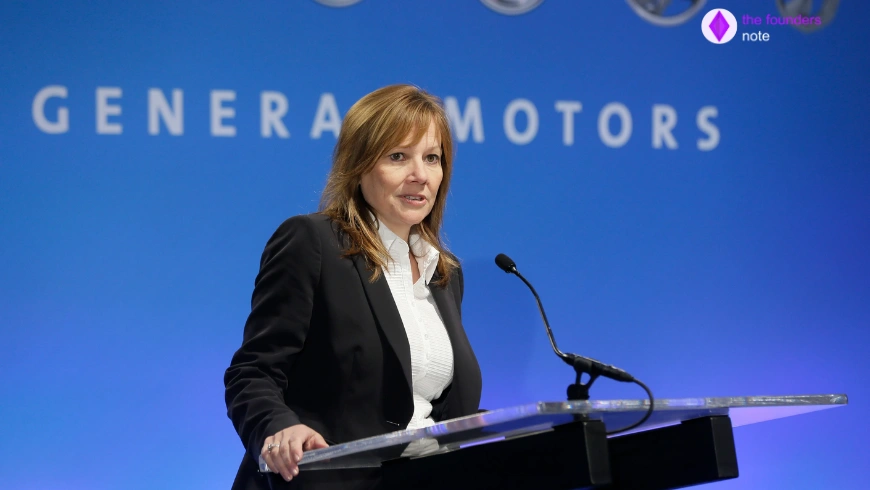
From inspecting fender panels on the factory floor as an 18-year-old co-op student, to running the entire company as its first female chief executive — this is the complete story of Mary Barra’s four-decade career at General Motors.

General Motors
Early Life & Family Origins
Mary Teresa Barra was born Mary Teresa Makela on December 24, 1961. Her birthplace is most commonly cited as Royal Oak, Michigan, though some accounts list Waterford, Michigan; either way, she grew up in the Detroit metropolitan area, the historical heart of the American automotive industry, during a period when the “Big Three” automakers — General Motors, Ford, and Chrysler — dominated both the local economy and everyday life.
She was raised in a middle-class family that valued hard work, responsibility, and education — principles that later became central to her leadership philosophy. Her father, Ray Makela, worked as a die maker for General Motors’ Pontiac division for nearly 40 years (accounts place the figure at approximately 39 years), exposing Mary to manufacturing and engineering from an early age. She has often said her father inspired her appreciation for engineering, craftsmanship, and the importance of quality. Her mother, Eva Makela, was a homemaker who focused on raising the family; Barra has kept most other details about her mother and extended family private, and little further verified public information is available about them. Through her father’s family, Mary is of Finnish ancestry.
Childhood & School Years Formative Years
General Motors was part of Mary’s life long before she became an employee. Her father’s decades-long career meant conversations about manufacturing, engineering, quality, and factory work were common at home, and watching his dedication helped her understand that building automobiles required teamwork, precision, and continuous improvement — a belief that later shaped her conviction that strong companies succeed by listening to employees and maintaining high quality standards.
Unlike many future CEOs, there are no widely documented stories of Mary running businesses as a child or displaying dramatic entrepreneurial behavior. Instead, people who knew her have described her as curious, disciplined, quiet but confident, academically focused, and practical and hardworking. She developed an interest in mathematics, science, and technology early on and, according to available accounts, excelled in those subjects at the public schools she attended in Michigan; teachers reportedly viewed her as a diligent student rather than someone seeking attention.
She loved GM cars and particularly admired a vintage Chevrolet Camaro owned by a cousin. As a teenager, she wanted to buy a Pontiac Firebird — a sporty muscle car — but instead opted for a more affordable, practical, if slower and clunkier, Chevrolet Chevette; the compromise between practicality and style would later influence her own philosophy in designing cars for GM. Mary graduated from Waterford Mott High School in 1980.
The broader U.S. auto industry was entering a difficult period during her childhood: the 1970s oil crises reshaped consumer demand, Japanese automakers gained market share, fuel efficiency became increasingly important, and American manufacturers faced growing competitive pressure — industry-wide challenges that would go on to influence many of the strategic decisions she would make as CEO decades later.
Choosing Engineering A Turning Point
As high school graduation approached, Mary decided to pursue engineering rather than the careers traditionally chosen by women at the time. She enrolled at the General Motors Institute (GMI) — a university created specifically to educate engineers while letting students work inside General Motors through a cooperative education program — marking the beginning of a career that would span more than four decades at a single company.
Entering GM as a Co-Op Student 1980
In 1980, at just 18 years old, Mary Barra joined General Motors as a cooperative education (co-op) student through the General Motors Institute, now known as Kettering University. The co-op program required students to alternate between classroom study and paid work assignments inside GM, letting them gain real-world engineering experience while earning their degrees. That same year she took her first job at GM, dividing her time between studying electrical engineering at GMI and working at a Pontiac manufacturing plant.
Her first assignment was at GM’s Pontiac Motor Division, where she inspected fender panels, hoods, and other body components to ensure they met the company’s quality standards. The work was physically demanding and repetitive, but it gave her a firsthand understanding of manufacturing quality, production processes, and attention to detail — and she began her career on the factory floor rather than in a corporate office, a background that later distinguished her from many executives who entered management through finance or consulting.
Education: GMI & Stanford MBA 1985 & 1990
While working at GM, Barra pursued a Bachelor of Science in Electrical Engineering at GMI Engineering and Management Institute (later Kettering University), a GM-affiliated school in Flint, Michigan. Her coursework in the early 1980s covered circuit analysis, electronics, control systems, industrial automation, computer programming, mathematics and physics, and manufacturing technology. The alternating work-and-study model let her apply classroom concepts directly to real manufacturing problems, and she graduated in 1985 with her engineering degree, earning induction into engineering honor societies for her academic performance.
Throughout the 1980s, Barra held a series of engineering and administrative assignments within GM. Although many of these early positions weren’t publicized individually, colleagues consistently described her as someone who prepared thoroughly before meetings, focused on solving problems instead of assigning blame, listened carefully to engineers and production workers, preferred facts and data over assumptions, and was willing to visit factories to understand issues firsthand. Former executives later recalled that she was identified early on as a high-potential leader in GM’s internal succession planning.
GM subsequently awarded Barra a company-sponsored fellowship to attend the Stanford Graduate School of Business in California — a pivotal moment, since until then she had spent her entire life in southeastern Michigan and her entire career at GM. At Stanford she was exposed to subjects beyond engineering, including corporate finance, strategic management, marketing, entrepreneurship, organizational behavior, and global business. Barra has said Stanford broadened her perspective and taught her “what I didn’t know,” and has credited the experience with preparing her to lead during periods of technological disruption and organizational change. She earned her MBA in 1990 before returning to General Motors.
The combination of factory-floor experience, engineering education, and business training shaped the leadership style that would define her tenure as CEO: engineering discipline (decisions based on evidence and testing), operational understanding (leaders should know how products are built), continuous learning, and respect for employees at every level.
Climbing the Ranks at GM (1985–2013) Career Path
After completing her bachelor’s degree, Barra began working for GM full-time, taking on a variety of roles over the following decades. She served for a time as an engineer at the same Pontiac plant where she had worked as a student, and was later named manager of manufacturing planning. In 1996, she took the position of executive assistant to GM’s chief executive officer and vice chair. She next worked in internal communications before being named manager of an assembly plant that manufactured cars such as the Buick LeSabre, and became executive director of vehicle manufacturing in 2004.
| Year | Role |
|---|---|
| 1980 | Co-op student, Pontiac Motor Division |
| 1985–1996 | Engineer; Manager of Manufacturing Planning |
| 1996 | Executive Assistant to GM’s CEO and Vice Chair |
| — | Internal Communications; Assembly Plant Manager (Buick LeSabre) |
| 2004 | Executive Director of Vehicle Manufacturing |
| 2008 | Vice President of Global Manufacturing Engineering |
| 2009 | Vice President of Global Human Resources |
| 2011 | Senior/Executive Vice President of Global Product Development |
| 2013–2014 | Executive Vice President, Global Product Development, Purchasing & Supply Chain |
She served as Vice President of Global Manufacturing Engineering from 2008 until July 2009. Like many other American car companies, GM struggled during the global recession that began in 2008; rising gas prices and a broader economic downturn sharply reduced sales, and in June 2009 GM filed for bankruptcy, surviving the period largely thanks to a government bailout. Shortly after the bankruptcy filing — which led to internal reorganization and made clear the need for major changes — GM leadership named Barra Vice President of Global Human Resources, a position she held until early 2011, when she became senior vice president of global product development. She went on to serve as Executive Vice President of Global Product Development, Purchasing, and Supply Chain from August 2013 to January 2014.
Becoming CEO 2014
In late 2013, it was announced that GM CEO Dan Akerson planned to retire, and the company’s leaders assembled a shortlist of potential successors, with Barra among them. By mid-December, following considerable speculation, she was named Akerson’s successor, and she officially began serving as CEO of General Motors on January 15, 2014 — making history as the first woman to lead one of the world’s major automobile manufacturers. In 2016, she also became Chair of GM’s Board of Directors.
The Ignition-Switch Crisis 2014
Barra faced her first major test just months into her tenure, when a government investigation revealed that some individuals at GM had known about a dangerous ignition-switch defect implicated in a number of deaths but had chosen not to order a recall — a problem that had reportedly been brewing for a decade before her appointment as CEO. The crisis resulted in millions of vehicle recalls and congressional hearings; Barra testified before Congress in 2014, publicly apologized on behalf of the company, and stated that delays in rectifying such issues were unacceptable under her leadership. She introduced stronger safety systems and emphasized a corporate culture centered on transparency and accountability.
As CEO, Barra became known for analyzing GM’s products not purely from the viewpoint of an engineer or executive but from that of the customer, weighing factors such as comfort, design, and ease of use. She encouraged compromise and coordination among engineers and pushed to improve efficiency in order to reduce manufacturing costs, acknowledging that GM’s history of costly production delays and vehicle cancellations would continue to hurt the company if left unaddressed.
Restructuring, Retreat & Recovery 2014–2019
Under Barra’s leadership, GM cut once-popular product lines, prioritized price over sales volume, pulled out of the Indian, Russian, and South African markets, and sold two legacy European brands. In their place, the company pivoted toward autonomous vehicle technology, battery-electric car production, investments in ride-sharing, and the highly competitive Chinese market. Alongside these changes, Barra announced multiple U.S. plant closures in 2018 and 2019, and in the fall of 2019 she responded to the company’s largest labor strike in decades, meeting not only with United Auto Workers leaders but also with President Donald Trump and White House officials.
COVID-19 & the Chip Shortage 2020–2022
Barra remained CEO throughout the COVID-19 pandemic that began in 2020, which presented worldwide complications for automakers — first a collapse in demand, then, as demand returned, severe and prolonged supply-chain disruption. GM, like other manufacturers, suffered from a shortage of vital vehicle computer components (semiconductors); by 2022, the company had an estimated 95,000 unfinished vehicles sitting in reserve as it waited for the necessary parts to arrive.
Electric Vehicle Strategy Ultium & Beyond
Barra made electrification the centerpiece of GM’s long-term strategy. Under her leadership, GM invested tens of billions of dollars in EV development, introduced the Ultium battery platform, and expanded electric versions of Chevrolet, Cadillac, GMC, and Buick models. In June 2022, she announced that GM was aiming to produce solely electric vehicles by 2035, effectively phasing out gasoline-powered light-duty vehicles in the United States by that date. While the company continued to reaffirm that goal in subsequent years, Barra acknowledged the transition would likely unfold over decades in light of industry-wide challenges — including slowing EV sales, shifting consumer demand, and regulatory uncertainty — all of which led GM to scale back EV output during the 2020s.
Autonomous Driving & Cruise Self-Driving Ambitions
Barra strongly supported autonomous vehicle technology through GM’s Cruise subsidiary. After a serious Cruise robotaxi accident in San Francisco in 2023, GM scaled back and reorganized its autonomous-driving strategy, while continuing to invest in advanced driver-assistance technologies.
Boards & Other Roles Beyond GM
Outside of General Motors, Barra has served on several prominent boards and advisory bodies, including The Walt Disney Company Board of Directors (joined 2017), the Stanford University Board of Trustees, and the U.S. Homeland Security Advisory Council. She is also a member of the Business Roundtable. She served on the board of General Dynamics Corporation from 2011 to 2017, and has long served on Kettering University’s board of trustees, for which she received the Kettering Alumni Association’s management achievement award in 2010. She has chaired GM’s own board of directors since 2016.
Awards & Recognition Honors
Barra has received numerous honors over her career. She has been repeatedly ranked among Fortune’s Most Powerful Women in Business — including second place in 2019, and named the world’s most powerful woman in business multiple times, including in 2024 and 2025 — and has frequently been listed among Forbes’ World’s Most Powerful Women, ranking fifth in 2019. She was named one of Time magazine’s 100 Most Influential People in both 2014 and 2021, and was included in the 2021 Forbes 50 Over 50 list. She was inducted into the Automotive Hall of Fame in 2023, and received the 2025 Centennial Award from Automotive News in recognition of her role transforming GM through a challenging decade of electrification and software innovation.
Personal Life & Family Family
Mary Barra is married to Anthony “Tony” Barra, an engineering consultant. Together they have two children, Rachel and Nicholas, and the family lives in the Detroit metropolitan area. She is known for a practical leadership style, a focus on engineering excellence, and a commitment to innovation.
Net Worth Wealth
Mary Barra has an estimated net worth of approximately $200 million to $350 million, depending on the valuation of her private equity holdings and recent stock trading activity. Her wealth is driven overwhelmingly by her executive compensation, with her recent GM salary and stock awards totaling roughly $29.9 million annually.
Status as of July 2026 Present Day
As of July 2026, Mary Barra, age 64, remains Chair and CEO of General Motors. She is one of the longest-serving leaders in the company’s history and continues to oversee GM’s transformation into an electric, software-driven mobility company. Industry observers have discussed eventual succession as she approaches traditional retirement age, but no official departure has been announced.
Significance & Legacy Impact
As the first female CEO of General Motors, Barra represented a major change in the automotive industry, a male-dominated field long considered inhospitable to women. Her career — beginning on the factory floor as a teenage co-op student and culminating in leadership of one of the world’s largest automakers — has been defined by an insistence that executives understand how products are actually designed and built, not just how companies are managed. Her tenure has spanned the ignition-switch crisis, a global pandemic, a semiconductor shortage, and the industry’s uneven transition toward electrification and autonomy, cementing her reputation as one of the most consequential and closely watched executives in modern American industry.
Quick Facts At a Glance
Full Name
Born
Birthplace
Nationality
Education
Current Position
Joined GM
Spouse
Children
Est. Net Worth
Milestone Timeline Journey
Born December 24 in Michigan.
Graduates Waterford Mott High School; joins GM as an 18-year-old co-op student at Pontiac Motor Division.
Graduates from GMI with a BS in Electrical Engineering.
Earns her MBA from Stanford Graduate School of Business on a GM fellowship.
Named executive assistant to GM’s CEO and vice chair.
Becomes executive director of vehicle manufacturing.
Named Vice President of Global Manufacturing Engineering.
GM files for bankruptcy; Barra named Vice President of Global Human Resources.
Becomes senior/executive vice president of Global Product Development.
Becomes CEO of General Motors — the first woman to lead a major global automaker.
Testifies before Congress over the ignition-switch recall crisis.
Becomes Chair of GM’s Board of Directors.
Joins The Walt Disney Company’s Board of Directors.
Manages GM’s response to its largest labor strike in decades.
Announces GM’s goal to produce only electric vehicles by 2035; chip shortage leaves ~95,000 vehicles unfinished.
Inducted into the Automotive Hall of Fame; GM scales back Cruise robotaxi operations after a San Francisco accident.
Ranked by Fortune as the world’s most powerful woman in business; receives Automotive News’ 2025 Centennial Award.
Remains Chair and CEO of GM as one of its longest-serving leaders; succession speculation continues without an official announcement.
Frequently Asked Questions FAQ
Who is Mary Barra?
Mary Barra is the Chair and CEO of General Motors, and the first woman to lead a major global automobile manufacturer, a role she has held since January 2014.
Where did Mary Barra go to school?
She earned a Bachelor of Science in Electrical Engineering from the General Motors Institute (now Kettering University) in 1985, and an MBA from the Stanford Graduate School of Business in 1990 on a GM-sponsored fellowship.
How did Mary Barra’s career at GM begin?
She joined GM in 1980 at age 18 as a cooperative education student, inspecting fender panels, hoods, and other body components at GM’s Pontiac Motor Division while studying engineering.
What is Mary Barra’s net worth?
Her net worth is estimated at approximately $200 million to $350 million, driven largely by GM compensation totaling roughly $29.9 million a year in salary and stock awards.
What was the ignition-switch crisis?
Shortly after Barra became CEO in 2014, a government investigation revealed GM had known about a dangerous ignition-switch defect linked to deaths but had not ordered a recall; Barra testified before Congress, apologized publicly, and introduced stronger safety and accountability measures.
Is Mary Barra still CEO of GM?
Yes. As of July 2026, she remains Chair and CEO of General Motors, one of the longest-serving leaders in the company’s history, though industry observers have begun discussing eventual succession.
Built on the Factory Floor
From inspecting body panels as a teenager to steering General Motors through recalls, a pandemic, and an industry-wide shift to electric and autonomous vehicles, Mary Barra’s career stands as proof that the clearest view of a company can come from where its products are actually built.