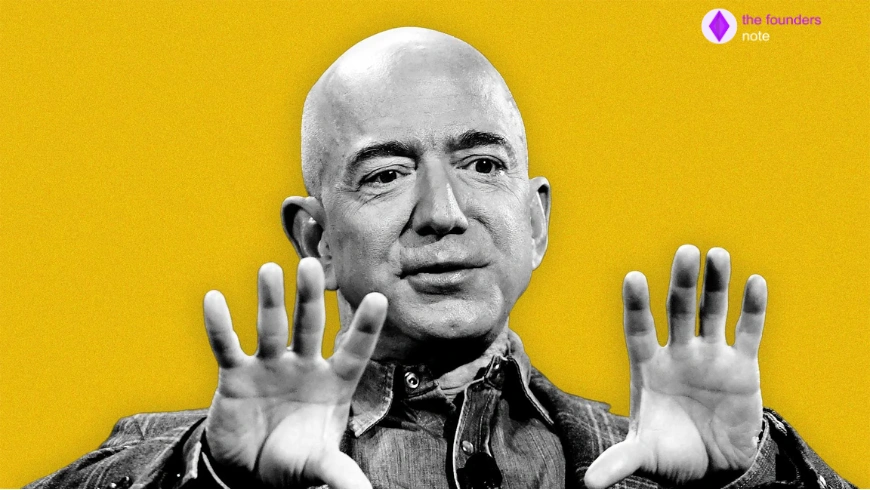
Jeff Bezos: From a Garage Bookstore to a Trillion-Dollar Empire
From a road trip out of New York with a business plan typed in the car, to owning a newspaper, a spaceflight company, and a new AI startup — this is the complete story of Amazon’s founder.

Amazon
Early Life & Family Origins
Jeff Bezos was born Jeffrey Preston Jorgensen on January 12, 1964, in Albuquerque, New Mexico, to Jacklyn Gise and Ted Jorgensen. His mother had him at 17; his parents’ marriage lasted less than a year, with Ted, who struggled with alcohol and money, agreeing to discontinue contact after the divorce was finalized when Jeff was 17 months old. Jeff’s maternal grandfather, Lawrence Preston Gise, was a regional director of the U.S. Atomic Energy Commission in Albuquerque, and young Jeff spent summers on his grandfather’s 25,000-acre cattle ranch in New Mexico, developing an early appreciation for science and hard work.
In April 1968, Jacklyn married Miguel “Mike” Bezos, a Cuban refugee who had arrived in the United States alone as a teenager. Mike formally adopted four-year-old Jeff shortly after the wedding, legally changing his surname from Jorgensen to Bezos. After Mike earned his engineering degree from the University of New Mexico, the family moved to Houston, Texas, where he took a job as an engineer for Exxon; Jeff attended River Oaks Elementary School there and tinkered with science projects in the family garage. As a teenager he dreamed of becoming an astronaut or a physicist, and while still in high school he developed the Dream Institute, a summer program aimed at promoting creative thinking in young students. The family later moved to Miami, Florida, where Bezos attended high school and graduated at the top of his class.
Education Foundations
Bezos attended Princeton University, graduating summa cum laude in 1986 with a Bachelor of Science degree in electrical engineering and computer science.
Early Career on Wall Street 1986–1994
After graduating, Bezos took a position at Fitel, a high-tech start-up, where he built software to track international stock trades. In 1990, he joined the New York investment bank D.E. Shaw & Co., helping develop a technically sophisticated, highly successful quantitative hedge fund. He was named senior vice president in 1992 — the firm’s youngest — and was put in charge of examining the investment potential of the internet. Web usage was growing by more than 2,000% a year, and that explosive potential sparked his entrepreneurial imagination. It was at D.E. Shaw that he met novelist MacKenzie Tuttle, a research associate at the firm; the two married within a year of meeting.
Founding Amazon 1994
In 1994, Bezos left D.E. Shaw and, with MacKenzie, drove across the country from New York to Seattle, reportedly drafting the company’s business plan along the way. He envisioned building the largest store in the world — one where people could buy virtually anything online — but chose to start with books specifically, since even the biggest physical bookstores could stock only a small fraction of available titles. His plan was to order books on demand from wholesalers as customers placed them, letting him launch with no real estate, little capital, and no inventory of his own.
The company was originally named Cadabra and operated out of the garage of a rented house in Bellevue, Washington, before Bezos renamed it Amazon after the world’s largest river — meant to convey a sense of scale and endless possibility. His parents, Jackie and Mike, invested $245,573 into the fledgling company in 1995, a stake now worth tens of billions of dollars. Working with a handful of early employees, Bezos and his team built the site’s software and business plan from scratch; Amazon sold its first book in July 1995, with Bezos personally filling orders in the early days.
Amazon’s Early Growth 1995–2003
Amazon grew quickly by staying open 24 hours a day and encouraging a level of user engagement rare for the era — customer reviews, personalized recommendations, discounts, and searches for out-of-print titles. By the end of 1996, the company had grown to more than one hundred employees. That year, Bezos launched the Associates Program, paying other websites a commission for traffic they referred to Amazon.com — one of the earliest large-scale affiliate marketing programs. Email alerts for new titles of interest were another early innovation aimed at keeping customers engaged.
Amazon went public in 1997, and Bezos used the proceeds to strengthen the company’s distribution network and expand its name recognition through partnerships with high-traffic sites like Yahoo! and America Online, along with early investment in banner advertising. In a memorable publicity move, he arranged for U.S. Vice President Al Gore to spend a day personally answering Amazon customer-service calls. In October 1997, Amazon became the first internet retailer to reach one million customers, and Bezos began acquiring European online bookstores to expand internationally. Despite the strong growth, Amazon’s losses exceeded its revenues for nearly eight years — the company didn’t post its first full-year profit until 2003.
Amazon steadily broadened its catalog during this period: CDs were added in June 1998, followed by videos later that year. In 1999, Bezos declared that “Amazon.com will be a place where you can find anything,” expanding into clothing, computers, toys, and tools, and adding online auctions the same year. In 2001, Amazon took over Borders Books’ online book-selling operations, turning a onetime competitor into a partner.
Diversifying: AWS, Kindle & Beyond 2003–2010
Bezos next focused on making Amazon more indispensable to customers: free shipping on orders over $25, “1-Click” ordering, wedding and baby registries, customer review forums, wish lists, and purchase-based product recommendations all arrived in this era. In 2003, Amazon introduced its “Search Inside the Book” feature, letting customers keyword-search across millions of pages of text — a move some publishers feared would cut into sales, but which Bezos pursued anyway in favor of long-term customer trust over short-term concerns. In 2005, Amazon introduced Amazon Prime, an annual membership offering free two-day shipping across the contiguous United States, which became one of the company’s most powerful tools for customer loyalty. A year later, the company launched video-on-demand under the name Amazon Unbox, later rebranded Amazon Prime Video.
As competition for internet retail dollars intensified, Bezos pushed Amazon to diversify further: by 2005 the company offered a vast array of products including consumer electronics, apparel, and hardware. In 2006, Amazon launched Amazon Web Services (AWS), a cloud computing platform that eventually grew into the largest service of its kind in the world and, by 2018, accounted for roughly half of the company’s operating income. In late 2007, Amazon released the Kindle, a wireless e-reader that let customers buy, download, and store books on demand; by 2010, Amazon announced Kindle e-book sales had overtaken hardcover sales. That same year, the company entered original television and film production through Amazon Studios. In June 2015, Amazon introduced the Echo smart speaker, powered by the voice assistant Alexa — technology built on IVONA Software, a Polish speech-synthesis company Amazon acquired in 2013. By January 2017, Alexa was being integrated into third-party products from Whirlpool appliances to Ford vehicles. In 2013, Bezos also unveiled Amazon’s drone delivery ambitions on the television program 60 Minutes.
Amazon’s financial growth over this period was extraordinary: annual net sales rose from $510,000 in 1995 to about $600 million in 1998, from more than $19.1 billion in 2008 to almost $233 billion in 2018, and Amazon posted record profits in 2020, with fourth-quarter revenue surpassing $100 billion for the first time — a surge partly driven by a pandemic-era boom in online shopping.
Blue Origin 2000–Present
Bezos founded the spaceflight company Blue Origin in 2000, saying friends had long known space exploration was his true number-one interest. In March 2003, Bezos was a passenger in a helicopter that crashed in West Texas while he was surveying land to buy for the company; he and the other occupants survived. Blue Origin soon acquired a launch site in Texas and began developing New Shepard, a crewed suborbital spacecraft. In 2015, New Shepard successfully launched to an altitude of over 300,000 feet and landed safely, marking a major milestone for reusable rocket technology; the same booster was successfully reused in early 2016 and flown a third time that April, each flight reaching a slightly higher altitude.
On July 20, 2021 — chosen to mark the 52nd anniversary of the Apollo moon landing — Bezos flew aboard New Shepard alongside his brother Mark Bezos, 18-year-old Oliver Daemen, and 82-year-old aviation pioneer Wally Funk, becoming the second billionaire after Richard Branson to fly his own company’s spacecraft, on a ten-minute, ten-second flight that reached 66 miles in altitude. The flight drew both admiration and criticism, with detractors arguing that private space tourism catered to the ultra-wealthy while pressing global problems like poverty and hunger went unaddressed.
Blue Origin’s heavy-lift orbital rocket, New Glenn, achieved its first successful launch in January 2025 and began flying regular missions for NASA and commercial customers, directly competing with SpaceX’s Falcon 9. In April 2025, Lauren Sánchez led Blue Origin’s first all-female crewed flight to the edge of space. The company’s Blue Moon Pathfinder lunar lander mission is scheduled for early 2026. Blue Origin suffered a significant setback in May 2026 when a New Glenn rocket exploded during a hot-fire engine test at a Space Force facility in Cape Canaveral, Florida; Bezos said it was too early to determine the cause but that the company was already investigating. In May 2026, Blue Origin accepted its first outside investment — reportedly $1 billion or more from undisclosed investors — after years of being funded solely by Bezos’s own capital, historically around $1–2 billion annually from Amazon stock sales.
The Washington Post 2013–Present
In 2013, Bezos purchased The Washington Post and its affiliated publications for $250 million through his private holding company, Nash Holdings, ending 80 years of ownership by the Graham family. By December 2016, the paper had seen a 75% increase in subscriptions and a doubling of digital revenue since the purchase.
The relationship between Bezos and the Post grew more contentious in the 2020s. In October 2024, in the final days of the presidential election, the Post’s Editorial Board had drafted an endorsement of Vice President Kamala Harris, but Bezos overruled it, publishing an op-ed arguing that presidential endorsements only deepen public mistrust of the media. Readers reacted with fury: within days, roughly 200,000 subscriptions — about 8% of the paper’s base — were canceled. The Post had endorsed Democratic nominees Hillary Clinton in 2016 and Joe Biden in 2020 over Donald Trump, though other major outlets, including the Los Angeles Times and USA Today, also declined to endorse a candidate in 2024.
Controversy deepened in February 2025, when Bezos announced on X that the paper’s opinion section would exclusively support “personal liberties and free markets,” stating that opposing viewpoints would “be left to be published by others.” Opinion editor David Shipley and Pulitzer-winning cartoonist Ann Telnaes both resigned in protest, and more than 75,000 digital subscribers canceled within two days of the announcement; by mid-2025, the Post had lost roughly 250,000 subscribers in total, close to 10% of its digital base. In 2026, the paper began a significant restructuring that included laying off approximately one-third of its staff.
Stepping Down as CEO 2021
In February 2021, Bezos announced he would step down as Amazon’s CEO later that year while remaining with the company as executive chairman. He formally handed the role to Andy Jassy, then CEO of Amazon Web Services, on July 5, 2021 — a date Bezos said he chose deliberately, as it marked the 27th anniversary of Amazon’s incorporation.
Project Prometheus 2025–Present
In November 2025, Bezos co-founded Project Prometheus alongside Vik Bajaj, a former Google executive and Stanford School of Medicine professor who had previously co-founded Alphabet’s life-sciences lab Verily. It marked Bezos’s first operational executive role since leaving Amazon’s CEO seat in 2021, and the San Francisco-based startup has no formal corporate ties to either Amazon or Blue Origin — though Bezos has called Blue Origin “a case study for a customer of Prometheus.”
Project Prometheus builds AI systems designed to model real-world physics for use in engineering, manufacturing, aerospace, and automotive production, aiming to dramatically compress the time it takes to design and build complex physical products. The company launched with $6.2 billion in Series A funding, with Bezos himself as the largest backer, and closed a $12 billion Series B round in June 2026 at a $41 billion valuation — investors included JPMorgan, BlackRock, Goldman Sachs, DST Global, and Arch Venture Partners. By mid-2026, the company had grown to more than 120 employees, recruiting researchers from OpenAI, Meta, and Google DeepMind, and had acquired the agentic-AI startup General Agents.
Family Background Family
Bezos’s mother, Jacklyn “Jackie” Bezos, co-founded the Bezos Family Foundation and remained a close influence throughout his life until her death in 2025; his adoptive father, Miguel “Mike” Bezos, invested $250,000 in Amazon’s earliest days and remained a steady presence in Jeff’s life, while his biological father, Ted Jorgensen, a bicycle shop owner, remained estranged from him for decades. Bezos has a brother, Mark Bezos — a marketing executive, philanthropist, and volunteer firefighter who flew alongside him on Blue Origin’s first crewed flight — and a sister, Christina Bezos, who has been involved in family philanthropic and private ventures.
Marriage to MacKenzie Scott & Divorce 1993–2019
Bezos married novelist MacKenzie Tuttle (later MacKenzie Scott) in 1993, and the couple relocated to Seattle the following year as Bezos founded Amazon. They had four children together — three sons and a daughter adopted from China. In January 2019, after 25 years of marriage, the couple announced their divorce; the National Enquirer had also published a story around this time detailing Bezos’s affair with Lauren Sánchez, including personal text messages, becoming a significant media scandal. Under their divorce settlement finalized in April 2019, Scott received a 25% share of the couple’s combined Amazon stock, amounting to roughly a 4% stake in the company at the time, valued at approximately $38 billion — reducing Bezos’s own ownership from around 16% to roughly 8%.
Following the divorce, MacKenzie Scott became one of the most prominent philanthropists in the world, signing the Giving Pledge and committing to give away the majority of her fortune, distributing billions of dollars to nonprofits through her own giving initiative, Yield Giving.
Lauren Sánchez & the Venice Wedding 2019–2025
Bezos began a relationship with Lauren Sánchez, a former television journalist and licensed helicopter pilot, in 2019. The couple became engaged in May 2023, and in April 2025 Sánchez led Blue Origin’s first all-female crewed flight to the edge of space. Bezos and Sánchez married in June 2025 during a multiday celebration in Venice, Italy, attended by numerous high-profile guests, with events held at historic venues including San Giorgio Maggiore and the Venetian Arsenal. Local protests over the event’s impact on the city led organizers to relocate some wedding activities to more secluded locations.
Net Worth Through the Years Wealth
Bezos’s fortune has always tracked closely with Amazon’s stock price, and it has swung wildly over three decades. He was worth an estimated $9 billion by 1999 during the dot-com boom, but by 2001, after the bubble burst, his Amazon shares were worth less than $2 billion. Forbes pegged his net worth at $44.9 billion in 2015; by July 2016 it had climbed to $65 billion, briefly making him the world’s third-richest person and unseating Warren Buffett for the first time. He first overtook Bill Gates as the world’s wealthiest person in July 2017, crossed $150 billion in July 2018 — earning him the label “richest man in modern history” — and became the first-ever centibillionaire on the Forbes Real-Time Billionaires Index.
His 2019 divorce from MacKenzie Scott reduced his ownership stake from about 16% to roughly 8%, cutting his fortune from around $140 billion to about $110 billion, though he retained the title of world’s wealthiest person into 2020 as Amazon’s pandemic-era growth pushed his wealth up by roughly $24 billion that year alone. By 2026, estimates diverged across trackers, reflecting how heavily his fortune depends on daily swings in Amazon’s stock: Forbes placed his net worth at roughly $224–252 billion across various points in the year, while Bloomberg’s index tracked him as high as $279–291 billion in the spring, with Wikipedia citing approximately $284 billion. He has ranked anywhere from third to fifth on global rich lists through 2026, trading places with Elon Musk, Larry Page, Sergey Brin, and Mark Zuckerberg as share prices move. Since Amazon’s 1997 IPO, Bezos has sold more than $48–49 billion worth of Amazon stock, much of it funding Blue Origin and his other ventures.
Real Estate & Lifestyle Personal
Despite his fortune, Bezos was famous for driving a 1996 Honda Accord well into his billionaire years. His real estate portfolio has since grown substantially, including a roughly 165,000-acre ranch in Texas, a 14-acre estate on Maui’s La Perouse Bay purchased for $78 million in 2022, and properties in Beverly Hills, Manhattan, and Washington, D.C. In late 2023, Bezos relocated to Indian Creek Island near Miami, spending around $237 million assembling three neighboring estates into a single compound. He also owns Koru, currently the world’s largest sailing yacht, valued at approximately $500 million. His relocation to Florida has also been linked to the state’s lack of individual income, estate, or inheritance tax.
Controversies & Criticism Scrutiny
Bezos has faced sustained criticism over Amazon’s labor practices throughout his career. In December 2021, twenty-three members of Congress wrote to Bezos and Andy Jassy after six Amazon workers died when a warehouse in Edwardsville, Illinois, collapsed during a tornado, criticizing Bezos for not publicly responding sooner and raising questions about whether unsafe working conditions had contributed to the deaths, describing the incident as fitting “an ongoing, company-wide pattern of worker mistreatment.”
His ownership of The Washington Post has drawn significant scrutiny, particularly his 2024 decision to block a presidential endorsement and his 2025 intervention reshaping the paper’s opinion section, both widely seen as breaks from journalistic independence at a moment when press freedom was under political pressure. Commentators including journalist Nellie Bowles have described his public persona as that of “a brilliant but mysterious and coldblooded corporate titan,” and critics such as Mark O’Connell and technologist Tim O’Reilly have argued his relentless customer-first focus has translated into comparatively little impact on broader social welfare relative to his wealth. He has also faced criticism for giving away comparatively little to charity over most of his career — under $3 billion by the early 2020s — before pledging in November 2022 to give away the majority of his wealth during his lifetime.
Philanthropy Giving Back
Bezos’s major philanthropic vehicles include the Bezos Day One Fund, which funds nonprofit organizations serving families experiencing homelessness and operates a network of tuition-free preschools in low-income communities — in 2024 alone awarding $110.5 million to 40 grantees across 23 states — and the Bezos Earth Fund, a $10 billion commitment announced in February 2020 to fund climate-change and environmental initiatives globally. The Bezos Academy extends the Day One Fund’s preschool model further, providing early education to underserved children. In November 2022, Bezos publicly committed to giving away the majority of his wealth during his lifetime, including funding for causes fighting climate change and homelessness, following years of criticism over his comparatively modest lifetime giving.
Companies Bezos Owns Outright Empire
Beyond Amazon, Bezos personally owns or controls several major independent entities, distinct from companies he has simply invested in:
| Company | Role | What It Does |
|---|---|---|
| Amazon | Founder & Executive Chairman | E-commerce and cloud computing (~8–9% ownership stake) |
| Blue Origin | Sole Owner & Founder | Aerospace manufacturing and spaceflight services |
| The Washington Post | Sole Owner (via Nash Holdings) | Major American daily newspaper |
| Project Prometheus | Co-Founder & Co-CEO | Physical-world AI for engineering & manufacturing |
| Bezos Expeditions | Founder | Personal venture capital and investment firm |
| Bezos Earth Fund | Founder | Philanthropic fund for environmental protection |
| Bezos Day One Fund | Founder | Charitable fund for homelessness and early education |
Amazon’s Acquisitions: The Full List 100+ Companies
Amazon’s growth has been fueled by well over a hundred acquisitions spanning e-commerce, media, cloud infrastructure, robotics, healthcare, and more. Below is a comprehensive list, from its earliest bookstore acquisitions in the late 1990s through 2024.
| Company | Founded | Acquired | Price |
|---|---|---|---|
| Bookpages | 1998 | 1998 | $55M (combined) |
| Telebook | 1990 | 1998 | $55M (combined) |
| Junglee | 1996 | 1998 | $250M |
| PlanetAll | 1996 | 1998 | $280M |
| IMDb | — | 1998 | $55M (combined) |
| LiveBid.com | 1996 | 1999 | $300M |
| Accept.com | 1998 | 1999 | $101M |
| Alexa Internet | 1996 | 1999 | $250M |
| e-Niche Incorporated | 1999 | 1999 | — |
| Convergence Corporation | 1999 | 1999 | $23M |
| Tool Crib of the North | 1970 | 1999 | — |
| Back to Basics Toys | 1988 | 1999 | — |
| Leep Technology Inc. | 1997 | 1999 | — |
| MindCorps Incorporated | 1996 | 1999 | — |
| Egghead Software | 1984 | 2001 | $6M |
| OurHouse.com | 1999 | 2001 | — |
| Joyo.com | 2004 | 2004 | $75M |
| BookSurge | 2000 | 2005 | — |
| Mobipocket | 2000 | 2005 | — |
| CustomFlix | 2002 | 2005 | — |
| Small Parts, Inc. | — | 2005 | — |
| Souq.com | 2005 | 2017 | $580M |
| Shopbop | 1999 | 2006 | — |
| TextPayMe | 2005 | 2006 | $3M |
| Digital Photography Review | 1998 | 2007 | — |
| Brilliance Audio | 1984 | 2007 | — |
| Withoutabox | 2000 | 2008 | — |
| Fabric.com | 1993 | 2008 | — |
| AbeBooks | 1996 | 2008 | — |
| Shelfari | 2006 | 2008 | — |
| Reflexive Entertainment | 1997 | 2008 | — |
| Box Office Mojo | 1998 | 2008 | — |
| Audible | 1995 | Jan 2008 | $300M |
| Lexcycle | 2008 | 2009 | — |
| SnapTell | 2006 | 2009 | — |
| Zappos | 1999 | 2009 | $1.2B |
| Touchco | 2009 | 2010 | — |
| Woot | 2004 | 2010 | $110M |
| Quidsi (Diapers.com) | 2003 | 2010 | $545M |
| Amie Street | 2006 | 2010 | — |
| BuyVIP | 2006 | 2010 | — |
| Toby Press | 1999 | 2010 | — |
| LoveFilm | 2002 | 2011 | $312M |
| The Book Depository | 2004 | 2011 | — |
| Pushbutton | 2002 | 2011 | — |
| Yap | 2006 | 2011 | — |
| Double Helix Games | 2007 | 2011 | — |
| Kiva Systems | 2003 | 2012 | $775M |
| Teachstreet | 2007 | 2012 | — |
| Evi | 2005 | 2012 | $26M |
| Avalon Books | 1950 | 2012 | — |
| UpNext | 2007 | 2012 | — |
| Goodreads | 2006 | 2013 | $150M |
| Liquavista | 2006 | 2013 | — |
| TenMarks Education | 2009 | 2013 | — |
| IVONA Software | 2001 | 2013 | — |
| ComiXology | 2007 | 2014 | — |
| Amiato | 2011 | 2014 | — |
| Rooftop Media | 2006 | 2014 | — |
| GoodGame | 2009 | 2014 | — |
| Twitch | — | 2014 | $970M |
| 2lemetry | 2011 | 2015 | — |
| Elemental Technologies | 2006 | 2015 | $500M |
| Annapurna Labs | 2011 | 2015 | $350–375M |
| Shoefitr | 2010 | 2015 | — |
| ClusterK | 2013 | 2015 | $35M |
| AppThwack | 2012 | 2015 | — |
| Safaba Translation Systems | 2009 | 2015 | — |
| Biba Systems | 2011 | 2015 | — |
| Orbeus | 2012 | 2015 | — |
| Colis Privé | 1993 | 2016 | — |
| NICE | 1986 | 2016 | — |
| Emvantage Payments | 2012 | 2016 | — |
| Cloud9 IDE | 2010 | 2016 | — |
| Curse, Inc. | 2006 | 2016 | — |
| Westland | 1962 | 2016 | — |
| Partpic | 2013 | 2016 | — |
| Whole Foods Market | 1980 | 2017 | $13.7B |
| Harvest.ai | 2014 | 2017 | $20M |
| Thinkbox Software | 2010 | 2017 | — |
| Do.com | 2014 | 2017 | — |
| Graphiq | 2009 | 2017 | $50M |
| GameSparks | 2013 | 2017 | $10M |
| Wing.ae | — | 2017 | — |
| Body Labs | 2013 | 2017 | $60M |
| Goo Technologies | 2012 | 2017 | — |
| Dispatch | 2015 | 2017 | — |
| Blink Home | 2009 | 2017 | $90M |
| Ring | 2013 | 2018 | $1B |
| Sqrrl | 2012 | 2018 | $40M |
| PillPack | 2013 | 2018 | ~$1B |
| Tapzo | 2010 | 2018 | $40M |
| CloudEndure | 2012 | 2019 | $250M |
| TSO Logic | 2013 | 2019 | — |
| Eero | 2014 | 2019 | $97M |
| Canvas Technology | 2015 | 2019 | — |
| Sizmek Ad Server | 1999 | 2019 | — |
| Bebo | 2005 | 2019 | $25M |
| E8 Storage | 2014 | 2019 | — |
| IGDB | 2015 | 2019 | — |
| INLT | 2017 | 2019 | — |
| Zoox | 2014 | 2020 | $1.2B |
| Wondery | 2016 | 2020 | $300M |
| Umbra 3D | 2007 | 2021 | — |
| Art19 | 2011 | 2021 | — |
| Wickr | 2012 | 2021 | — |
| Veeqo | 2013 | 2021 | — |
| Metro-Goldwyn-Mayer (MGM) | 1924 | 2022 | $8.5B |
| Strio.AI | 2020 | 2022 | — |
| GlowRoad | 2017 | 2022 | — |
| iRobot | 1990 | 2022 | $1.4B |
| Cloostermans | 1884 | 2022 | — |
| Spirit.ai | 2015 | 2022 | — |
| One Medical | 2007 | 2023 | $3.9B |
| Snackable AI | 2018 | 2023 | — |
| Fig | 2016 | 2023 | — |
| MX Player | 2011 | 2024 | — |
| Bray Film Studios | 1951 | 2024 | — |
| Perceive | 2010 | 2024 | — |
Other significant subsidiaries built or acquired by Amazon over the years — several already detailed above — include Kuiper Systems (satellite internet), Amazon Lab126 (hardware R&D), Rivian (electric vehicle investment), and Aurora Innovation (self-driving technology investment). In April 2026, Amazon reportedly agreed to acquire satellite operator Globalstar for $11.57 billion to expand its Kuiper satellite-internet network in direct competition with SpaceX’s Starlink.
Personal Investments via Bezos Expeditions Portfolio
Through his family office and venture firm, Bezos Expeditions, Bezos has backed more than 90 companies across fintech, healthcare, space, agriculture, and media. In 1998, he made an early $250,000 angel investment in Google, a stake now worth an estimated $3 billion. He was also an early investor in Airbnb’s 2011 funding round, contributing to a $112 million raise, and in Nextdoor’s 2011–2012 round, part of $40.2 million in funding. Other notable investments include Business Insider ($12 million, 2014), the cancer-detection biotech Grail, age-related disease specialist Unity Biotechnology, immunotherapy firm Juno Therapeutics ($145 million), and software companies Domo ($60 million) and Workday ($85 million).
More recent bets reflect newer trends: agriculture-tech companies Plenty (vertical farming) and Biome Makers (soil microbiome analysis); Cloud Paper, which makes bamboo-based paper products to reduce deforestation (2022); Doxo, an online bill-payment platform (2022); digital sports media Overtime Sports and financial-literacy app Realworld (2022); rental-investment platform Arrived Homes; and, in 2025, a $475 million seed round for chip startup Unconventional AI, a $72 million funding round led by Bezos Expeditions for AI data-labeling firm Toloka, and a $1 billion venture fund seeded jointly with Michael Dell’s family office under Coatue Management. In early 2026, Bezos’s office also participated in a $1 billion seed round for AMI Labs, founded by AI researcher Yann LeCun.
Significance & Legacy Impact
Bezos fundamentally reshaped how the world shops, proving that an internet start-up could launch with no employees, no real estate, and no inventory and still grow into one of the most widely used platforms on Earth. Amazon’s rise forced brick-and-mortar giants like Barnes & Noble to rethink their business models and directly contributed to the 2011 bankruptcy of the Borders Group. Many practices Bezos pioneered or popularized — email alerts, personalized recommendations, expedited shipping, banner advertising, and customer review systems — are now standard across virtually all of e-commerce.
His ownership of The Washington Post has also placed him at the center of debates over media independence and the influence of billionaire owners on American journalism, particularly during a period of heightened political pressure on the press.
Quick Facts At a Glance
Full Name
Born
Education
Current Roles
Amazon Founded
Spouses
Children
Amazon Stake
Est. Net Worth
Known For
Milestone Timeline Journey
Born in Albuquerque, New Mexico.
Adopted by stepfather Miguel Bezos; surname changed to Bezos.
Graduates summa cum laude from Princeton University.
Joins investment bank D.E. Shaw & Co. in New York.
Marries MacKenzie Tuttle.
Founds Amazon (originally Cadabra) in a Bellevue garage.
Amazon sells its first book in July.
Amazon goes public.
Founds Blue Origin.
Amazon posts its first full-year profit; Bezos survives a helicopter crash while scouting Blue Origin land.
Launches Amazon Web Services (AWS).
Releases the Kindle e-reader.
Purchases The Washington Post for $250 million.
Blue Origin’s New Shepard completes its first successful landing.
Becomes the world’s wealthiest person for the first time.
Divorces MacKenzie Scott; begins relationship with Lauren Sánchez.
Steps down as Amazon CEO on July 5, succeeded by Andy Jassy; flies to space aboard New Shepard on July 20.
Commits to giving away the majority of his wealth.
Becomes engaged to Lauren Sánchez; relocates to Indian Creek Island, Miami.
Blocks The Washington Post’s presidential endorsement, sparking mass subscription cancellations.
Marries Lauren Sánchez in Venice, Italy.
Co-founds Project Prometheus with Vik Bajaj.
Project Prometheus raises $12B at a $41B valuation; Blue Origin accepts outside investment for the first time.
Frequently Asked Questions FAQ
Who is Jeff Bezos?
Jeff Bezos is an American entrepreneur who founded Amazon in 1994 and built it into the world’s largest e-commerce and cloud computing company; he now also owns Blue Origin, The Washington Post, and co-leads the AI startup Project Prometheus.
Is Jeff Bezos still CEO of Amazon?
No. He stepped down as CEO on July 5, 2021, handing the role to Andy Jassy, while remaining executive chairman.
What is Jeff Bezos’s net worth?
Estimates vary by tracker and date given how closely his fortune tracks Amazon’s stock price; in 2026, figures have ranged from roughly $224 billion to $291 billion across Forbes, Bloomberg, and other trackers.
Why was Amazon originally called Cadabra?
Bezos initially named the company Cadabra, short for “abracadabra,” before renaming it Amazon after the world’s largest river to convey scale and endless selection.
Is Jeff Bezos married?
Yes. He married Lauren Sánchez in Venice, Italy, in June 2025, following his 1993–2019 marriage to MacKenzie Scott, with whom he has four children.
What is Project Prometheus?
An AI startup Bezos co-founded in November 2025 with former Google executive Vik Bajaj, focused on applying artificial intelligence to physical engineering and manufacturing problems.
Still Day One
From a garage in Bellevue to a spaceflight company, a newspaper, and a new AI venture, Jeff Bezos’s career has been defined by a willingness to keep starting over — even after building one of the largest companies in history.