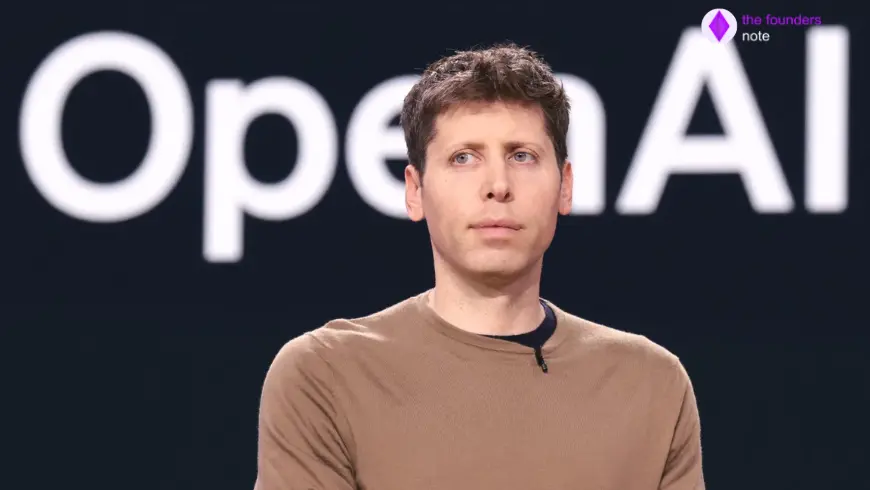
Sam Altman: The Visionary Leading the AI Revolution
From an eight-year-old taking apart a Macintosh in St. Louis to steering OpenAI through firing, reinstatement, and a trillion-dollar ambition — this is the full story behind ChatGPT’s most public face.

OpenAI
Early Life Origins
Samuel Harris Altman was born on April 22, 1985, in Chicago, Illinois, and grew up in St. Louis, Missouri. From a young age, he displayed a deep curiosity about technology and computers. His parents encouraged learning and creativity, giving him room to explore new ideas rather than steering him toward a fixed path.
At the age of eight, Sam received his first Macintosh computer — an experience that sparked a lifelong interest in programming and software. Unlike many children, he spent countless hours learning how computers actually worked rather than simply using them for entertainment, an early sign of the systems-level curiosity that would define his career.
Education Foundations
Altman attended John Burroughs School in St. Louis, where he developed strong analytical and leadership skills. After high school, he enrolled at Stanford University to study computer science. In 2005, after two years, he left Stanford before completing his degree — a decision he has compared to those made by Steve Jobs and Bill Gates, reasoning that building companies offered more immediate impact than staying in the classroom.
Loopt: The First Startup 2005
At just 19 years old, Altman co-founded Loopt, a location-based social networking app that let users share their real-time location with friends. Loopt became part of the Y Combinator accelerator’s very first batch and went on to raise tens of millions of dollars from investors.
Loopt never became a runaway consumer hit, but it gave Altman formative experience in building products, raising venture capital, managing teams, and navigating the inevitable setbacks of an early-stage company. In 2012, Loopt was acquired by Green Dot Corporation for roughly $43 million, giving Altman both a financial cushion and growing recognition in Silicon Valley. He used the proceeds to seed his own venture fund.
Journey with Y Combinator 2011–2019
After Loopt, Altman became a partner at Y Combinator, one of the world’s most successful startup accelerators, and in 2014 was named its President. Under his leadership, YC expanded significantly, backing companies including Airbnb, Stripe, DoorDash, and Reddit as they grew into major players in the technology industry.
Altman became known during this period for pushing founders to think bigger — to aim at global-scale problems rather than incremental ones, and to build for the long term instead of chasing short-term profit. He stepped back from day-to-day YC operations in 2019 to focus fully on OpenAI.
Founding OpenAI 2015
In 2015, Altman joined a group of technology leaders to establish OpenAI, including Greg Brockman, Ilya Sutskever, Elon Musk, John Schulman, and Wojciech Zaremba, with an initial funding pledge exceeding $1 billion. The organization’s founding goal was ambitious and explicit: to ensure that artificial general intelligence benefits all of humanity.
Unlike a typical software company, OpenAI began as a nonprofit research lab, later adopting a hybrid “capped-profit” structure in 2019 to attract the capital needed for frontier AI research, with Altman becoming CEO of the for-profit arm that same year.
What Is Artificial General Intelligence? Context
Artificial General Intelligence, or AGI, refers to AI systems capable of understanding, learning, and performing a wide variety of intellectual tasks at a level comparable to or exceeding humans — as opposed to “narrow” AI built for one specific task. OpenAI’s stated long-term mission has centered on researching and developing AGI responsibly, with an emphasis on safety and broad societal benefit rather than concentrated power.
OpenAI’s Major Innovations Products
Under Altman’s leadership, OpenAI released a rapid succession of increasingly capable models — GPT, GPT-2, GPT-3, GPT-3.5, GPT-4, GPT-4o, and later GPT-5 and GPT-5.2 — alongside tools like DALL-E for image generation, Whisper for speech recognition, and agent-style products including Operator and a “deep research” agent capable of independently investigating complex questions.
The Launch of ChatGPT Nov 2022
In November 2022, OpenAI launched ChatGPT, a conversational chatbot built on the GPT family of language models. The launch became one of the fastest-growing consumer technology products in history, with millions of users adopting it within weeks for writing, coding, research, education, customer support, translation, and everyday brainstorming.
The moment is widely credited with catalyzing the broader generative AI boom, pushing rivals across the industry to accelerate their own AI roadmaps and reshaping public expectations of what conversational software could do.
The November 2023 Firing Crisis
On November 17, 2023, Altman was abruptly removed as CEO by OpenAI’s board during a video call, with chief scientist Ilya Sutskever delivering the news. The board’s public statement said Altman “was not consistently candid in his communications with the board,” and Chief Technology Officer Mira Murati was named interim CEO. Later reporting indicated the board had also raised concerns about safety priorities being outpaced by rapid commercialization and about how Altman had communicated with directors.
The decision triggered an extraordinary backlash. Hundreds of OpenAI employees threatened to resign, Microsoft — OpenAI’s largest financial backer — publicly signaled support for Altman, and Greg Brockman resigned as board chairman in protest. Within five days, Altman was reinstated as CEO following a reconstituted board, in one of the most dramatic corporate reversals in recent tech history.
Restructuring & the Musk Lawsuit 2024–2026
In the years following his reinstatement, Altman pushed to convert OpenAI’s capped-profit structure into a more conventional for-profit entity capable of raising the kind of capital — Altman has cited figures in the trillions of dollars — he believes AGI-scale research ultimately requires. The plan drew sustained criticism from AI-safety advocates, former employees, nonprofit groups, and co-founder-turned-rival Elon Musk, who filed suit to block the restructuring and separately led a rejected $97.4 billion bid to buy the nonprofit outright in February 2025.
Facing mounting pressure, OpenAI reversed course in May 2025, announcing that its nonprofit, renamed the OpenAI Foundation, would retain ultimate control even as the for-profit arm became a Delaware public benefit corporation. That restructuring was formally completed in October 2025: the OpenAI Foundation holds a 26% stake, Microsoft holds roughly 27%, and employees and other investors hold the remainder. Musk’s litigation against Altman and OpenAI has continued into 2026, including a trial in which Musk testified that OpenAI “wouldn’t exist” without him; Musk has said he plans to appeal an adverse verdict.
Leadership Style Management
Altman is known for forward-thinking, optimistic leadership that emphasizes long-term ambition over short-term metrics. Colleagues and profiles describe his approach as encouraging innovation, backing ambitious bets, and trying to balance rapid capability progress with attention to AI safety — though critics argue the balance has tilted toward speed, particularly since ChatGPT’s runaway success.
He has repeatedly said he believes AI should enhance human capability rather than simply replace workers indiscriminately, a framing he and Anthropic’s Dario Amodei have both used, even as both have separately warned about near-term labor market disruption.
Business Philosophy Principles
Several recurring principles define Altman’s public approach to building companies: solve meaningful, large-scale problems; think in decades rather than fiscal quarters; invest heavily in talented people; embrace calculated, sometimes very large risks; and aim to build products capable of positively affecting billions of lives rather than a narrow market segment.
Personal Life & Marriage Family
Altman generally keeps his personal life private, though some details have become public over time. He is in a long-term relationship with Oliver Mulherin, an Australian software engineer and University of Melbourne graduate who previously worked at Meta. The couple, who split time between a home in San Francisco and a ranch in Napa Valley, married in a small seaside ceremony in January 2024, with around a dozen guests present. Their first child arrived via surrogacy in early 2025.
Altman has spoken about the internet being personally formative growing up in Missouri, describing it as a place where he made friends and learned as much as he did in school — an experience he has said resonated with many LGBTQ people of his generation. Outside of work, he has described interests in reading, science and technology discussions, and long-horizon investing in frontier research.
Investments & Other Ventures Portfolio
Beyond OpenAI, Altman has built one of the more unusual wealth profiles among major tech CEOs: rather than holding equity in the company he leads, his fortune comes almost entirely from independent venture investments made over roughly two decades. He has invested in more than 400 companies, including early stakes in Stripe (acquired for 2% equity in 2009) and Reddit, where he became one of the largest shareholders ahead of its 2024 IPO.
He has also co-founded Tools for Humanity, the company behind World (formerly Worldcoin), a proof-of-personhood and digital identity project, and has backed companies in nuclear fusion (Helion Energy), advanced nuclear reactors (Oklo), biotechnology (Retro Biosciences), and other frontier technology sectors including robotics, climate tech, and healthcare.
Net Worth Wealth
Altman’s financial profile is a genuine outlier among AI leaders: he holds no direct equity in OpenAI and has said so repeatedly under oath and in public testimony, drawing a base annual salary reported at roughly $65,000–$76,000 — an amount he has described as “whatever the minimum for health insurance is.” Forbes estimated his net worth at approximately $3.3–3.4 billion as of mid-2026, derived almost entirely from his outside venture portfolio rather than any stake in the company he leads; other outlets have published estimates ranging from roughly $1.2 billion to $6+ billion depending on how private holdings like Helion and Reddit are valued.
Altman does not currently hold OpenAI equity, meaning the person leading the world’s most talked-about AI company cannot directly cash in on its rising valuation unless a future restructuring changes that.
Major Achievements Highlights
OpenAI
ChatGPT
Y Combinator
Loopt
Restructuring
Reinstatement
Challenges & Controversies Scrutiny
Altman’s tenure has not been free of controversy. The November 2023 firing remains the most dramatic governance crisis in OpenAI’s history, and questions about candor with the board were central to it. His push to restructure OpenAI into a more traditional for-profit entity drew sustained criticism from safety advocates, former employees, and Elon Musk’s ongoing litigation, which continued into 2026 with a jury verdict Musk has said he intends to appeal.
OpenAI has also faced data-protection inquiries in the U.S. and EU following security issues, prompting a temporary halt to sign-ups and a public apology from Altman. Separately, in 2026 Altman was reportedly the target of an attempted attack at his home, and he has faced questions from lawmakers about potential conflicts of interest between his personal investment portfolio and OpenAI’s business decisions. Throughout, he has consistently advocated for closer collaboration between industry and government on AI regulation.
Awards & Recognition Recognition
2023
2023–2026
Congress
Industry
Quick Facts At a Glance
Full Name
Born
Hometown
Education
Current Role
Spouse
Children
OpenAI Equity
Est. Net Worth
Known For
Career Timeline Journey
Born in Chicago, Illinois; raised in St. Louis, Missouri.
Develops an early interest in computers after receiving a Macintosh at age eight.
Enters Stanford University to study computer science.
Leaves Stanford to co-found Loopt.
Loopt is acquired by Green Dot Corporation for about $43 million.
Becomes President of Y Combinator.
Co-founds OpenAI.
Steps back from YC to become CEO of OpenAI’s new for-profit arm.
OpenAI launches ChatGPT, sparking the generative AI boom.
Fired by the OpenAI board, then reinstated as CEO five days later.
Marries Oliver Mulherin in a seaside ceremony.
Musk-led group’s $97.4B bid to buy OpenAI’s nonprofit is rejected.
First child born via surrogacy.
OpenAI completes restructuring into a public benefit corporation.
Navigates Musk’s ongoing litigation while reportedly preparing OpenAI for a future IPO.
Frequently Asked Questions FAQ
Who is Sam Altman?
Sam Altman is an American entrepreneur, investor, and the CEO and co-founder of OpenAI, the company behind ChatGPT.
Is Sam Altman the founder of ChatGPT?
ChatGPT was developed by OpenAI’s research and engineering teams. Altman is a co-founder and CEO of OpenAI and played a key leadership role in bringing it to the public.
What is OpenAI?
OpenAI is an artificial intelligence research and deployment company, now structured as a public benefit corporation under nonprofit oversight, focused on developing AI that benefits humanity.
Did Sam Altman graduate from Stanford?
No. He left Stanford University in 2005, after two years, to pursue entrepreneurship.
Does Sam Altman own equity in OpenAI?
As of 2026, he holds no direct equity in OpenAI; his personal wealth comes from outside venture investments made over the past two decades.
Was Sam Altman really fired from OpenAI?
Yes. The OpenAI board removed him as CEO on November 17, 2023, before reinstating him five days later following employee and investor pressure.
Is Sam Altman married?
Yes, he married Oliver Mulherin, an Australian software engineer, in a seaside ceremony in January 2024, and the couple has one child born via surrogacy in early 2025.
From a Macintosh to a Movement
Sam Altman’s journey — from a curious eight-year-old in Missouri to the most public face of the generative AI era — shows how a willingness to bet on ambitious, unproven ideas can reshape an entire industry, for better and for worse.