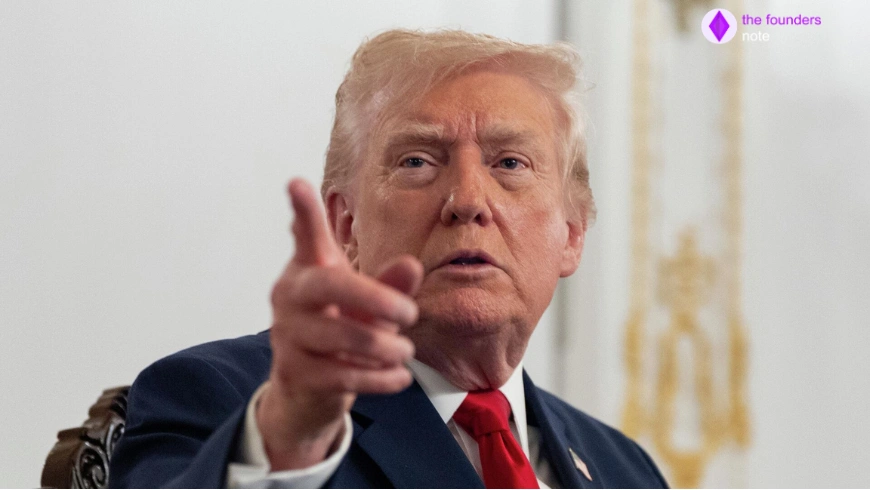
Donald J. Trump: From Queens Real Estate to the White House Twice
From collecting rent on his father’s Queens apartment buildings, to Manhattan skyscrapers, reality television, and two nonconsecutive terms as president — this is the complete story of Donald J. Trump.

President
Early Life & Family Origins
Donald John Trump was born on June 14, 1946, at Jamaica Hospital Medical Center in Jamaica, Queens, New York City. He was the fourth of five children of Fred Trump, a successful real estate developer, and Mary Anne MacLeod Trump, who had emigrated from Stornoway, Scotland, at age 18 and worked as a domestic servant in New York before marrying Fred. Fred Trump’s real estate company, Elizabeth Trump & Son (named for Fred’s mother and himself), built and managed middle-class rental housing across Queens, Staten Island, and Brooklyn. The family lived in the upscale Jamaica Estates neighborhood of Queens, and the three Trump sons — Fred Jr., Donald, and Robert — worked at the company’s construction sites and offices when they were old enough, while daughters Elizabeth and Maryanne did not.
Trump attended the Kew-Forest School, a private school in Forest Hills, Queens, beginning at age five. At 13, after his father discovered he had been secretly traveling into Manhattan and acquiring knives, Fred sent him to the New York Military Academy, a private boarding school, where he attended from 1959 to 1964. Trump later described the disciplined environment as “tough, but excellent training,” excelled at sports including baseball and soccer, and was named a cadet captain.
Education & Draft Deferments 1964–1968
After graduating from the military academy in 1964, Trump enrolled at Fordham University in the Bronx, studying economics. Seeking a larger business network — and with his father favoring the school’s prestige — he transferred early in his sophomore year to the Wharton School at the University of Pennsylvania, graduating in May 1968 with a Bachelor of Science in economics. He was not a member of any club, sports team, or fraternity at Penn. He has repeatedly claimed to have graduated first in his class at Wharton, but Wharton’s published academic honors and dean’s list from that era do not include his name, and he did not make the honor roll.
During the Vietnam War, Trump received four student deferments while at Fordham and Penn, then a fifth medical deferment in 1968 after a podiatrist diagnosed him with bone spurs in his heels, which he later said also allowed him to play sports. Two months later, in the first Vietnam draft lottery, his birth date drew number 356 out of 366, and he was never called into service.
Joining the Family Business 1968–1974
Trump began working full-time at Trump Management, his father’s company, in 1968, mainly collecting rent and overseeing repairs at the firm’s outer-borough apartment complexes for about five years. During the 1960s and early 1970s, Trump-owned housing developments in New York City, Cincinnati, and Norfolk, Virginia, were the subject of complaints alleging racial discrimination against Black applicants; in 1973, the Department of Justice sued Trump Management and Fred and Donald Trump, alleging violations of the Fair Housing Act. The company settled the suit in 1975 without admitting wrongdoing, agreeing to advertise vacancies to minority applicants.
Wanting to expand into Manhattan, where prices were higher, Trump moved there in 1971 against his father’s initial preference to stay in the outer boroughs; that year, Fred made himself chairman of the family company and Donald became its president, and Trump began using the name Trump Organization as an umbrella for his father’s various corporate entities (formally renamed in 1973). Attorney and fixer Roy Cohn became Trump’s most important mentor after his father, advising him for roughly 13 years through the 1970s and 1980s.
Manhattan Real Estate & Trump Tower 1976–1996
Trump’s first major Manhattan deal, in 1976, was redeveloping the bankrupt Penn Central Railroad’s Commodore Hotel into what became the Grand Hyatt. Though the Trump Organization lacked the money to buy the hotel outright, Trump used his father’s political connections and a relationship with the Hyatt chain to negotiate an unusual 40-year property tax abatement from New York City — worth roughly $400 million over its life once inflation and tax-code changes were factored in — to make the deal work.
In 1983, Trump completed Trump Tower, a 58-story luxury skyscraper on Fifth Avenue designed by architect Der Scutt, featuring shops, offices, condominium residences (including Trump’s own penthouse), and a five-story atrium with a 60-foot waterfall; it became both Trump Organization headquarters and a tourist attraction, and later the set for the NBC show The Apprentice. He also built the 36-story Trump Plaza cooperative apartment complex. In 1996, he acquired a vacant 70-story office tower at 40 Wall Street, renovated it, and rebranded it The Trump Building. In 1998, Trump and Conseco purchased the General Motors Building in Manhattan for $878 million, financed largely through a $700 million Lehman Brothers loan, with Trump reportedly contributing only $15–20 million of his own money.
Atlantic City Casinos & Bankruptcies 1982–2009
Trump received his first New Jersey casino license in March 1982 and, over the following decade, built a significant presence on the Atlantic City boardwalk: Harrah’s at Trump Plaza (1984, financed by Holiday Corp.), Trump Castle, and — his largest and most ambitious project — the nearly $1 billion Trump Taj Mahal, which he called the “eighth wonder of the world” when it opened in April 1990. At their peak, Trump’s Atlantic City casinos accounted for nearly a third of the city’s gambling revenue. But the ventures were heavily over-leveraged; the Taj Mahal alone could not cover $47.3 million in annual interest on $675 million in financing. In December 1990, with an $18.4 million interest payment due at Trump Castle, Fred Trump sent a lawyer to buy $3.3 million in casino chips to provide emergency cash — a transaction New Jersey regulators later ruled was effectively an illegal loan, fining the Castle $65,000.
Trump’s businesses filed for Chapter 11 bankruptcy protection six times between 1991 and 2009 — the Trump Taj Mahal (1991), Trump Plaza Hotel and Casino and the Plaza Hotel and Trump Castle (all 1992), and Trump Hotels & Casino Resorts, later Trump Entertainment Resorts (2004 and 2009) — while continuing to operate as banks restructured the underlying debt. Trump himself never filed for personal bankruptcy, though by the early 1990s he was personally responsible for more than $100 million in remaining debt and sold assets including the Trump Shuttle airline and his megayacht, the Trump Princess, to pay it down. Of the more than 70 banks that had lent Trump roughly $4 billion during the 1980s, only Deutsche Bank continued lending to him after the early-1990s bankruptcies (Deutsche Bank itself cut ties following the January 6, 2021 Capitol attack). Trump later described his approach candidly: “I’ve used the laws of this country to pare debt. … We’ll have the company. We’ll throw it into a chapter. We’ll negotiate with the banks. … It’s not personal. It’s just business.” His final Atlantic City property, the Trump Taj Mahal, closed permanently in October 2016.
Licensing, Trump University & the Trump Brand 1990s–2016
As his real estate and casino businesses struggled, Trump increasingly shifted toward ventures that required little of his own capital, especially licensing the Trump name to hotels, golf courses (17 globally by 2016), and consumer products including food, apparel, and home furnishings. He acquired the Mar-a-Lago estate in Palm Beach, Florida, in 1985, converted it into a private club in 1995, and later declared it his primary residence in 2019. A 2018 USA Today review of state and federal court files found Trump and his businesses had been involved in more than 4,000 lawsuits, liens, and other legal filings, many involving nonpayment claims from employees, contractors, and even his own attorneys.
Trump University, a for-profit venture launched in 2005 offering real estate seminars, drew multiple lawsuits alleging consumer fraud; after the 2016 election, Trump paid $25 million to settle the suits without admitting wrongdoing. He also shut down his charitable nonprofit, the Trump Foundation, after reporting revealed he had not contributed his own money to it since 2008 and had instead used it to distribute funds solicited from others, in ways New York’s attorney general said involved unlawful “self-dealing.”
The Apprentice & Media Career 2004–2015
Producer Mark Burnett turned Trump into a television star with The Apprentice, which aired on NBC from 2004 to 2015 (including the spin-off Celebrity Apprentice). Trump played a superrich chief executive who eliminated contestants with the catchphrase “you’re fired”; the show and related licensing deals earned him more than $400 million, and reshaped his public image — described by the New York Times as “a highly flattering, highly fictionalized version” of himself — for a national audience largely unfamiliar with his earlier financial troubles. NBCUniversal ended its relationship with Trump only after he formally launched his 2016 presidential campaign with remarks about Mexican immigrants that the network deemed unacceptable. Trump also partly or fully owned several beauty pageants, including Miss Universe, between 1996 and 2015.
Entering Politics & the 2016 Campaign 2015–2016
Trump had flirted with running for president for decades, briefly seeking the Reform Party’s nomination in 2000 before withdrawing, and changed his political party registration multiple times over the years (Republican, independent, Democrat, and back to Republican). He formally declared his 2016 candidacy in June 2015, positioning himself as a political outsider and populist, with a platform emphasizing renegotiating trade deals like NAFTA, immigration enforcement including a proposed border wall with Mexico, and skepticism of NATO and international climate agreements. He secured the Republican nomination and, running with Indiana Gov. Mike Pence, defeated Democratic nominee and former Secretary of State Hillary Clinton in the November 2016 election, becoming the first president in American history without prior public office or military service. A subsequent U.S. intelligence and Special Counsel investigation led by Robert Mueller concluded Russia had interfered in the election to help Trump’s campaign, though it did not establish that Trump’s campaign had criminally conspired with Russia.
First Presidency: Domestic Policy 2017–2021
Trump was inaugurated as the 45th president on January 20, 2017; the following day, an estimated 2.6 million people worldwide, including roughly 500,000 in Washington, D.C., took part in Women’s Marches protesting his presidency. In his first two weeks, he signed 18 executive orders, including steps toward repealing the Affordable Care Act, withdrawing from Trans-Pacific Partnership talks, advancing the Keystone XL and Dakota Access pipelines, and planning a border wall. During his term, the U.S. built 73 miles of new border wall and replaced 365 miles of older barrier, and his administration reduced the annual refugee admissions cap from 110,000 to 15,000 by 2021. A 2018 dispute over wall funding led to a then-record 35-day government shutdown from December 2018 into January 2019.
Trump signed the Tax Cuts and Jobs Act, reforming the tax code, and appointed three U.S. Supreme Court justices — Neil Gorsuch, Brett Kavanaugh, and Amy Coney Barrett — the most confirmed by any one-term president since Herbert Hoover. His administration pursued deregulation, expanded the military, and worked to defeat the Islamic State (ISIS). His first term also saw an unprecedented rate of White House staff turnover: 34 percent of his original staff had resigned, been fired, or been reassigned within his first year.
First Presidency: Foreign Policy 2017–2021
Trump withdrew the United States from the Paris Climate Agreement and the Iran nuclear deal, moved the U.S. embassy in Israel from Tel Aviv to Jerusalem, and brokered the Abraham Accords normalizing relations between Israel and several Arab states. He met North Korean leader Kim Jong Un three times, becoming the first sitting U.S. president to meet a North Korean leader, and ordered the 2020 assassination of Iranian general Qasem Soleimani, sharply escalating tensions with Iran. His administration negotiated a conditional agreement with the Taliban for a U.S. troop withdrawal from Afghanistan, which was completed under his successor in 2021.
First Impeachment 2019–2020
Following a whistleblower complaint that Trump had pressured Ukraine’s president to announce investigations into Joe Biden and his son Hunter while withholding congressionally approved military aid, the Democratic-controlled House impeached Trump on December 18, 2019, on charges of abuse of power and obstruction of Congress — making him the third U.S. president ever impeached. The Senate acquitted him on both counts on February 5, 2020, with no votes to convict reaching the required two-thirds threshold; he remained in office for the rest of his term.
COVID-19 Pandemic 2020
The first confirmed U.S. COVID-19 case was reported on January 20, 2020, and the remainder of Trump’s first term was dominated by the pandemic response. Critics argued his administration’s response was delayed and did not sufficiently promote public health measures such as masking; his administration’s Operation Warp Speed program, however, is credited with helping accelerate private-sector development of two authorized vaccines within roughly a year. The May 2020 murder of George Floyd during this period also triggered nationwide protests over police brutality.
2020 Election, January 6 & Second Impeachment 2020–2021
Trump lost the November 2020 election to Democratic nominee Joe Biden, becoming the first incumbent president since 1992 to lose a re-election bid, having lost both the Electoral College and popular vote. Starting in early 2020 and continuing after his loss, Trump repeatedly and falsely claimed the election had been rigged through massive fraud, and pressed numerous state officials — including a recorded January 2, 2021 call in which he urged Georgia Secretary of State Brad Raffensperger to “find” enough votes to overturn Biden’s win there — to reverse the results.
On January 6, 2021, as Congress met to formally certify Biden’s victory, Trump addressed a rally near the White House and urged supporters to march to the Capitol. A mob of his supporters then stormed the Capitol building, temporarily halting the certification and forcing the evacuation of Vice President Mike Pence and members of Congress; at least five people died in connection with the attack, including a Capitol Police officer. On January 13, 2021, the House impeached Trump a second time — on a single article for “incitement of insurrection” — making him the only U.S. president impeached twice. The Senate trial, held after Trump had already left office, ended in acquittal on February 13, 2021, with seven Republican senators joining all Democrats in voting to convict, short of the two-thirds needed.
Post-Presidency Legal Cases 2021–2025
After leaving office, Trump faced an unprecedented number of criminal and civil cases. In September 2023, a New York judge found Trump liable for business fraud, having inflated his net worth to obtain favorable loan terms, and later ordered him to pay roughly $355–454 million in penalties (a figure that grew with interest); in August 2025 an appeals court upheld the underlying fraud finding but threw out the financial penalty as an unconstitutionally “excessive fine,” while upholding restrictions on Trump Organization business practices — a ruling New York’s attorney general has continued to appeal.
Writer E. Jean Carroll brought two civil suits against Trump alleging sexual abuse and defamation; a 2023 jury found him liable for sexual abuse (though not rape) and defamation, awarding Carroll roughly $5 million, and a second 2024 trial awarded her a further $83.3 million in defamation damages, a verdict a federal appeals court upheld in 2025. Separately, Manhattan District Attorney Alvin Bragg charged Trump in 2023 with falsifying business records to conceal hush-money payments to adult-film actress Stormy Daniels ahead of the 2016 election; a jury convicted him on all 34 felony counts on May 30, 2024, making him the first U.S. president or former president convicted of a crime. In January 2025, days before his second inauguration, the presiding judge sentenced Trump to an “unconditional discharge” — leaving the conviction on his record with no jail time, fine, or probation — while Trump’s appeal of the conviction has continued.
Two separate federal cases brought by Special Counsel Jack Smith — one over Trump’s alleged mishandling of classified documents after leaving office, another over his efforts to overturn the 2020 election — were both dismissed following Trump’s 2024 election win, under long-standing Justice Department policy against prosecuting a sitting president. A related Georgia state racketeering case, alleging a conspiracy to overturn the state’s 2020 results, stalled after an appeals court disqualified the lead prosecutor and was ultimately dropped by her successor.
2024 Campaign & Assassination Attempts 2023–2024
Trump announced his 2024 candidacy in November 2022 and secured the Republican nomination, campaigning on immigration enforcement, tariffs to boost American manufacturing, and reducing federal regulation. On July 13, 2024, while speaking at an outdoor rally near Butler, Pennsylvania, Trump was shot and wounded in the upper right ear by 20-year-old Thomas Crooks, who fired eight rounds from a rooftop with an AR-15-style rifle before being killed by Secret Service counter-snipers; the attack also killed rallygoer Corey Comperatore and critically injured two others. Trump was rushed off stage bleeding, and raised his fist to the crowd as he was escorted away — an image that became iconic within his movement. Two days later he named Ohio Sen. JD Vance as his running mate, and he addressed the Republican National Convention in Milwaukee that week with a bandage over his ear. A second apparent assassination attempt occurred in September 2024 at his golf course in Florida, and a man was separately arrested with firearms near an October 2024 rally in California. The security failures behind the Butler shooting prompted the resignation of Secret Service Director Kimberly Cheatle and a congressional review.
2024 Election Victory November 2024
In November 2024, Trump defeated Democratic nominee and sitting Vice President Kamala Harris (who had replaced Joe Biden as the Democratic nominee after Biden withdrew from the race that July), winning 312 electoral votes and a plurality of the popular vote. The victory made him only the second U.S. president, after Grover Cleveland, to serve two nonconsecutive terms.
Second Presidency: Domestic Policy 2025–Present
Trump was inaugurated as the 47th president on January 20, 2025, signing more than 200 executive actions within hours, including rescinding nearly 80 Biden-era orders and pardoning roughly 1,500 people convicted in connection with the January 6 Capitol attack. He established the Department of Government Efficiency (DOGE), initially led by businessman Elon Musk, which oversaw mass layoffs of federal employees (nearly 10,000 by February 2025) and moved to dismantle agencies including USAID; Musk’s promised savings target shrank over time from $2 trillion to roughly $150 billion, and independent analyses disputed DOGE’s own savings claims, while Musk stepped back from the role by mid-2025 amid a high-profile public falling-out with Trump.
Trump signed the One Big Beautiful Bill Act, permanently extending his first-term tax cuts while adding an estimated $3 trillion to the deficit by 2034. His administration imposed sweeping tariffs — including a universal 10 percent tariff and higher country-specific rates announced in April 2025 as “Liberation Day,” which triggered a stock market selloff — before rolling out a mix of pauses, country-by-country deals (including a July 2025 agreement with the European Union for 15 percent tariffs), and a temporary tariff truce with China. In August 2025, a federal appeals court ruled many of the tariffs invalid under the law Trump had cited, and in February 2026 the Supreme Court ruled 6–3 that the International Emergency Economic Powers Act did not authorize the tariffs at all, striking them down. The first quarter of 2025 saw negative GDP growth of -0.5 percent, followed by growth of 3.8 percent and 4.3 percent in the following two quarters; consumer sentiment nonetheless fell to record lows by April 2026 amid rising inflation. On immigration, Trump signed the Laken Riley Act, sought to restrict birthright citizenship by executive order (a move facing ongoing legal challenges), and dramatically expanded ICE enforcement and deportations, with the U.S. recording negative net migration in 2025 for the first time in at least 50 years. His administration also moved to reduce the federal government’s role in DEI initiatives, higher education oversight, and gender-related policy, while a lengthy government shutdown extended into late 2025.
Second Presidency: Foreign Policy 2025–Present
Trump’s second-term foreign policy has combined aggressive unilateral action with mediation efforts. He helped broker a Gaza ceasefire and 20-point peace plan between Israel and Hamas beginning in October 2025, though implementation has stalled amid continued violence and unresolved questions over Hamas’s disarmament. In June 2025, the U.S. carried out “Operation Midnight Hammer,” striking Iranian nuclear facilities alongside Israel; in February 2026, following renewed tensions and Iranian domestic protests, the U.S. and Israel launched a further major attack on Iran with the stated goal of regime change. Trump has pursued a warmer relationship with Russian President Vladimir Putin in pursuit of ending the Russia-Ukraine war — including hosting a summit with Putin in Alaska — while pressuring Ukraine toward territorial concessions, a stance criticized by many U.S. allies; as of 2026 the war remained unresolved. His administration also carried out military strikes against alleged drug traffickers in the Caribbean and eastern Pacific, captured former Venezuelan president Nicolás Maduro in a January 2026 operation, brokered agreements including one between Armenia and Azerbaijan, floated proposals to acquire Greenland and retake control of the Panama Canal, and withdrew the U.S. from multilateral bodies including the World Health Organization. By early 2026, Gallup polling showed Trump’s approval rating had fallen to around 36 percent, down from 47 percent at his second inauguration.
Personal Life & Family Family
Trump has been married three times. His first marriage, to Czech-born model Ivana Zelníčková, lasted from 1977 to 1992 and produced three children: Donald Jr. (b. 1977), Ivanka (b. 1981), and Eric (b. 1984). He married actress Marla Maples in 1993; they had a daughter, Tiffany (b. 1993), before divorcing in 1999. In 2005 he married Slovenian-born model Melania Knauss, with whom he has a son, Barron (b. 2006); Melania became First Lady during both of his presidencies. Ivanka is married to Jared Kushner, who served as a senior White House adviser during Trump’s first term; Eric is married to Lara Trump, a Republican National Committee co-chair; and Tiffany is married to Michael Boulos. Trump’s parents, Fred and Mary Anne Trump, are both deceased, as is his older brother, Fred Jr., whose struggles with alcoholism Trump has cited as an influence on his own lifelong abstinence from alcohol and tobacco.
Net Worth Wealth
Trump’s fortune, historically concentrated in real estate and licensing, has shifted substantially during his second term toward cryptocurrency ventures. Forbes estimated his net worth at roughly $6.5–7.3 billion in 2026 (Bloomberg’s estimate ran closer to $7.1 billion), a roughly $3 billion increase over the prior year that Forbes attributed largely to his crypto ventures — including the World Liberty Financial platform, co-founded with his sons, and a personal memecoin — which together added an estimated $2 billion, alongside growing international licensing deals. The gain moved him up 118 spots to No. 201 on the 2025 Forbes 400 list. Several of his adult children have also built significant independent fortunes during his second term, notably through crypto ventures such as American Bitcoin (co-founded by Eric Trump and Donald Trump Jr.) and World Liberty Financial, in which youngest son Barron holds an early stake reportedly worth around $150 million, with potentially hundreds of millions more in currently locked tokens.
Net Worth & Trump Media Stock Interactive Chart
The chart below tracks Donald Trump’s estimated net worth from the late 1980s through 2026, alongside the share price of Trump Media & Technology Group (NASDAQ: DJT) since its 2024 public listing — his single most-watched publicly traded asset. Use the toggle buttons to isolate either series, and hover or tap any point for the exact figure.
Net worth figures are Forbes’ historical estimates (1989, 1996, 2007, 2015–2026); Trump has long disputed Forbes’ methodology as too conservative. DJT stock price reflects year-end closing prices and is only plotted from 2024 onward, since Trump Media went public via SPAC merger in March 2024. Figures are approximate and sourced from Forbes, Bloomberg, and public market data.
Significance & Legacy Impact
Donald Trump's career — spanning real estate, reality television, and two nonconsecutive presidential terms — has been among the most consequential and polarizing in modern American history. Supporters credit him with reshaping the Republican Party around economic nationalism and immigration enforcement, appointing a decisive conservative majority to the Supreme Court, and pursuing aggressive dealmaking on trade and foreign policy that they argue has produced real, if incomplete, results on fronts from Gaza to Middle East normalization. Critics point to his unprecedented legal record — two impeachments, a felony conviction, and multiple civil liability findings — his role in the events of January 6, 2021, his many false or misleading public statements documented by fact-checkers throughout both campaigns and administrations, and his second-term efforts to expand executive power in ways that have drawn extensive litigation and eroded some long-standing institutional norms. Whichever lens is applied, Trump's business empire, media stardom, and status as the only person other than Grover Cleveland to serve two nonconsecutive presidential terms have made him one of the most closely studied figures in contemporary American public life.
Quick Facts At a Glance
Full Name
Born
Education
Current Position
Party
Vice President
Business
Spouse
Children
Est. Net Worth
Milestone Timeline Journey
Born in Queens, New York City.
Graduates from the Wharton School with a degree in economics; joins his father's real estate company.
Becomes president of the family business, later renamed the Trump Organization.
Redevelops the Commodore Hotel into the Grand Hyatt, his first major Manhattan deal.
Completes Trump Tower on Fifth Avenue.
Opens the Trump Taj Mahal casino in Atlantic City.
Trump-owned casino and hotel businesses file for Chapter 11 bankruptcy six times.
The Apprentice premieres on NBC.
Wins the presidential election, defeating Hillary Clinton.
Inaugurated as the 45th president.
Impeached for the first time by the House; acquitted by the Senate in February 2020.
COVID-19 pandemic dominates the final year of his first term; loses re-election to Joe Biden.
Supporters storm the U.S. Capitol on January 6; Trump is impeached a second time.
Found liable for sexual abuse and defamation in the E. Jean Carroll case; found liable for business fraud in New York.
Convicted on 34 felony counts in the New York hush-money case.
Survives an assassination attempt at a rally in Butler, Pennsylvania.
Defeats Kamala Harris, winning a second, nonconsecutive presidential term.
Sentenced to an unconditional discharge in the hush-money case; inaugurated as the 47th president.
Launches DOGE with Elon Musk; imposes sweeping tariffs; brokers a Gaza ceasefire.
Supreme Court strikes down his IEEPA tariffs; U.S. and Israel launch a major attack on Iran; approval ratings decline amid economic uncertainty.
Frequently Asked Questions FAQ
Who is Donald Trump?
Donald J. Trump is an American real estate developer, media personality, and politician who served as the 45th president of the United States from 2017 to 2021 and is currently serving as the 47th president since January 2025.
Why is Trump called both the 45th and 47th president?
Because he served two nonconsecutive terms — losing re-election in 2020 before winning again in 2024 — making him only the second person in U.S. history to do so, after Grover Cleveland.
What is Donald Trump's educational background?
He earned a Bachelor of Science in economics from the Wharton School at the University of Pennsylvania in 1968, after two years at Fordham University.
How many times has Trump been impeached?
Twice — in 2019 for abuse of power and obstruction of Congress, and in 2021 for incitement of insurrection following the January 6 Capitol attack. The Senate acquitted him both times.
Was Donald Trump convicted of a crime?
Yes. In May 2024, a Manhattan jury convicted him on 34 felony counts of falsifying business records related to hush-money payments; in January 2025 he was sentenced to an unconditional discharge, with no jail time, fine, or probation, though the conviction remains on his record pending appeal.
What is Donald Trump's net worth?
Estimates for 2026 place his net worth at roughly $6.5 billion to $7.3 billion, with much of his recent wealth growth attributed to cryptocurrency ventures rather than his traditional real estate and licensing business.
Who is in Donald Trump's family?
He has five children — Donald Jr., Ivanka, and Eric from his marriage to Ivana Trump; Tiffany from his marriage to Marla Maples; and Barron from his current marriage to Melania Trump.
An Unprecedented American Story
From a Queens apartment complex to Fifth Avenue, from reality television to the Oval Office twice over, Donald Trump's life has repeatedly defied the conventional arc of American business and political careers — for supporters and critics alike.