
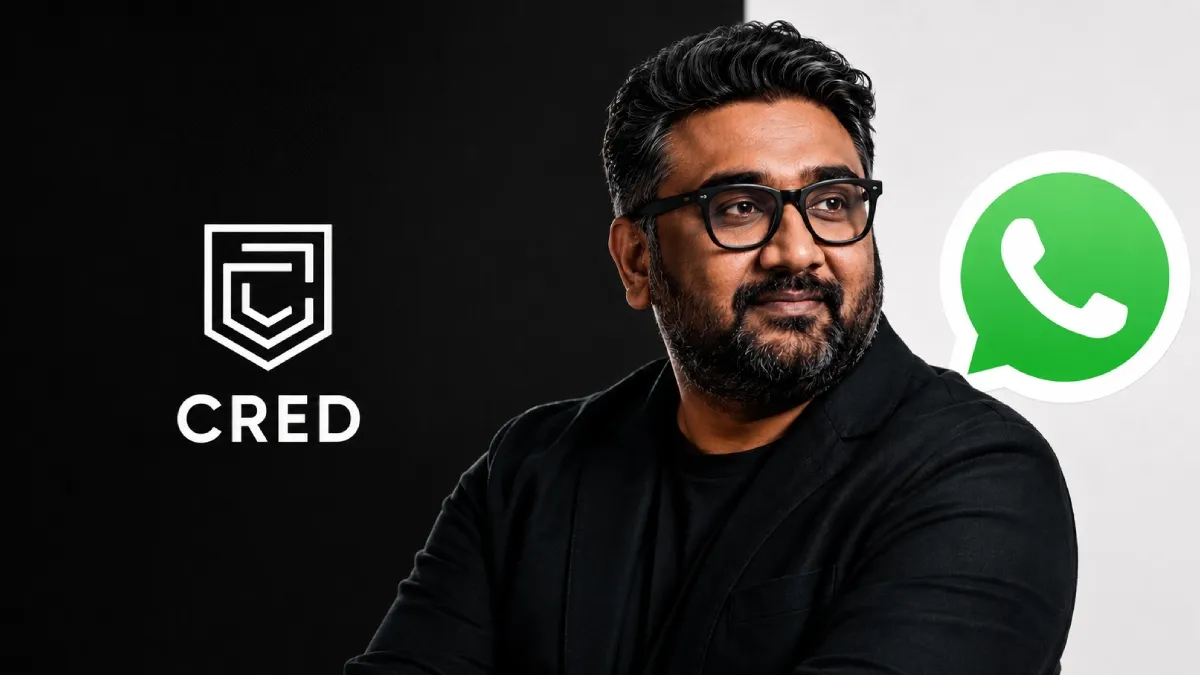

Kunal Shah
Philosophy graduate. MBA dropout. The man who built India’s most exclusive fintech platform — and now leads the world’s largest messaging app for 3.3 billion people.
MBA NMIMS — Dropped Out
- The Boy Who Worked at 15
- Philosophy, Not Engineering — The Unconventional Path
- PaisaBack to FreeCharge — First Big Bet
- The CRED Idea — Rewarding Trust
- What CRED Became — Numbers Tell the Story
- The Meta Move — WhatsApp Global CEO
- Angel Investor — Betting on India’s Future
- The Delta 4 Theory — Kunal Shah’s Business Philosophy
- FAQs — Everything You Want to Know
The Boy Who Worked at 15
Kunal Shah’s story doesn’t begin in a plush Mumbai apartment or a top-tier college dorm. It begins in a family that hit a financial wall — the kind that forces a teenager to grow up fast.
At just 15 years old, Kunal started working to help his family through a financial crisis. While most kids his age were focused on board exams and cricket, Kunal was juggling odd jobs, developing a sharp instinct for money, business, and the gap between what people needed and what the market was giving them.
He kept working through college — picking up freelance design and programming gigs — learning how to build things before he had any formal technical training. That restlessness, that hustle-before-the-degree energy, never left him.
“I often learned more outside the classroom than inside it.”
— Kunal Shah, in multiple interviews on his entrepreneurial philosophyPhilosophy, Not Engineering — The Unconventional Path
When most ambitious Indian students were chasing engineering seats at IITs and NITs, Kunal Shah took a different road. Unable to pursue a conventional engineering degree due to family finances, he enrolled in a Bachelor of Arts in Philosophy at Wilson College, Mumbai.
Philosophy taught him something no management textbook could: how to question first principles, identify flawed assumptions, and think in systems. He later enrolled in an MBA program at Narsee Monjee Institute of Management Studies (NMIMS) — and dropped out within a year, choosing the school of entrepreneurship instead.
In India’s startup ecosystem, his educational background became somewhat legendary. A Philosophy graduate and MBA dropout who went on to build two of India’s most important fintech companies and ultimately became the first Indian CEO of WhatsApp — it is a story that punches through every stereotype about what success requires.
When Meta announced Kunal Shah as WhatsApp’s global CEO in June 2026, the two facts that went most viral on Indian social media were: his Philosophy degree from Wilson College, and that he never finished his MBA. Within 24 hours, searches for “Wilson College Mumbai Philosophy” spiked 900% on Google India.
PaisaBack to FreeCharge — First Big Bet
Before CRED, before the fame, before the angel portfolio — there was PaisaBack. A small but clever SaaS platform that ran cashback and promotional discount campaigns for retailers. It was Kunal’s first real company, built on a simple insight: people love getting money back. Brands love retaining customers. Why isn’t there infrastructure connecting these two needs?
PaisaBack was the prototype. The real product was what it became.
In 2010, Kunal co-founded FreeCharge with Sandeep Tandon. The idea: let people recharge their mobile phones online, earn cashback equivalent to the recharge amount — effectively making the recharge free. India’s digital payments ecosystem was barely crawling at the time. There was no UPI, no widespread internet banking, no comfort with online transactions.
FreeCharge changed the game. Millions signed up, attracted by the cashback model. The platform expanded beyond mobile recharges into utility bill payments, DTH, and more. It became one of India’s fastest-growing consumer internet companies.
In 2015, Snapdeal acquired FreeCharge in a deal widely reported at approximately $400–450 million (₹2,800 crore) — at that time, one of the largest startup acquisitions in Indian history. Kunal continued overseeing operations before exiting in 2016. He had his first major exit. He was still in his 30s.
The CRED Idea — Rewarding Trust
After FreeCharge, Kunal spent time as an angel investor — backing early-stage startups, attending YC as a part-time partner, advising founders. But a question kept nagging him: Why is there no system that rewards responsible financial behavior?
India had 50 million+ credit card holders — people who were creditworthy, financially disciplined, high-income — and yet nobody was rewarding them for paying bills on time. The opposite, in fact: banks were profiting from the small percentage who paid late.
In 2018, Kunal founded CRED with $1 million of his own capital. The proposition was elegant: pay your credit card bills through CRED and earn CRED Coins — redeemable for exclusive rewards, products, and experiences. But there was a catch that made CRED unlike anything else in India: you could only join if your credit score was above 750.
CRED was, by design, exclusive. In a country where most apps chase maximum users, Kunal deliberately limited who could sign up. The exclusivity wasn’t a bug — it was the product.
“CRED is built for trustworthy people. The entire premise is that being financially responsible should be recognized and rewarded.”
— Kunal Shah on CRED’s founding philosophyWhat CRED Became — Numbers Tell the Story
Critics initially questioned CRED’s model. Burning money on rewards for people who already had credit cards? How does this make money? But Kunal had a longer vision: once you have India’s most creditworthy users on one platform, the product possibilities are enormous.
CRED expanded from bill payments into lending (CRED Cash), commerce (CRED Store), rent payments, travel bookings, insurance, and wealth management. Each product designed for the same high-trust user base.
And then, in June 2026 — just as CRED reported its first ever profitable quarter — Meta led a $900 million investment round valuing CRED at $4.5 billion. The company Kunal started with $1 million of his own money had become a multi-billion-dollar institution.
The Meta Move — WhatsApp Global CEO
On June 22, 2026, Mark Zuckerberg made the announcement: Kunal Shah would become the new Global CEO of WhatsApp, succeeding Will Cathcart who had led the platform since 2019.
WhatsApp is not just a product. It is infrastructure. With 3.3 billion monthly active users, it is the world’s most widely used communication platform. India alone accounts for 500 million+ users — making it WhatsApp’s single largest market by far.
Zuckerberg’s logic was explicit: Shah’s experience building consumer products in India — the world’s most competitive and diverse digital market — made him ideally suited to lead WhatsApp’s next chapter. Shah will relocate from Bengaluru to Meta’s headquarters in Menlo Park, California, becoming the first Indian CEO of WhatsApp in its history.
On LinkedIn, Shah wrote: “While WhatsApp has already achieved massive scale, its full potential is still far from realized.” Coming from someone who built two fintech companies from scratch, that sentence carries weight.
WhatsApp’s Agenda Under Kunal Shah
- Scale WhatsApp Pay across India and eventually other markets — Shah’s fintech DNA is central to this mission
- Deepen WhatsApp Business tools for SMBs, enterprises, and CRM-style commerce integrations
- Embed Meta AI natively into WhatsApp conversations, search, and smart replies
- Expand Channels and Communities for creator economy and group commerce
- Convert WhatsApp from a communication app into a full commerce and financial services platform
Angel Investor — Betting on India’s Future
Beyond his own ventures, Kunal Shah is one of India’s most prolific and respected angel investors. He has backed 200+ startups across fintech, edtech, consumer internet, logistics, and entertainment — often writing early checks that helped companies find their first institutional believers.
He has served as a part-time partner at Y Combinator — the world’s most prestigious startup accelerator — and as an advisor to Sequoia Capital. He has also served as a Business Advisor to Bennett Coleman & Co. Ltd. (Times Group) and AngelList.
The Delta 4 Theory — Kunal Shah’s Business Philosophy
Kunal Shah is not just known for what he built — but for how he thinks. His most discussed intellectual contribution is the Delta 4 framework for evaluating business ideas.
The concept is simple but powerful: if a new product or service is only slightly better than the existing solution, users will not abandon the old behavior. But if it’s at least 4 points better on an efficiency scale — if switching back becomes psychologically painful — you have a truly sticky product that creates real behavior change.
Shah used this lens to design CRED: paying credit card bills was already possible through banking apps. But CRED made it meaningfully better — rewards, seamless UX, financial insights, exclusive access — enough to create a habitual switch that users wouldn’t reverse. That’s Delta 4 in practice.
His Twitter threads and public talks on this framework have been shared widely across India’s startup community, making him one of the most quoted thinkers in the Indian entrepreneurial ecosystem.
“Most products are incrementally better. They don’t change behavior. Only delta 4 products create irreversible behavior change.”
— Kunal Shah, Delta 4 FrameworkFrom Mumbai to Menlo Park
The Full Journey — Visualized & Explained
This timeline infographic captures every defining milestone in Kunal Shah’s life — from a family financial crisis in 1998 to being appointed Global CEO of WhatsApp in 2026. Here’s what each moment meant, in detail.

Every Milestone — Explained
The year that shaped everything. Kunal Shah’s family faced a serious financial crisis when their business collapsed. In most families, this kind of blow leaves lasting damage. For Kunal, it became a formative teacher. He watched his family navigate loss, debt, and the grinding reality of rebuilding — and absorbed lessons about money, resilience, and survival that no business school could have offered. The hardship lit a fire.
Same year, different chapter. While most Indian teenagers of his age were focused on coaching classes and board exams, 15-year-old Kunal stepped into the workforce to help his family. He took on freelance jobs — design, programming, whatever he could do — building real-world skills while his peers were still in theory. This early exposure to earning, selling, and building taught him something textbooks rarely do: that problems are just opportunities in disguise, and that learning happens fastest under pressure.
After years of building small ventures and developing his thinking, Kunal co-founded FreeCharge with Sandeep Tandon. The product was deceptively simple: recharge your mobile online and earn cashback equal to the recharge amount — effectively making it free. But the insight behind it was sharp. Kunal saw that India’s mobile users were paying for something they considered a utility necessity, and he asked: why can’t we make this feel like a reward? FreeCharge turned a transactional moment into a delightful one. Millions of users agreed. The platform exploded.
In 2015, Snapdeal acquired FreeCharge in a deal widely reported at $400–450 million — one of the largest startup acquisitions in Indian history at the time. For context: this was a company that Kunal and Sandeep had built from near-zero, in a country where digital payments were still a novelty. The exit validated not just FreeCharge’s model, but Kunal’s instinct that consumer fintech in India was going to be massive. He stayed on to oversee operations before exiting in 2016. His first big bet had paid off enormously.
Post-FreeCharge, Kunal didn’t rush into another venture. Instead, he spent nearly two years in a deliberate investing and learning phase. He backed 200+ early-stage startups — companies like Razorpay, BharatPe, Unacademy, Spinny, Mobile Premier League, TVF, Rupeek, and many more. He also joined Y Combinator as a part-time partner, where he was exposed to the best startup thinking from around the world. This wasn’t idle time — it was pattern recognition at scale. Kunal was essentially paying himself to study what makes companies work and fail across every sector.
Armed with the FreeCharge experience, two years of investor learnings, and a burning insight — that India’s most creditworthy citizens were being ignored and unrewarded — Kunal founded CRED in 2018 with $1 million of his own capital. CRED’s premise was radical by Indian startup standards: not everyone can join. You needed a credit score of 750+ to even get in. No mass-market approach. No chasing Daily Active Users at any cost. Instead: a premium, members-only fintech club that rewarded financial responsibility. Critics called it elitist. Kunal called it focused.
By 2025, CRED had 17 million monthly active members — a number that sounds modest compared to mass-market apps with hundreds of millions, but means something very different in context. These 17 million people represent India’s highest-credit-score population: HNIs, salaried professionals, high-spending consumers. CRED was processing over 40% of all credit card bill payments in India. Revenue hit ₹2,735 crore in FY25. And for the first time, CRED reported its first profitable quarter in early 2026 — proving that the premium model worked. The skeptics had been wrong.
On June 22, 2026, Meta CEO Mark Zuckerberg confirmed that Kunal Shah would succeed Will Cathcart as the Global CEO of WhatsApp. Simultaneously, Meta led a $900 million investment in CRED, valuing the company at $4.5 billion. Kunal stepped down as CRED’s CEO (retaining his shareholding) and relocated from Bengaluru to Menlo Park, California. He became the first Indian to lead WhatsApp — a platform used by 3.3 billion people globally, with 500 million+ in India alone. From a family financial collapse in Mumbai in 1998 to the CEO’s chair at the world’s largest messaging app in 2026. That’s the arc. That’s the journey.
❓ Frequently Asked Questions — Kunal Shah
Who is Kunal Shah?
Kunal Shah is an Indian entrepreneur, angel investor, and the founder of CRED — India’s members-only credit card bill payment and rewards platform. In June 2026, Meta appointed him as the Global CEO of WhatsApp, making him the first Indian to lead the world’s largest messaging platform with 3.3 billion users.
What is Kunal Shah’s educational background?
He holds a BA in Philosophy from Wilson College, Mumbai. He subsequently enrolled in an MBA at Narsee Monjee Institute of Management Studies (NMIMS) but dropped out within a year to pursue entrepreneurship full-time. His unconventional educational path became famous when Meta announced his WhatsApp appointment.
What is CRED and what did Kunal Shah build it into?
CRED is a members-only fintech platform founded by Kunal Shah in 2018 that started by rewarding users for paying credit card bills on time. Under Shah, it grew to 17M+ monthly active users, processed 40%+ of India’s credit card bill payments, expanded into lending, insurance, travel, and wealth management, hit ₹2,735 crore revenue in FY25, achieved its first profitable quarter in Q1 2026, and was valued at $4.5 billion after Meta’s $900M investment.
What was FreeCharge and what happened to it?
FreeCharge was a digital payments and mobile recharge platform co-founded by Kunal Shah and Sandeep Tandon in 2010, offering cashback that effectively made recharges free. Snapdeal acquired it in 2015 for approximately $400–450 million (₹2,800 crore) — one of India’s biggest M&A deals at the time. Axis Bank subsequently acquired FreeCharge from Snapdeal in 2017.
Why did Meta appoint Kunal Shah as WhatsApp CEO?
Mark Zuckerberg cited Shah’s “builder mentality and global perspective.” Strategically, India is WhatsApp’s largest market with 500M+ users. Shah’s track record building two consumer fintech giants in India made him the ideal candidate to lead WhatsApp’s next phase — particularly in payments (WhatsApp Pay), business messaging, and AI integration. The appointment also coincided with Meta’s $900M investment in CRED.
What is Kunal Shah’s net worth in 2026?
Kunal Shah’s net worth is estimated at over $500 million (approximately ₹15,000 crore+). This comes primarily from his CRED equity stake (now valued at $4.5B), the FreeCharge exit proceeds, and his portfolio of 200+ angel investments in companies like Razorpay, BharatPe, Unacademy, and many others.
What is the Delta 4 theory by Kunal Shah?
Delta 4 is Kunal Shah’s framework for evaluating business ideas. He argues that products need to be at least 4 points more efficient than the existing solution to create true behavior change — making it psychologically painful for users to revert. Products below this threshold get used but don’t change habits. CRED was designed as a Delta 4 product: meaningfully better than paying credit card bills through a bank app, to the point where switching back feels like a downgrade.
Who replaced Kunal Shah as CRED CEO?
Miten Sampat, who led strategy and finance at CRED since 2020, took over as interim CEO when Kunal Shah stepped down to join WhatsApp. CRED’s board is working on a longer-term leadership structure as the company prepares for a potential IPO. Kunal retains his personal shareholding in CRED and remains a shareholder even as he leads WhatsApp.
What companies has Kunal Shah invested in as an angel?
Kunal Shah has invested in 200+ startups including Razorpay, BharatPe, Unacademy, Go-Jek, Zilingo, Shuttl, Innov8, Spinny, Jugnoo, Mobile Premier League (MPL), Rupeek, TVF, PocketAces, Dil Mil, Voonik, Flyrobe, Runnr, Tapzo, Lifcare, TinyOwl, Chillr, and Azani, among many others.
How old is Kunal Shah in 2026?
Kunal Shah was born on May 30, 1979, making him 46–47 years old in 2026. He is 46 at the time of his WhatsApp CEO appointment.