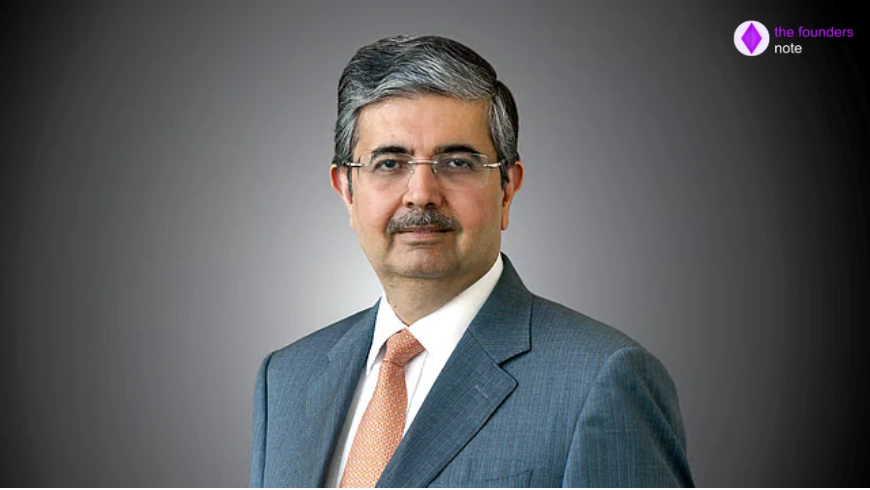
Uday Kotak: The Man Who Put His Name on a Bank
Born into a family of cotton traders, Uday Kotak turned down the family business and a stack of prestigious job offers to start a bill-discounting firm with ₹30 lakh — and built it into one of India’s largest private banks.

Kotak Mahindra Bank
Early Life & Family Background Origins
Uday Suresh Kotak was born on March 15, 1959, in Mumbai, into an upper-middle-class Gujarati Hindu Lohana family traditionally engaged in cotton trading. He grew up in a large, traditional joint family of roughly 60 people involved in the family business — an upbringing he has famously described as “capitalism at work and socialism at home.” As a child, Kotak dreamed of playing cricket for India, before his path shifted decisively toward business and finance.
Education & the Road Not Taken 1982
Kotak completed a Bachelor’s degree in Commerce and went on to earn his MBA (an MMS degree) from the Jamnalal Bajaj Institute of Management Studies (JBIMS) in Mumbai in 1982. On graduating, he faced an enviable set of choices: prestigious job offers from Hindustan Unilever and Boston Consulting Group’s U.S. office, the comfortable option of joining the family’s established trading business — where 14 family members already worked — or striking out on his own in finance, a field he had grown genuinely passionate about during his MBA. With his father, Suresh Kotak, backing the decision, he chose the third path.
The Nelco Deal That Started It All 1985
The opening that launched Kotak’s career came through a friend working at Nelco, a Tata group company where Ratan Tata had begun his own career. At the time, India’s Credit Authorization Scheme (CAS) capped how much large companies like Nelco could borrow from banks — no more than ₹5 crore, at a steep 17% interest rate — and Nelco needed funds fast for a 90-day period. With fixed-deposit rates sitting around just 6% annually, Kotak convinced private investors to put in money at 12% — double the standard return — by leveraging the trusted Tata name, and pocketed a 5% margin on the capital he raised. That single successful deal led directly to the formal incorporation of Kotak Capital Management Finance Ltd. on November 21, 1985.
Founding Kotak Capital 1985
Kotak started the firm with seed capital of roughly ₹30 lakh (about $40,000 at the time), raised from family and friends, initially focusing on bill discounting — providing short-term working-capital credit to businesses, a niche most established lenders overlooked. It was through this early business that he first met Anand Mahindra in 1985, then newly returned from Harvard Business School and working at Mahindra Ugine Steel, which — like most steel businesses — was constantly in need of working capital. Kotak helped Mahindra raise funds, and the two struck up a friendship that would soon reshape both of their companies.
Asking Anand Mahindra for His Name 1986
Kotak had long admired how Western financial institutions like J.P. Morgan and Goldman Sachs used their founders’ family names as symbols of trust and permanence. Recognizing that “Kotak” alone was still an unproven name in a reputation-driven industry, he approached his new friend Anand Mahindra with an unusual request: to lend the Mahindra name to his fledgling NBFC.
Let’s put our names into the company. All the great financial houses — the Morgans, the Rothschilds, and others — are known by the names of their founders. Let’s show people that we care enough about this business to put our names on it.
Mahindra agreed, and in April 1986, Kotak Capital Management Finance Ltd. was renamed Kotak Mahindra Finance Ltd. (KMFL). When Kotak needed ₹30 lakh in fresh capital to launch the venture, Anand personally invested ₹4 lakh, with the rest arranged by Kotak, his family, and friends; Anand’s father, Harish Mahindra, joined as the company’s first chairman. A single ₹1 lakh investment made at that time would be worth more than ₹2,160 crore today at roughly ₹1,800 per share — one of the most extraordinary returns in Indian corporate history.
Taking On Citibank 1989
In 1989, Citibank became the first bank in India to offer car loans, charging a flat 13% interest rate on the full original loan amount for the entire loan term — a structure that effectively let it earn up to 36% in total interest over the life of a loan. KMFL, then a non-banking financial company borrowing from banks to lend against vehicle collateral, saw an opening. With Maruti cars in short supply and buyers facing long waiting periods, KMFL began booking cars in bulk — 5,000 to 10,000 at a time — and offered instant delivery at standard pricing, provided the buyer financed the purchase through KMFL at a matching 13% rate. The strategy let KMFL compete directly with Citibank’s brand power and established the young NBFC as a serious force in vehicle financing.
The Decision to Become a Bank 2001–2003
Through the 1990s and into the 2000s, KMFL diversified rapidly into mutual funds, asset management, and insurance, but Kotak’s real ambition remained a full banking license. When the Reserve Bank of India announced in 2001 that it would open India’s banking sector to new private-sector players, Kotak faced internal resistance: why abandon an already highly profitable NBFC for banking, an industry projected to be less profitable, at least initially? He pushed ahead anyway, convinced that only a full banking platform could make the group genuinely robust and stable over the long run. In February 2003, the RBI approved KMFL’s conversion, and Kotak Mahindra Bank was born — the first Indian NBFC ever converted into a bank. Kotak positioned the new entrant with the tagline “Think Investments, Think Kotak,” leaning into the group’s investment and capital-markets expertise to stand out among established rivals.
Growth Through Crisis: 2008 & Beyond Risk Management
One of the defining traits of Kotak’s leadership has been a conservative, calculated approach to risk. During the 2008 global financial crisis, while banks worldwide absorbed severe losses, Kotak Mahindra Bank emerged relatively unscathed — a direct result of Kotak’s insistence on prudent lending and a consistently strong balance sheet, rather than chasing aggressive short-term growth.
The ING Vysya Acquisition 2014
In November 2014, Kotak Mahindra Bank acquired ING Vysya Bank — ING Bank’s Indian operations — for $2.4 billion, a deal that significantly expanded the bank’s branch network and customer base and helped cement its position among India’s top private-sector banks.
Building a Financial Powerhouse Diversification
Beyond core banking, the Kotak Mahindra Group grew into a fully integrated financial-services conglomerate spanning commercial banking, investment banking, life and general insurance, wealth management, mutual funds, and stockbroking. In 2015, the group formally entered the general insurance business, and it also partnered with Bharti Airtel to help establish a small payments bank.
Stepping Down as CEO 2023
In September 2023, Uday Kotak stepped down as CEO and managing director of Kotak Mahindra Bank, four months ahead of his scheduled retirement, amid Reserve Bank of India succession norms for private-bank promoters. He remains a non-executive director on the board. The bank is now led by Ashok Vaswani, a former Citibank executive — a notable full-circle moment given Kotak’s early-career rivalry with Citibank in the car-financing business. To comply with RBI shareholding directives, Kotak has also progressively reduced his personal stake in the bank to roughly 26–30%.
Recent Moves: Insurance, GIFT City & Padma Bhushan 2024–2026
In 2024, Kotak Mahindra Bank sold a 70% stake in its general insurance arm to Zurich Insurance Group for $640 million; the joint venture now operates as Zurich Kotak General Insurance. In January 2026, Kotak was awarded the Padma Bhushan, India’s third-highest civilian honour, for his contributions to trade and industry. The following month, in February 2026, he was appointed chairman of GIFT City (Gujarat International Finance Tec-City), India’s flagship international financial services hub.
Kotak Group’s Top 20 Portfolio Holdings Investment Reach
Beyond banking, the Kotak Group — through its asset management, mutual fund, and institutional investing arms — holds significant equity stakes across many of India’s largest listed companies, spanning autos, banking, cement, steel, defence, and pharmaceuticals. The infographic below shows the group’s top 20 portfolio holdings by value, led by its own Kotak Mahindra Bank stake worth over ₹86,000 crore, followed by major positions in Mahindra & Mahindra, ICICI Bank, Axis Bank, and Larsen & Toubro.

Public & Institutional Roles Beyond Kotak Bank
Kotak has taken on numerous public and institutional responsibilities over the years. In June 2017, the Securities and Exchange Board of India (SEBI) asked him to chair a panel on corporate governance; that panel submitted its report in October 2017, recommending sweeping changes to strengthen governance and transparency across listed Indian companies. In October 2018, the Government of India appointed him non-executive chairman of the reconstituted board of Infrastructure Leasing & Financial Services (IL&FS), tasked with steering the troubled NBFC giant out of crisis — a role he has described as a form of national duty. He has also served as a member of the International Advisory Panel of the Monetary Authority of Singapore, President of the Confederation of Indian Industry (CII), and on the boards of the Indian School of Business, Mahindra United World College of India, and the Indian Council for Research on International Economic Relations.
Personal Life & Family Family
Uday Kotak is married to Pallavi Kotak. The couple lives in Mumbai, and their family life reflects the same joint-family values Kotak grew up with, even as his own career took him far from the traditional family trading business.
Children Next Generation
Uday and Pallavi Kotak’s son, Jay Kotak, is a Harvard Business School graduate who now serves as Vice President and co-head of Kotak811, the bank’s digital-banking arm. Jay is married to Aditi Arya, an actress, model, and Femina Miss India 2015 titleholder.
Philanthropy Giving Back
Beyond banking, Kotak’s philanthropic focus centers on the Kotak Education Foundation, which works with some of India’s most economically underprivileged communities, aiming to alleviate poverty through education and livelihood programs — extending the group’s stated vision of “equitable prosperity” beyond financial services alone.
Awards & Recognition Recognition
2014
2015
2016
2018
Jan 2026
Leadership Philosophy Values
Kotak has consistently emphasized that the true measure of business performance is sustainable, long-term value creation rather than short-term gains — investors who stayed with the enterprise over its first 33 years saw a roughly 40% compound annual growth rate on their investment. He has been equally consistent about the importance of prudent, calculated risk management, disciplined diversification across financial-services lines, and building a business rooted in integrity and customer trust rather than chasing rapid, unsustainable expansion.
Net Worth Wealth
Uday Kotak’s fortune comes almost entirely from his remaining stake — roughly 26% as of recent RBI-mandated reductions — in Kotak Mahindra Bank, which had total assets of about ₹6.93 lakh crore (roughly $72 billion) and total equity of ₹1.29 lakh crore (about $13 billion) as of 2024. Estimates of his personal net worth have varied by tracker and date: it stood at roughly $13.1–13.3 billion across much of 2024, climbed to around $14.1 billion by October 2024, and reached approximately $14.5–14.8 billion across 2025 and into 2026, generally placing him among India’s top ten richest individuals and the wealthiest banker in the country. Because his fortune is tied so closely to Kotak Mahindra Bank’s daily share price, single-day swings have moved his net worth by billions of rupees on multiple occasions — including one October 2024 session in which the bank’s stock fell nearly 5% following disappointing quarterly earnings, erasing an estimated ₹15,954 crore (about $1.9 billion) from his holdings in a single day.
Quick Facts At a Glance
Full Name
Born
Nationality
Education
Company Founded
Current Role
Spouse
Son
Est. Net Worth
Known For
Milestone Timeline Journey
Born in Mumbai, India.
Completes his MBA at JBIMS; turns down job offers and the family business.
Founds Kotak Capital Management Finance Ltd. with ₹30 lakh in seed capital.
Renames the company Kotak Mahindra Finance Ltd. after Anand Mahindra invests and lends his name.
Takes on Citibank in the car-financing market.
Receives RBI approval; Kotak Mahindra Bank is born.
Kotak Mahindra Bank weathers the global financial crisis relatively unscathed.
Acquires ING Vysya Bank for $2.4 billion; wins the E&Y World Entrepreneur of the Year Award.
Chairs SEBI’s panel on corporate governance.
Appointed non-executive chairman of IL&FS by the Government of India.
Steps down as CEO and MD of Kotak Mahindra Bank, remaining a non-executive director.
Sells 70% of the general insurance arm to Zurich Insurance for $640 million.
Awarded the Padma Bhushan.
Appointed chairman of GIFT City.
Frequently Asked Questions FAQ
Who is Uday Kotak?
Uday Kotak is an Indian banker and entrepreneur who founded Kotak Mahindra Bank, one of India’s largest private-sector banks, after starting a bill-discounting firm in 1985.
Why is it called Kotak Mahindra?
Kotak asked his friend Anand Mahindra to lend the Mahindra family name to his fledgling NBFC in 1986, modeling the move on how Western financial houses like J.P. Morgan used founders’ names as symbols of trust; Mahindra agreed and also invested in the company.
Is Uday Kotak still CEO of Kotak Mahindra Bank?
No. He stepped down as CEO and managing director in September 2023, ahead of RBI-mandated succession norms, and now serves as a non-executive director.
What is Uday Kotak’s net worth?
Estimates for 2025–2026 range from roughly $14.1 billion to $14.8 billion, depending on the tracker and Kotak Mahindra Bank’s share price on a given day.
Did Uday Kotak inherit his business?
No. He came from a family of cotton traders and deliberately chose not to join the family trading business, instead starting his own finance firm from scratch in 1985.
What honors has Uday Kotak received?
He was awarded the Padma Bhushan, India’s third-highest civilian honour, in January 2026, alongside earlier honours including the Ernst & Young World Entrepreneur of the Year Award (2014) and the Economic Times Business Leader of the Year Award (2015).
The Name He Chose to Share
Uday Kotak’s story is a reminder that some of the boldest business decisions aren’t about building alone — his willingness to share his name, and his company, with a friend’s family in 1986 helped turn a small bill-discounting firm into one of India’s most trusted banks.